Atrás

Herramientas a pie de cama para evaluar la capacidad de (des)reclutamiento

Artículo

Autor: Giorgio A. lotti, Caroline Brown

Fecha: 29.04.2025

¿Qué es la capacidad de reclutamiento y cómo podemos medirla?

Mensajes importantes

  • Uno de los principales retos en el tratamiento de pacientes con SDRA es garantizar una oxigenación y eliminación de CO2 suficientes al tiempo que se evitan más daños en el pulmón.
  • Dado que el nivel adecuado de PEEP que se va a aplicar depende del potencial para el reclutamiento del pulmón, evaluar el grado de capacidad de reclutamiento puede ayudar a determinar la configuración de la PEEP.
  • Uno de los dos métodos a pie de cama para medir la capacidad de reclutamiento basados en las mediciones de la mecánica respiratoria es la relación reclutamiento/insuflación (R/I), que se puede calcular a partir de los parámetros de monitorización del respirador.
  • Cuanto menor es la relación R/I, menor es el potencial de reclutamiento.

Tipos de pulmón y el efecto de la PEEP

Lograr el equilibrio entre estos dos valores es uno de los mayores retos a la hora de tratar a pacientes con SDRA. En el caso de enfermedades pulmonares agudas, los alvéolos pueden dividirse en tres grupos: los alvéolos que están abiertos y estables, incluso a presión baja (como en un pulmón normal); los alvéolos colapsados, que se pueden reabrir y mantenerse abiertos a presiones positivas razonablemente seguras (pulmón reclutable); y los alvéolos colapsados o solidificados, que no se pueden reabrir (pulmón no reclutable). En función de las proporciones relativas de estos grupos en un determinado espacio de tiempo, los pulmones se pueden clasificar como próximos a ser mecánicamente normales, reclutables o no reclutables. En el caso de un pulmón reclutable, proporcionar ventilación con la intención de reclutar con el nivel adecuado de presión positiva al final de la espiración (PEEP) sería una ventilación protectora. Por un lado, la PEEP eleva las presiones inspiratorias, lo que favorece el reclutamiento de los alvéolos colapsados y hace que el pulmón sea más proclive a aceptar el volumen tidal de manera segura. Por otro lado, un nivel adecuado de PEEP funciona como un estabilizador mecánico, en oposición al desreclutamiento alveolar cíclico durante la espiración y el consiguiente atelectotrauma. La cuestión varía en el caso de los pulmones no reclutables o que están próximos a ser mecánicamente normales: Un nivel de PEEP alto sería excesivo a la par que nada eficaz.

La manera más sencilla de establecer la PEEP para pacientes con SDRA es aumentar su valor al mismo tiempo que se busca una mejora satisfactoria de la oxigenación; pero este enfoque solo resulta acertado en el caso de “pacientes que responden” ya que podría derivar en sobredistensión, especialmente, en pacientes que no responden bien a la PEEP. La medición de la capacidad de reclutamiento podría proporcionar información importante para determinar la PEEP idónea.


¿Qué es la capacidad de reclutamiento y cómo podemos medirla?

Pero ¿qué es la capacidad de reclutamiento? La inestabilidad alveolar y la capacidad de responder a la presión positiva son requisitos previos para el potencial de reclutamiento. Está claro que cualquier pulmón que tenga potencial para el reclutamiento también lo tiene para el desreclutamiento; es decir, los alvéolos inestables también pueden volver a colapsarse si la presión de las vías aéreas desciende por debajo de una cierta presión de cierre. 

Los métodos a pie de cama para evaluar la capacidad de reclutamiento van desde la obtención de imágenes mediante ecografía pulmonar o tomografía de impedancia eléctrica hasta enfoques basados en las mediciones de la mecánica respiratoria obtenidos durante maniobras específicas: el análisis de un bucle estático de presión/volumen (PV) del sistema respiratorio y la relación reclutamiento/insuflación (R/I). Ambos métodos precisan de ventilación invasiva y de que el paciente se relaje por completo.

El bucle PV estático

El primer método, el bucle estático de PV, implica el uso de una herramienta especial en el respirador para registrar el volumen frente a la presión de las vías aéreas durante una maniobra de insuflado y desinflado lenta y controlada. Se establece una maniobra típica para analizar el sistema respiratorio durante una rampa de presión constante lenta de 2 cmH2O/s de 5 a 40 cmH2O, y vuelta. Otra alternativa común es empezar y terminar en cero. En la práctica, estas maniobras lentas permiten examinar dos aspectos en uno: los posibles efectos en el reclutamiento del aumento lento de los niveles de presión y el posible desreclutamiento asociado a los niveles de reducción lenta. En el gráfico de una maniobra donde Pva se sitúa en el eje X y el Volumen en el eje Y, suele producirse cierta histéresis entre la rama inspiratoria y la espiratoria, lo que se traduce en que la rama espiratoria crece más alto que la inspiratoria. Cuanto más se distancia una rama de la otra, mayor es el grado de histéresis. Curiosamente, se ha hallado que una histéresis mayor (es decir, un bucle más amplio) está asociado a un mayor potencial de reclutamiento, mientras que una histéresis más pequeña (es decir, un bucle más fino) indica menor potencial de capacidad de reclutamiento (Demory D, Arnal JM, Wysocki M, et al. Recruitability of the lung estimated by the pressure volume curve hysteresis in ARDS patients. Intensive Care Med. 2008;34(11):2019-2025. doi:10.1007/s00134-008-1167-81​, Chiumello D, Arnal JM, Umbrello M, et al. Hysteresis and Lung Recruitment in Acute Respiratory Distress Syndrome Patients: A CT Scan Study [published correction appears in Crit Care Med. 2022 Mar 1;50(3):e339]. Crit Care Med. 2020;48(10):1494-1502. doi:10.1097/CCM.00000000000045182​). El grado de histéresis se puede expresar como la distancia normalizada máxima (DNM), que representa la relación entre la distancia máxima entre dos ramas y el volumen máximo de la maniobra. Un valor de DNM de 0,41 indica un nivel de capacidad de reclutamiento intermedio y sirve para distinguir entre condiciones con un potencial de reclutamiento inferior o superior (Chiumello D, Arnal JM, Umbrello M, et al. Hysteresis and Lung Recruitment in Acute Respiratory Distress Syndrome Patients: A CT Scan Study [published correction appears in Crit Care Med. 2022 Mar 1;50(3):e339]. Crit Care Med. 2020;48(10):1494-1502. doi:10.1097/CCM.00000000000045182).

La relación reclutamiento/insuflación

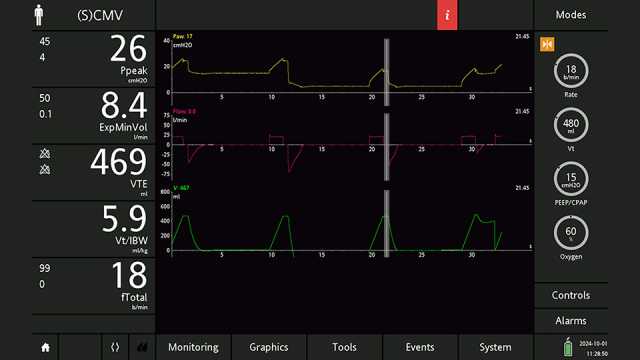
El segundo método, la relación reclutamiento/insuflación (R/I), también conocida como la “técnica simplificada de desreclutamiento”, fue sugerida por Chen et al. (Chen L, Del Sorbo L, Grieco DL, et al. Potential for Lung Recruitment Estimated by the Recruitment-to-Inflation Ratio in Acute Respiratory Distress Syndrome. A Clinical Trial. Am J Respir Crit Care Med. 2020;201(2):178-187. doi:10.1164/rccm.201902-0334OC3​, Chen L, Chen GQ, Shore K, et al. Implementing a bedside assessment of respiratory mechanics in patients with acute respiratory distress syndrome. Crit Care. 2017;21(1):84. Published 2017 Apr 4. doi:10.1186/s13054-017-1671-84​). Se analiza el posible desreclutamiento que se produce durante la ventilación controlada por volumen convencional (CMV) cuando la PEEP disminuye bruscamente 10 cmH2O desde un nivel alto (entre 15 y 18 cmH2O mantenido durante un mínimo de 30 minutos) hasta un nivel bajo (entre 5 y 8 cmH2O). La respiración de transición con una inspiración que se inicia a partir de una PEEP alta y una espiración que termina con una PEEP baja da lugar a un volumen espiratorio mayor en comparación con las respiraciones anteriores. El volumen espiratorio adicional consta de dos componentes totalmente diferentes. El primero (señalado como «volumen desinflado») depende de la respuesta de desinflado de los alvéolos que permanecen estables en un nivel de PEEP bajo. El volumen desinflado analiza el efecto de los cambios de presión en la insuflación (I) y el desinflado del «pulmón de bebé» y está relacionado con el tamaño de éste. El segundo componente (señalado como «volumen desreclutado») depende del desreclutamiento de los alvéolos inestables que colapsan inmediatamente y liberan su contenido gaseoso por completo cuando la PEEP cambia al nivel mínimo. El volumen desreclutado analiza el efecto de los cambios de presión en el reclutamiento (R) y el desreclutamiento. El índice de R/I se corresponde con el volumen desreclutado dividido entre el volumen desinflado. En la práctica, el índice normaliza el desreclutamiento observado según el tamaño del «pulmón de bebé» y, por lo tanto, expresa el grado de capacidad de reclutamiento. 

¿Cómo la calculamos?

El cálculo de la relación R/I es relativamente sencillo al basarse en los datos que se pueden leer en el sistema de monitorización del respirador: el volumen espiratorio con una PEEP alta, el volumen espiratorio durante la respiración de transición de la PEEP y la compliance del sistema respiratorio con una PEEP baja. Cuanto menor es la relación R/I, menor es el potencial de reclutamiento; donde cero representa que no hay capacidad de reclutamiento. Los valores intermedios están en torno al 0,5 (el valor medio de la población estudiada por Chen et al.) y se considera que los valores por encima de 0,6 representan una alta capacidad de reclutamiento (Chen L, Del Sorbo L, Grieco DL, et al. Potential for Lung Recruitment Estimated by the Recruitment-to-Inflation Ratio in Acute Respiratory Distress Syndrome. A Clinical Trial. Am J Respir Crit Care Med. 2020;201(2):178-187. doi:10.1164/rccm.201902-0334OC3​). Los resultados obtenidos utilizando la relación R/I se compararon con la histéresis en los bucles de PV estáticos y se llegó a un buen consenso (Nakayama R, Bunya N, Katayama S, et al. Correlation between the hysteresis of the pressure-volume curve and the recruitment-to-inflation ratio in patients with coronavirus disease 2019. Ann Intensive Care. 2022;12(1):106. Published 2022 Nov 12. doi:10.1186/s13613-022-01081-x5​). 

¿Qué nos dicen sobre el valor de la PEEP?

Una vez que se ha identificado un estado de capacidad de reclutamiento alta, media o baja, ya sea mediante la histéresis en un único bucle de PV estático o mediante la relación R/I basada en una maniobra de desreclutamiento de 10 cmH2O, ¿qué debemos hacer con el valor de PEEP en la práctica clínica? Una PEEP baja suele ser la elección correcta para una capacidad de reclutamiento baja. Aunque una capacidad de reclutamiento alta se suele considerar un buen indicativo para una PEEP alta, es importante tener en cuenta la precaución surgida recientemente sobre este concepto (Gattinoni L, Collino F, Camporota L. Assessing lung recruitability: does it help with PEEP settings? Intensive Care Med. 2024;50(5):749-751. doi:10.1007/s00134-024-07351-56). ¿Y qué pasa con la capacidad de reclutamiento media? Curiosamente, durante un ensayo de reducción de la PEEP, se ha sugerido que la evaluación de la histéresis en varios bucles de PV estáticos es un método de evaluación preciso para determinar el nivel de PEEP más adecuado para el reclutamiento y la estabilización mecánica de los alvéolos inestables (Mojoli F, Pozzi M, Arisi E. Setting positive end-expiratory pressure: using the pressure-volume curve. Curr Opin Crit Care. 2024;30(1):35-42. doi:10.1097/MCC.00000000000011277​). Del mismo modo, el enfoque basado en la relación R/I se ha utilizado también para una evaluación pormenorizada del desreclutamiento durante un ensayo de reducción de la PEEP, aunque en este caso la tecnología necesaria es muy exigente ya que se precisa medir el volumen pulmonar al final de la espiración mediante la dilución de nitrógeno (Grieco DL, Pintaudi G, Bongiovanni F, et al. Recruitment-to-inflation Ratio Assessed through Sequential End-expiratory Lung Volume Measurement in Acute Respiratory Distress Syndrome. Anesthesiology. 2023;139(6):801-814. doi:10.1097/ALN.00000000000047168​) 

En su respirador

La relación R/I ofrece una manera de evaluar el grado de capacidad de reclutamiento a pie de cama mediante los parámetros de monitorización estándar de los respiradores de Hamilton Medical. El otro método que implica el bucle de PV estático se puede aplicar utilizando la herramienta P/V Tool, disponible en los respiradores HAMILTON‑C3/C6 y HAMILTON‑G5/S1 (Disponible de manera opcional en los respiradores HAMILTON-G5 y HAMILTON-C3/C6A​, Incluida de serie en el HAMILTON-S1B​). En este caso, la capacidad de reclutamiento se puede evaluar directamente a partir de la curva de presión/volumen en una única maniobra de diagnóstico. La P/V Tool se puede utilizar también para llevar a cabo las maniobras de reclutamiento o para hallar el ajuste de PEEP óptimo, basado en una evaluación detallada de la histéresis a partir de varias maniobras de diagnóstico.
 

Notas al pie

  • A. Disponible de manera opcional en los respiradores HAMILTON-G5 y HAMILTON-C3/C6
  • B. De serie en el HAMILTON-S1

Referencias

  1. 1. Demory D, Arnal JM, Wysocki M, et al. Recruitability of the lung estimated by the pressure volume curve hysteresis in ARDS patients. Intensive Care Med. 2008;34(11):2019-2025. doi:10.1007/s00134-008-1167-8
  2. 2. Chiumello D, Arnal JM, Umbrello M, et al. Hysteresis and Lung Recruitment in Acute Respiratory Distress Syndrome Patients: A CT Scan Study [published correction appears in Crit Care Med. 2022 Mar 1;50(3):e339]. Crit Care Med. 2020;48(10):1494-1502. doi:10.1097/CCM.0000000000004518
  3. 3. Chen L, Del Sorbo L, Grieco DL, et al. Potential for Lung Recruitment Estimated by the Recruitment-to-Inflation Ratio in Acute Respiratory Distress Syndrome. A Clinical Trial. Am J Respir Crit Care Med. 2020;201(2):178-187. doi:10.1164/rccm.201902-0334OC
  4. 4. Chen L, Chen GQ, Shore K, et al. Implementing a bedside assessment of respiratory mechanics in patients with acute respiratory distress syndrome. Crit Care. 2017;21(1):84. Published 2017 Apr 4. doi:10.1186/s13054-017-1671-8
  5. 5. Nakayama R, Bunya N, Katayama S, et al. Correlation between the hysteresis of the pressure-volume curve and the recruitment-to-inflation ratio in patients with coronavirus disease 2019. Ann Intensive Care. 2022;12(1):106. Published 2022 Nov 12. doi:10.1186/s13613-022-01081-x
  6. 6. Gattinoni L, Collino F, Camporota L. Assessing lung recruitability: does it help with PEEP settings?. Intensive Care Med. 2024;50(5):749-751. doi:10.1007/s00134-024-07351-5
  7. 7. Mojoli F, Pozzi M, Arisi E. Setting positive end-expiratory pressure: using the pressure-volume curve. Curr Opin Crit Care. 2024;30(1):35-42. doi:10.1097/MCC.0000000000001127
  8. 8. Grieco DL, Pintaudi G, Bongiovanni F, et al. Recruitment-to-inflation Ratio Assessed through Sequential End-expiratory Lung Volume Measurement in Acute Respiratory Distress Syndrome. Anesthesiology. 2023;139(6):801-814. doi:10.1097/ALN.0000000000004716

Recruitability of the lung estimated by the pressure volume curve hysteresis in ARDS patients.

Demory D, Arnal JM, Wysocki M, et al. Recruitability of the lung estimated by the pressure volume curve hysteresis in ARDS patients. Intensive Care Med. 2008;34(11):2019-2025. doi:10.1007/s00134-008-1167-8

OBJECTIVE To assess the hysteresis of the pressure-volume curve (PV curve) as to estimate, easily and at the bedside, the recruitability of the lung in ARDS patients. DESIGN Prospective study. SETTING Twelve medico-surgical ICU beds of a general hospital. PATIENTS Twenty-six patients within the first 24 h from meeting ARDS criteria. INTERVENTION A Quasi-static inflation and deflation PV curve from 0 to 40 cmH(2)O and a 40 cmH(2)O recruitment maneuver (RM) maintained for 10 s were successively done with an interval of 30 min in between. RECORDINGS AND CALCULATION: Hysteresis of the PV curve (H(PV)) was calculated as the ratio of the area enclosed by the pressure volume loop divided by the predicted body weight (PBW). The volume increase during the RM (V(RM)) was measured by integration of the flow required to maintain the pressure at 40 cmH(2)O and divided by PBW, as an estimation of the volume recruited during the RM. RESULTS A positive linear correlation was found between H(PV) and V(RM) (r = 0.81, P < 0.0001). CONCLUSIONS The results suggest using the hysteresis of the PV curve to assess the recruitability of the lung.

Hysteresis and Lung Recruitment in Acute Respiratory Distress Syndrome Patients: A CT Scan Study.

Chiumello D, Arnal JM, Umbrello M, et al. Hysteresis and Lung Recruitment in Acute Respiratory Distress Syndrome Patients: A CT Scan Study [published correction appears in Crit Care Med. 2022 Mar 1;50(3):e339]. Crit Care Med. 2020;48(10):1494-1502. doi:10.1097/CCM.0000000000004518

OBJECTIVES Hysteresis of the respiratory system pressure-volume curve is related to alveolar surface forces, lung stress relaxation, and tidal reexpansion/collapse. Hysteresis has been suggested as a means of assessing lung recruitment. The objective of this study was to determine the relationship between hysteresis, mechanical characteristics of the respiratory system, and lung recruitment assessed by a CT scan in mechanically ventilated acute respiratory distress syndrome patients. DESIGN Prospective observational study. SETTING General ICU of a university hospital. PATIENTS Twenty-five consecutive sedated and paralyzed patients with acute respiratory distress syndrome (age 64 ± 15 yr, body mass index 26 ± 6 kg/m, PaO2/FIO2 147 ± 42, and positive end-expiratory pressure 9.3 ± 1.4 cm H2O) were enrolled. INTERVENTIONS A low-flow inflation and deflation pressure-volume curve (5-45 cm H2O) and a sustained inflation recruitment maneuver (45 cm H2O for 30 s) were performed. A lung CT scan was performed during breath-holding pressure at 5 cm H2O and during the recruitment maneuver at 45 cm H2O. MEASUREMENTS AND MAIN RESULTS Lung recruitment was computed as the difference in noninflated tissue and in gas volume measured at 5 and at 45 cm H2O. Hysteresis was calculated as the ratio of the area enclosed by the pressure-volume curve and expressed as the hysteresis ratio. Hysteresis was correlated with respiratory system compliance computed at 5 cm H2O and the lung gas volume entering the lung during inflation of the pressure-volume curve (R = 0.749, p < 0.001 and R = 0.851, p < 0.001). The hysteresis ratio was related to both lung tissue and gas recruitment (R = 0.266, p = 0.008, R = 0.357, p = 0.002, respectively). Receiver operating characteristic analysis showed that the optimal cutoff value to predict lung tissue recruitment for the hysteresis ratio was 28% (area under the receiver operating characteristic curve, 0.80; 95% CI, 0.62-0.98), with sensitivity and specificity of 0.75 and 0.77, respectively. CONCLUSIONS Hysteresis of the respiratory system computed by low-flow pressure-volume curve is related to the anatomical lung characteristics and has an acceptable accuracy to predict lung recruitment.

Potential for Lung Recruitment Estimated by the Recruitment-to-Inflation Ratio in Acute Respiratory Distress Syndrome. A Clinical Trial.

Chen L, Del Sorbo L, Grieco DL, et al. Potential for Lung Recruitment Estimated by the Recruitment-to-Inflation Ratio in Acute Respiratory Distress Syndrome. A Clinical Trial. Am J Respir Crit Care Med. 2020;201(2):178-187. doi:10.1164/rccm.201902-0334OC

Rationale: Response to positive end-expiratory pressure (PEEP) in acute respiratory distress syndrome depends on recruitability. We propose a bedside approach to estimate recruitability accounting for the presence of complete airway closure.Objectives: To validate a single-breath method for measuring recruited volume and test whether it differentiates patients with different responses to PEEP.Methods: Patients with acute respiratory distress syndrome were ventilated at 15 and 5 cm H2O of PEEP. Multiple pressure-volume curves were compared with a single-breath technique. Abruptly releasing PEEP (from 15 to 5 cm H2O) increases expired volume: the difference between this volume and the volume predicted by compliance at low PEEP (or above airway opening pressure) estimated the recruited volume by PEEP. This recruited volume divided by the effective pressure change gave the compliance of the recruited lung; the ratio of this compliance to the compliance at low PEEP gave the recruitment-to-inflation ratio. Response to PEEP was compared between high and low recruiters based on this ratio.Measurements and Main Results: Forty-five patients were enrolled. Four patients had airway closure higher than high PEEP, and thus recruitment could not be assessed. In others, recruited volume measured by the experimental and the reference methods were strongly correlated (R2 = 0.798; P < 0.0001) with small bias (-21 ml). The recruitment-to-inflation ratio (median, 0.5; range, 0-2.0) correlated with both oxygenation at low PEEP and the oxygenation response; at PEEP 15, high recruiters had better oxygenation (P = 0.004), whereas low recruiters experienced lower systolic arterial pressure (P = 0.008).Conclusions: A single-breath method quantifies recruited volume. The recruitment-to-inflation ratio might help to characterize lung recruitability at the bedside.Clinical trial registered with www.clinicaltrials.gov (NCT02457741).

Implementing a bedside assessment of respiratory mechanics in patients with acute respiratory distress syndrome.

Chen L, Chen GQ, Shore K, et al. Implementing a bedside assessment of respiratory mechanics in patients with acute respiratory distress syndrome. Crit Care. 2017;21(1):84. Published 2017 Apr 4. doi:10.1186/s13054-017-1671-8

BACKGROUND Despite their potential interest for clinical management, measurements of respiratory mechanics in patients with acute respiratory distress syndrome (ARDS) are seldom performed in routine practice. We introduced a systematic assessment of respiratory mechanics in our clinical practice. After the first year of clinical use, we retrospectively assessed whether these measurements had any influence on clinical management and physiological parameters associated with clinical outcomes by comparing their value before and after performing the test. METHODS The respiratory mechanics assessment constituted a set of bedside measurements to determine passive lung and chest wall mechanics, response to positive end-expiratory pressure, and alveolar derecruitment. It was obtained early after ARDS diagnosis. The results were provided to the clinical team to be used at their own discretion. We compared ventilator settings and physiological variables before and after the test. The physiological endpoints were oxygenation index, dead space, and plateau and driving pressures. RESULTS Sixty-one consecutive patients with ARDS were enrolled. Esophageal pressure was measured in 53 patients (86.9%). In 41 patients (67.2%), ventilator settings were changed after the measurements, often by reducing positive end-expiratory pressure or by switching pressure-targeted mode to volume-targeted mode. Following changes, the oxygenation index, airway plateau, and driving pressures were significantly improved, whereas the dead-space fraction remained unchanged. The oxygenation index continued to improve in the next 48 h. CONCLUSIONS Implementing a systematic respiratory mechanics test leads to frequent individual adaptations of ventilator settings and allows improvement in oxygenation indexes and reduction of the risk of overdistention at the same time. TRIAL REGISTRATION The present study involves data from our ongoing registry for respiratory mechanics (ClinicalTrials.gov identifier: NCT02623192 . Registered 30 July 2015).

Correlation between the hysteresis of the pressure-volume curve and the recruitment-to-inflation ratio in patients with coronavirus disease 2019.

Nakayama R, Bunya N, Katayama S, et al. Correlation between the hysteresis of the pressure-volume curve and the recruitment-to-inflation ratio in patients with coronavirus disease 2019. Ann Intensive Care. 2022;12(1):106. Published 2022 Nov 12. doi:10.1186/s13613-022-01081-x

BACKGROUND Since the response to lung recruitment varies greatly among patients receiving mechanical ventilation, lung recruitability should be assessed before recruitment maneuvers. The pressure-volume curve (PV curve) and recruitment-to-inflation ratio (R/I ratio) can be used bedside for evaluating lung recruitability and individualing positive end-expiratory pressure (PEEP). Lung tissue recruitment on computed tomography has been correlated with normalized maximal distance (NMD) of the quasi-static PV curve. NMD is the maximal distance between the inspiratory and expiratory limb of the PV curve normalized to the maximal volume. However, the relationship between the different parameters of hysteresis of the quasi-static PV curve and R/I ratio for recruitability is unknown. METHODS We analyzed the data of 33 patients with severe coronavirus disease 2019 (COVID-19) who received invasive mechanical ventilation. Respiratory waveform data were collected from the ventilator using proprietary acquisition software. We examined the relationship of the R/I ratio, quasi-static PV curve items such as NMD, and respiratory system compliance (Crs). RESULTS The median R/I ratio was 0.90 [interquartile range (IQR), 0.70-1.15] and median NMD was 41.0 [IQR, 37.1-44.1]. The NMD correlated significantly with the R/I ratio (rho = 0.74, P < 0.001). Sub-analysis showed that the NMD and R/I ratio did not correlate with Crs at lower PEEP (- 0.057, P = 0.75; and rho = 0.15, P = 0.41, respectively). On the contrary, the ratio of Crs at higher PEEP to Crs at lower PEEP (Crs ratio (higher/lower)) moderately correlated with NMD and R/I ratio (rho = 0.64, P < 0.001; and rho = 0.67, P < 0.001, respectively). CONCLUSIONS NMD of the quasi-static PV curve and R/I ratio for recruitability assessment are highly correlated. In addition, NMD and R/I ratio correlated with the Crs ratio (higher/lower). Therefore, NMD and R/I ratio could be potential indicators of recruitability that can be performed at the bedside.

Assessing lung recruitability: does it help with PEEP settings?

Gattinoni L, Collino F, Camporota L. Assessing lung recruitability: does it help with PEEP settings?. Intensive Care Med. 2024;50(5):749-751. doi:10.1007/s00134-024-07351-5

Setting positive end-expiratory pressure: using the pressure-volume curve.

Mojoli F, Pozzi M, Arisi E. Setting positive end-expiratory pressure: using the pressure-volume curve. Curr Opin Crit Care. 2024;30(1):35-42. doi:10.1097/MCC.0000000000001127

PURPOSE OF REVIEW To discuss the role of pressure-volume curve (PV curve) in exploring elastic properties of the respiratory system and setting mechanical ventilator to reduce ventilator-induced lung injury. RECENT FINDINGS Nowadays, quasi-static PV curves and loops can be easily obtained and analyzed at the bedside without disconnection of the patient from the ventilator. It is shown that this tool can provide useful information to optimize ventilator setting. For example, PV curves can assess for patient's individual potential for lung recruitability and also evaluate the risk for lung injury of the ongoing mechanical ventilation setting. SUMMARY In conclusion, PV curve is an easily available bedside tool: its correct interpretation can be extremely valuable to enlighten potential for lung recruitability and select a high or low positive end-expiratory pressure (PEEP) strategy. Furthermore, recent studies have shown that PV curve can play a significant role in PEEP and driving pressure fine tuning: clinical studies are needed to prove whether this technique will improve outcome.

Recruitment-to-inflation Ratio Assessed through Sequential End-expiratory Lung Volume Measurement in Acute Respiratory Distress Syndrome.

Grieco DL, Pintaudi G, Bongiovanni F, et al. Recruitment-to-inflation Ratio Assessed through Sequential End-expiratory Lung Volume Measurement in Acute Respiratory Distress Syndrome. Anesthesiology. 2023;139(6):801-814. doi:10.1097/ALN.0000000000004716

BACKGROUND Positive end-expiratory pressure (PEEP) benefits in acute respiratory distress syndrome are driven by lung dynamic strain reduction. This depends on the variable extent of alveolar recruitment. The recruitment-to-inflation ratio estimates recruitability across a 10-cm H2O PEEP range through a simplified maneuver. Whether recruitability is uniform or not across this range is unknown. The hypotheses of this study are that the recruitment-to-inflation ratio represents an accurate estimate of PEEP-induced changes in dynamic strain, but may show nonuniform behavior across the conventionally tested PEEP range (15 to 5 cm H2O). METHODS Twenty patients with moderate-to-severe COVID-19 acute respiratory distress syndrome underwent a decremental PEEP trial (PEEP 15 to 13 to 10 to 8 to 5 cm H2O). Respiratory mechanics and end-expiratory lung volume by nitrogen dilution were measured the end of each step. Gas exchange, recruited volume, recruitment-to-inflation ratio, and changes in dynamic, static, and total strain were computed between 15 and 5 cm H2O (global recruitment-to-inflation ratio) and within narrower PEEP ranges (granular recruitment-to-inflation ratio). RESULTS Between 15 and 5 cm H2O, median [interquartile range] global recruitment-to-inflation ratio was 1.27 [0.40 to 1.69] and displayed a linear correlation with PEEP-induced dynamic strain reduction (r = -0.94; P < 0.001). Intraindividual recruitment-to-inflation ratio variability within the narrower ranges was high (85% [70 to 109]). The relationship between granular recruitment-to-inflation ratio and PEEP was mathematically described by a nonlinear, quadratic equation (R2 = 0.96). Granular recruitment-to-inflation ratio across the narrower PEEP ranges itself had a linear correlation with PEEP-induced reduction in dynamic strain (r = -0.89; P < 0.001). CONCLUSIONS Both global and granular recruitment-to-inflation ratio accurately estimate PEEP-induced changes in lung dynamic strain. However, the effect of 10 cm H2O of PEEP on lung strain may be nonuniform. Granular recruitment-to-inflation ratio assessment within narrower PEEP ranges guided by end-expiratory lung volume measurement may aid more precise PEEP selection, especially when the recruitment-to-inflation ratio obtained with the simplified maneuver between PEEP 15 and 5 cm H2O yields intermediate values that are difficult to interpret for a proper choice between a high and low PEEP strategy.

Related articles. Get a deeper look