


Autor: Jorge Crespo
Fecha: 20.04.2022
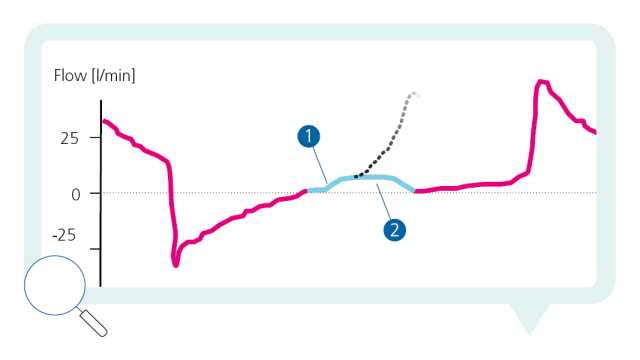
Is this a) Flow asynchrony, b) Ineffective effort, c) Early cycling, or c) Auto-triggering?
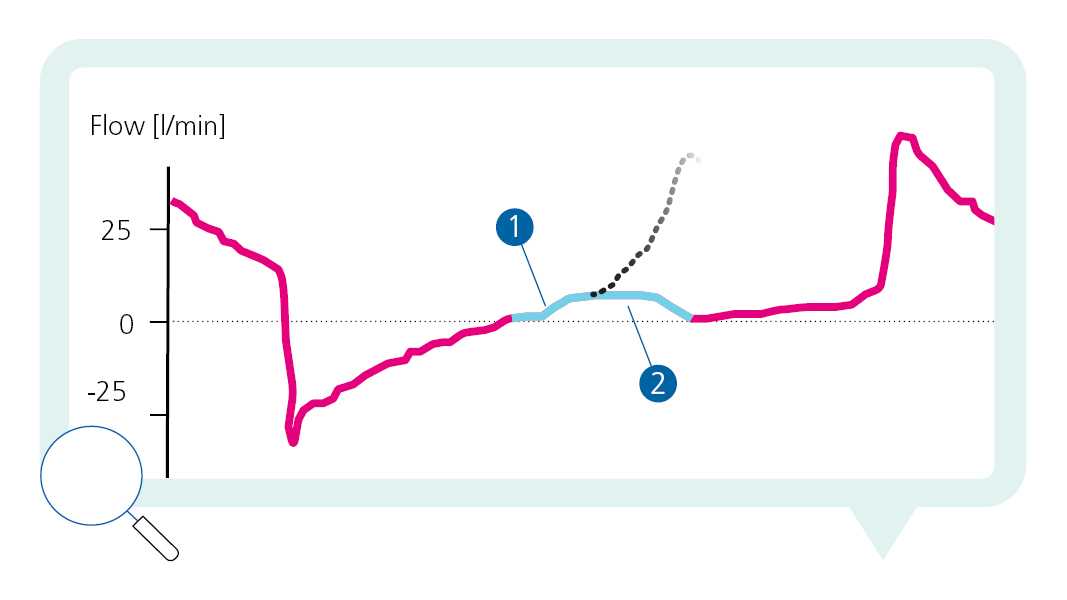
Ineffective effort. The patient’s effort fails to trigger the ventilator. This is indicated on the flow waveform by an abrupt change in the steepness of the waveform (1) (a decrease in expiratory flow or an increase in inspiratory flow) that is not followed by ventilatory support (2).
Expiratory flow does not decelerate straight down to 0 l/min, but shows a positive deflection instead.
Depending on when the effort starts, it is also possible that the patient does not achieve positive flow values and stays in the negative range. According to an internal survey we conducted online in May - June, 2019 with 155 voluntary participants worldwide (respiratory therapists, physicians, nurses, biomed/technician/engineer, paramedics, other), 72% of healthcare professionals use waveform analysis to monitor and recognize asynchronies.
Evaluate the patient’s respiratory drive and correct as needed. Assess the patient for over-sedation and reduce the rate of sedative infusion. Determine whether the patient is receiving too much assistance; adjust pressure-support ventilation to reduce tidal volume if necessary.