







Session expired

Due to inactivity your session has expired. Please login again.

Hemos detectado que visita nuestro sitio web desde Estados Unidos.
Disponemos de una versión específica del sitio web para su país (Estados Unidos).

Cambiar a Estados Unidos

Nuevas funciones y mejoras.

Versión de software 3.1.1 para HAMILTON-C1/T1/MR1

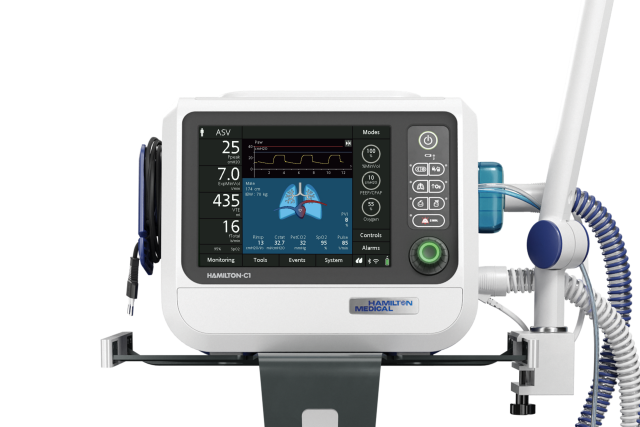
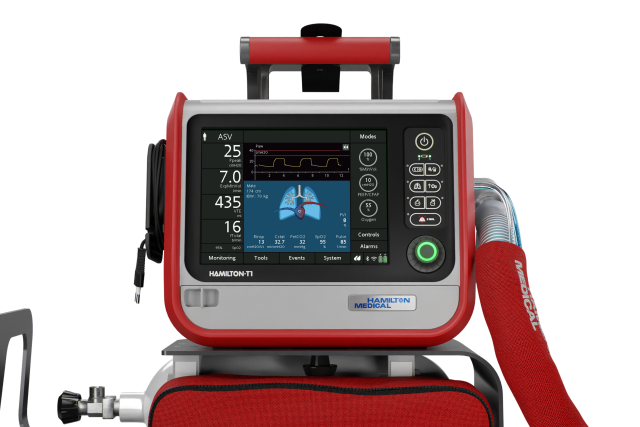
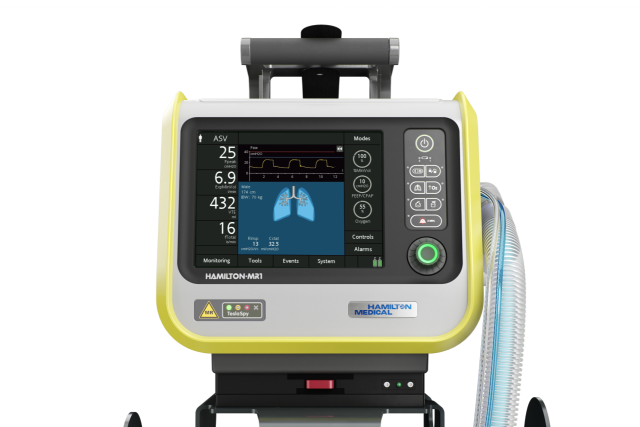
Foto de los respiradores HAMILTON-C1, HAMILTON-T1 y HAMILTON-MR1 situados consecutivamente Foto de los respiradores HAMILTON-C1, HAMILTON-T1 y HAMILTON-MR1 situados consecutivamente

Actualice una vez, benefíciese tres. La potencia del software 3.1.1

La actualización de software 3.1.1 cuenta con tres increíbles funciones nuevas (No disponible en todos los mercadosA) para los respiradores HAMILTON-C1/T1/MR1.

Para obtener información detallada sobre la actualización, consulte el folleto correspondiente, las notas de la versión de software 3.1.1 y el manual del operador del dispositivo.
 

Las nuevas opciones del software

NIV_Adult

Opción NIV-only. La solución completa para la ventilación no invasiva

Menos también puede ser más El HAMILTON-C1/T1 con la opción NIV-only le ofrece exactamente los modos que necesita para proporcionar una ventilación asistida no invasiva de alto rendimiento.


Permite cambiar fácilmente entre los modos de ventilación no invasiva y terapia con flujo alto de oxígeno (También conocida como terapia de cánulas nasales de flujo alto. Esta terminología se puede usar indistintamente junto con «terapia con flujo alto de oxígeno.B) (opcional) para pacientes pediátricos y adultos sin necesidad de cambiar el dispositivo, ni siquiera el circuito respiratorio.

O2 assist

O2 assist. El asistente de cuidados de precisión

O2 assist es su asistente de cuidados de precisión a pie de cama. Ayuda a mantener los niveles de SpO2 del paciente dentro de los intervalos objetivo definidos individualmente al ajustar continuamente el suministro de oxígeno.


Esto garantiza una gestión del oxígeno continua y eficaz, y reduce el uso de los pulsadores (Roca O, Caritg O, Santafé M, et al. Closed-loop oxygen control improves oxygen therapy in acute hypoxemic respiratory failure patients under high flow nasal oxygen: a randomized cross-over study (the HILOOP study). Crit Care. 2022;26(1):108. Published 2022 Apr 14. doi:10.1186/s13054-022-03970-w1, Atakul G, Ceylan G, Sandal O, et al. Closed-loop oxygen usage during invasive mechanical ventilation of pediatric patients (CLOUDIMPP): a randomized controlled cross-over study. Front Med (Lausanne). 2024;11:1426969. Published 2024 Sep 10. doi:10.3389/fmed.2024.14269692).

Intellisync

IntelliSync®+. Con la vista puesta en la sincronización entre paciente y respirador

El ojo entrenado de un experto en ventilación es capaz de detectar asincronías analizando las formas de onda de presión o de flujo. IntelliSync+ aporta gran ayuda en el flujo de trabajo al gestionar los disparos y activar los ciclos automáticamente.


Esta función puede ayudar a los profesionales sanitarios a dedicar menos tiempo al ajuste de estos parámetros y, por tanto, liberarlos para que puedan centrarse mejor en otras importantes tareas a pie de cama.

Estándar Opcional No disponible
HAMILTON-C1 HAMILTON-T1 HAMILTON-MR1

O2 assist

Opción NIV-only

IntelliSync+

Disponibilidad

Véalo con sus propios ojos. Reserve una demostración personal gratuita o programe una llamada

Reserve una demostración personal gratuita o una llamada con uno de nuestros especialistas, o solicite más información. Rellene el siguiente formulario y nos pondremos en contacto con usted con toda la información que necesite.

Closed-loop oxygen control improves oxygen therapy in acute hypoxemic respiratory failure patients under high flow nasal oxygen: a randomized cross-over study (the HILOOP study).

Roca O, Caritg O, Santafé M, et al. Closed-loop oxygen control improves oxygen therapy in acute hypoxemic respiratory failure patients under high flow nasal oxygen: a randomized cross-over study (the HILOOP study). Crit Care. 2022;26(1):108. Published 2022 Apr 14. doi:10.1186/s13054-022-03970-w

BACKGROUND We aimed to assess the efficacy of a closed-loop oxygen control in critically ill patients with moderate to severe acute hypoxemic respiratory failure (AHRF) treated with high flow nasal oxygen (HFNO). METHODS In this single-centre, single-blinded, randomized crossover study, adult patients with moderate to severe AHRF who were treated with HFNO (flow rate ≥ 40 L/min with FiO2 ≥ 0.30) were randomly assigned to start with a 4-h period of closed-loop oxygen control or 4-h period of manual oxygen titration, after which each patient was switched to the alternate therapy. The primary outcome was the percentage of time spent in the individualized optimal SpO2 range. RESULTS Forty-five patients were included. Patients spent more time in the optimal SpO2 range with closed-loop oxygen control compared with manual titrations of oxygen (96.5 [93.5 to 98.9] % vs. 89 [77.4 to 95.9] %; p < 0.0001) (difference estimate, 10.4 (95% confidence interval 5.2 to 17.2). Patients spent less time in the suboptimal range during closed-loop oxygen control, both above and below the cut-offs of the optimal SpO2 range, and less time above the suboptimal range. Fewer number of manual adjustments per hour were needed with closed-loop oxygen control. The number of events of SpO2 < 88% and < 85% were not significantly different between groups. CONCLUSIONS Closed-loop oxygen control improves oxygen administration in patients with moderate-to-severe AHRF treated with HFNO, increasing the percentage of time in the optimal oxygenation range and decreasing the workload of healthcare personnel. These results are especially relevant in a context of limited oxygen supply and high medical demand, such as the COVID-19 pandemic. Trial registration The HILOOP study was registered at www. CLINICALTRIALS gov under the identifier NCT04965844 .

Closed-loop oxygen usage during invasive mechanical ventilation of pediatric patients (CLOUDIMPP): a randomized controlled cross-over study.

Atakul G, Ceylan G, Sandal O, et al. Closed-loop oxygen usage during invasive mechanical ventilation of pediatric patients (CLOUDIMPP): a randomized controlled cross-over study. Front Med (Lausanne). 2024;11:1426969. Published 2024 Sep 10. doi:10.3389/fmed.2024.1426969

BACKGROUND The aim of this study is the evaluation of a closed-loop oxygen control system in pediatric patients undergoing invasive mechanical ventilation (IMV). METHODS Cross-over, multicenter, randomized, single-blind clinical trial. Patients between the ages of 1 month and 18 years who were undergoing IMV therapy for acute hypoxemic respiratory failure (AHRF) were assigned at random to either begin with a 2-hour period of closed-loop oxygen control or manual oxygen titrations. By using closed-loop oxygen control, the patients' SpO2 levels were maintained within a predetermined target range by the automated adjustment of the FiO2. During the manual oxygen titration phase of the trial, healthcare professionals at the bedside made manual changes to the FiO2, while maintaining the same target range for SpO2. Following either period, the patient transitioned to the alternative therapy. The outcomes were the percentage of time spent in predefined SpO2 ranges ±2% (primary), FiO2, total oxygen use, and the number of manual adjustments. FINDINGS The median age of included 33 patients was 17 (13-55.5) months. In contrast to manual oxygen titrations, patients spent a greater proportion of time within a predefined optimal SpO2 range when the closed-loop oxygen controller was enabled (95.7% [IQR 92.1-100%] vs. 65.6% [IQR 41.6-82.5%]), mean difference 33.4% [95%-CI 24.5-42%]; P < 0.001). Median FiO2 was lower (32.1% [IQR 23.9-54.1%] vs. 40.6% [IQR 31.1-62.8%]; P < 0.001) similar to total oxygen use (19.8 L/h [IQR 4.6-64.8] vs. 39.4 L/h [IQR 16.8-79]; P < 0.001); however, median SpO2/FiO2 was higher (329.4 [IQR 180-411.1] vs. 246.7 [IQR 151.1-320.5]; P < 0.001) with closed-loop oxygen control. With closed-loop oxygen control, the median number of manual adjustments reduced (0.0 [IQR 0.0-0.0] vs. 1 [IQR 0.0-2.2]; P < 0.001). CONCLUSION Closed-loop oxygen control enhances oxygen therapy in pediatric patients undergoing IMV for AHRF, potentially leading to more efficient utilization of oxygen. This technology also decreases the necessity for manual adjustments, which could reduce the workloads of healthcare providers. CLINICAL TRIAL REGISTRATION This research has been submitted to ClinicalTrials.gov (NCT05714527).