

Atrás

El método de formas de onda para detectar la actividad del paciente: ¿Es tan eficaz como la Pes?

Artículo

Autor: Caroline Brown, Giorgio Iotti

Fecha: 08.07.2022

La presencia de asincronías entre el paciente y el respirador es una situación habitual en pacientes con ventilación mecánica (1, 2).

El método de formas de onda para detectar la actividad del paciente: ¿Es tan eficaz como la Pes?

Mensajes importantes

  • El concepto de analizar las formas de onda de presión y flujo para detectar esfuerzos respiratorios se describió por primera vez hace décadas, pero las pruebas posteriores sobre la fiabilidad de este enfoque no son del todo claras.
  • En un estudio reciente, los investigadores evaluaron un método sistemático de análisis de formas de onda para evaluar la actividad del paciente y la interacción entre el paciente y el respirador a pie de cama, utilizando una curva de Pes como referencia.
  • El método de análisis de formas de onda permitió a los profesionales sanitarios detectar un porcentaje extremadamente alto de esfuerzos espontáneos y demostró ser un medio altamente reproducible y fiable para identificar incluso asincronías menores.

Una parte importante del tratamiento

Este desfase entre los tiempos de inspiración y espiración del paciente y el respirador puede presentarse de distintas formas, es decir, puede provocar ciclos tempranos o tardíos, disparos automáticos o disparos dobles, o esfuerzos ineficaces, lo cual ha demostrado tener un impacto en los resultados de los pacientes (de Wit M, Miller KB, Green DA, Ostman HE, Gennings C, Epstein SK. Ineffective triggering predicts increased duration of mechanical ventilation. Crit Care Med. 2009;37(10):2740-2745. doi:10.1097/ccm.0b013e3181a98a053, Blanch L, Villagra A, Sales B, et al. Asynchronies during mechanical ventilation are associated with mortality. Intensive Care Med. 2015;41(4):633-641. doi:10.1007/s00134-015-3692-64). Por lo tanto, parte importante del tratamiento radica en la capacidad de reconocer estas asincronías y ajustar los ajustes del respirador en consecuencia para mejorar la interacción entre el paciente y el respirador.

El concepto de analizar las formas de onda de presión y flujo de las vías aéreas para detectar esfuerzos respiratorios y sus tiempos se describió por primera vez hace casi tres décadas (Fabry B, Guttmann J, Eberhard L, Bauer T, Haberthür C, Wolff G. An analysis of desynchronization between the spontaneously breathing patient and ventilator during inspiratory pressure support. Chest. 1995;107(5):1387-1394. doi:10.1378/chest.107.5.13875, Giannouli E, Webster K, Roberts D, Younes M. Response of ventilator-dependent patients to different levels of pressure support and proportional assist. Am J Respir Crit Care Med. 1999;159(6):1716-1725. doi:10.1164/ajrccm.159.6.97040256), pero las pruebas posteriores sobre la fiabilidad de este enfoque no son del todo claras (Thille AW, Rodriguez P, Cabello B, Lellouche F, Brochard L. Patient-ventilator asynchrony during assisted mechanical ventilation. Intensive Care Med. 2006;32(10):1515-1522. doi:10.1007/s00134-006-0301-82, Colombo D, Cammarota G, Alemani M, et al. Efficacy of ventilator waveforms observation in detecting patient-ventilator asynchrony. Crit Care Med. 2011;39(11):2452-2457. doi:10.1097/CCM.0b013e318225753c7). La opinión generalizada es que es necesario medir la presión esofágica; sin embargo, esto requiere el uso de equipos especiales y no es una práctica clínica habitual. En un estudio realizado recientemente con 16 pacientes se investigó si el análisis de formas de onda es un medio fiable y reproducible para detectar la actividad de los músculos respiratorios de un paciente a pie de cama (Mojoli F, Pozzi M, Orlando A, et al. Timing of inspiratory muscle activity detected from airway pressure and flow during pressure support ventilation: the waveform method. Crit Care. 2022;26(1):32. Published 2022 Jan 30. doi:10.1186/s13054-022-03895-48).

Aplicación del método de análisis de formas de onda

Un elemento clave de este ensayo fue el uso de un método sistemático para analizar las formas de onda de presión y flujo de las vías aéreas, que comprendía cinco principios fisiológicos generales y un conjunto de reglas específicas definidas de antemano (“el método de análisis de formas de onda”). Se administró ventilación a todos los pacientes en modo de presión de soporte mediante la colocación de un catéter esofágico. El método se aplicó a las formas de onda de presión y flujo de las vías aéreas que se obtuvieron utilizando un sensor proximal, y se utilizó como referencia la presión esofágica (Pes). Para cada paciente, tres investigadores de un equipo de cuatro (tres médicos jefe y un residente) analizaron solo las formas de onda de flujo y presión, mientras que otro investigador analizó las formas de onda de flujo y presión, además del trazado de la curva de Pes. Las respiraciones se clasificaron como respiraciones «normalmente» asistidas, respiraciones con disparo automático, respiraciones con disparo doble o esfuerzos ineficaces. En el caso de las respiraciones normalmente asistidas, también se evaluaron asincronías menores (retraso del disparo, ciclo temprano y ciclo tardío).

Criterios de valoración y resultados

El criterio principal de valoración fue el porcentaje de esfuerzos espontáneos detectados mediante el método de análisis de formas de onda. Entre los criterios de valoración secundarios se encontraba la concordancia entre los métodos de análisis de formas de onda y de referencia en la detección de asincronías mayores y menores, así como la concordancia entre evaluadores para el método de análisis de formas de onda.

Se registró un total de 4426 respiraciones. Según las mediciones de la Pes de referencia, el 77,8 % de estas se identificaron como respiraciones detectadas correctamente por el respirador, el 22,1 % como esfuerzos ineficaces y el 0,1 % como respiraciones con disparo automático. El método de análisis de formas de onda permitió detectar el 99,5 % de los esfuerzos espontáneos y todas menos una de las respiraciones con disparo automático. Del mismo modo, la concordancia entre los métodos de referencia y de análisis de formas de onda para identificar las respiraciones como asistidas, con disparo automático, con disparo doble o esfuerzos ineficaces fue muy alta. El índice de asincronía, calculado como la suma de las respiraciones con disparo automático, con disparo doble y esfuerzos ineficaces, dividido por el número total de respiraciones, fue del 5,9 % y no difirió cuando se evaluó mediante el método de análisis de formas de onda frente a la presión esofágica. El tiempo de asincronía total, calculado como el tiempo durante el cual el respirador y el paciente no están sincronizados, dividido por el tiempo total de registro, fue del 22,4 % y las asincronías menores representaron el 92,1 % del mismo. La concordancia entre los diferentes operadores para clasificar las respiraciones también fue muy alta.

En más del 90 % de los casos, el método de formas de onda permitió a los investigadores identificar el inicio y el final de los esfuerzos respiratorios con suficiente precisión como para identificar correctamente que las asincronías menores (retraso del disparo, ciclo temprano y ciclo tardío) también eran posibles.

¿Qué nos dicen estos resultados?

Este estudio presenta algunos hallazgos importantes. Los investigadores demuestran que el método de análisis de formas de onda permite a los profesionales sanitarios detectar un porcentaje extremadamente alto de esfuerzos espontáneos y evaluar con precisión el tiempo de actividad del paciente. Incluso para asincronías menores, el método de análisis de formas de onda es altamente fiable y reproducible. La importancia de esto queda subrayada por otro hallazgo del estudio, es decir, que la mayor parte del tiempo de asincronía en PSV estuvo relacionado con asincronías menores.

Estos resultados, además de demostrar la reproducibilidad del método de análisis formas de onda (alta concordancia entre operadores), denotan la importancia fundamental de la formación en análisis de formas de onda de acuerdo con un método sistemático predefinido. Las pruebas han demostrado que la experiencia clínica en el tratamiento de pacientes con ventilación mecánica no proporciona necesariamente la competencia necesaria para el reconocimiento de asincronías, que en general es bastante baja en los médicos de la UCI (Ramirez II, Arellano DH, Adasme RS, et al. Ability of ICU Health-Care Professionals to Identify Patient-Ventilator Asynchrony Using Waveform Analysis. Respir Care. 2017;62(2):144-149. doi:10.4187/respcare.047509). En el presente estudio, uno de los operadores apenas era residente en ese momento, pero todos los operadores tenían al menos dos años de experiencia con el análisis de formas de onda y utilizaban un método sistemático con reglas específicas. Los autores citan esto como una de las posibles explicaciones de la diferencia entre sus hallazgos y los de Colombo et al. (Colombo D, Cammarota G, Alemani M, et al. Efficacy of ventilator waveforms observation in detecting patient-ventilator asynchrony. Crit Care Med. 2011;39(11):2452-2457. doi:10.1097/CCM.0b013e318225753c7), quienes encontraron una buena especificidad pero poca sensibilidad para detectar las principales asincronías de las formas de onda.

Los autores concluyen asimismo que las formas de onda proximales de la presión y el flujo de aire de las vías aéreas aportan información suficiente para evaluar con precisión la actividad del paciente y la interacción entre el paciente y el respirador, siempre que se adopte un método de análisis sistemático adecuado como el “método de análisis de formas de onda”.

Análisis constante con IntelliSync+

La tecnología IntelliSync®+ integrada en los respiradores de Hamilton Medical(IntelliSync+ está disponible como característica opcional en los respiradores mecánicos HAMILTON-C6 y HAMILTON-G5, y se incluye de serie en el HAMILTON-S1.A) analiza continuamente el flujo proximal y la presión de las vías aéreas de acuerdo con principios similares a los del “método de análisis de formas de onda”. Esto le permite identificar los primeros signos de relajación o esfuerzo inspiratorio del paciente e iniciar la inspiración y el ciclo hasta la espiración en consecuencia. Se puede activar para automatizar el ajuste de disparo inspiratorio o espiratorio de forma individual o ambos juntos.


Puede consultar las citas completas a continuación: (Chao DC, Scheinhorn DJ, Stearn-Hassenpflug M. Patient-ventilator trigger asynchrony in prolonged mechanical ventilation. Chest. 1997;112(6):1592-1599. doi:10.1378/chest.112.6.15921).

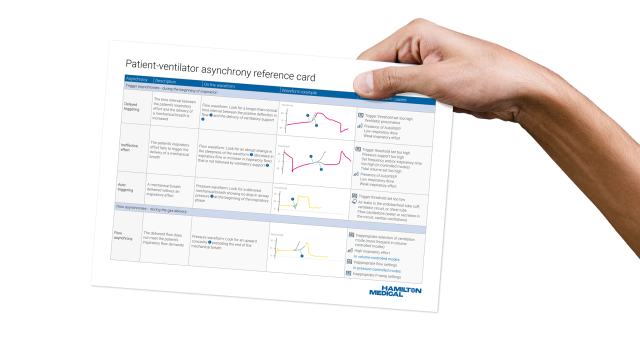
Hoja de referencia de asincronías

Aprenda a detectar las asincronías más comunes. Hoja de referencia gratuita

Nuestra hoja de referencia de asincronías incluye una descripción general de los tipos de asincronías más comunes, sus causas y cómo detectarlas.
Notas al pie

  • A. IntelliSync+ está disponible como característica opcional en los respiradores mecánicos HAMILTON-C6 y HAMILTON-G5, y se incluye de serie en el HAMILTON-S1.

Referencias

  1. 1. Chao DC, Scheinhorn DJ, Stearn-Hassenpflug M. Patient-ventilator trigger asynchrony in prolonged mechanical ventilation. Chest. 1997;112(6):1592-1599. doi:10.1378/chest.112.6.1592
  2. 2. Thille AW, Rodriguez P, Cabello B, Lellouche F, Brochard L. Patient-ventilator asynchrony during assisted mechanical ventilation. Intensive Care Med. 2006;32(10):1515-1522. doi:10.1007/s00134-006-0301-8
  3. 3. de Wit M, Miller KB, Green DA, Ostman HE, Gennings C, Epstein SK. Ineffective triggering predicts increased duration of mechanical ventilation. Crit Care Med. 2009;37(10):2740-2745. doi:10.1097/ccm.0b013e3181a98a05
  4. 4. Blanch L, Villagra A, Sales B, et al. Asynchronies during mechanical ventilation are associated with mortality. Intensive Care Med. 2015;41(4):633-641. doi:10.1007/s00134-015-3692-6
  5. 5. Fabry B, Guttmann J, Eberhard L, Bauer T, Haberthür C, Wolff G. An analysis of desynchronization between the spontaneously breathing patient and ventilator during inspiratory pressure support. Chest. 1995;107(5):1387-1394. doi:10.1378/chest.107.5.1387
  6. 6. Giannouli E, Webster K, Roberts D, Younes M. Response of ventilator-dependent patients to different levels of pressure support and proportional assist. Am J Respir Crit Care Med. 1999;159(6):1716-1725. doi:10.1164/ajrccm.159.6.9704025
  7. 7. Colombo D, Cammarota G, Alemani M, et al. Efficacy of ventilator waveforms observation in detecting patient-ventilator asynchrony. Crit Care Med. 2011;39(11):2452-2457. doi:10.1097/CCM.0b013e318225753c
  8. 8. Mojoli F, Pozzi M, Orlando A, et al. Timing of inspiratory muscle activity detected from airway pressure and flow during pressure support ventilation: the waveform method. Crit Care. 2022;26(1):32. Published 2022 Jan 30. doi:10.1186/s13054-022-03895-4
  9. 9. Ramirez II, Arellano DH, Adasme RS, et al. Ability of ICU Health-Care Professionals to Identify Patient-Ventilator Asynchrony Using Waveform Analysis. Respir Care. 2017;62(2):144-149. doi:10.4187/respcare.04750

Patient-ventilator trigger asynchrony in prolonged mechanical ventilation.

Chao DC, Scheinhorn DJ, Stearn-Hassenpflug M. Patient-ventilator trigger asynchrony in prolonged mechanical ventilation. Chest. 1997;112(6):1592-1599. doi:10.1378/chest.112.6.1592

STUDY OBJECTIVE To investigate patient-ventilator trigger asynchrony (TA), its prevalence, physiologic basis, and clinical implications in patients requiring prolonged mechanical ventilation (PMV). STUDY DESIGN Descriptive and prospective cohort study. SETTING Barlow Respiratory Hospital (BRH), a regional weaning center. PATIENTS Two hundred consecutive ventilator-dependent patients, transferred to BRH over an 18-month period for attempted weaning from PMV. METHODS AND INTERVENTIONS Patients were assessed clinically for TA within the first week of hospital admission, or once they were in hemodynamically stable condition, by observation of uncoupling of accessory respiratory muscle efforts and onset of machine breaths. Patients were excluded if they had weaned by the time of assessment or if they never achieved hemodynamic stability. Ventilator mode was patient triggered, flow control, volume cycled, with a tidal volume of 7 to 10 mL/kg. Esophageal pressure (Peso), airway-opening pressure, and airflow were measured in patients with TA who consented to esophageal catheter insertion. Attempts to decrease TA in each patient included application of positive end-expiratory pressure (PEEP) stepwise to 10 cm H2O, flow triggering, and reduction of ventilator support in pressure support (PS) mode. Patients were followed up until hospital discharge, when outcomes were scored as weaned (defined as >7 days of ventilator independence), failed to wean, or died. RESULTS Of the 200 patients screened, 26 were excluded and 19 were found to have TA. Patients with TA were older, carried the diagnosis of COPD more frequently, and had more severe hypercapnia than their counterparts without TA. Only 3 of 19 patients (16%), all with intermittent TA, weaned from mechanical ventilation, after 70, 72, and 108 days, respectively. This is in contrast to a weaning success rate of 57%, with a median (range) time to wean of 33 (3 to 182) days in patients without TA. Observation of uncoupling of accessory respiratory muscle movement and onset of machine breaths was accurate in identifying patients with TA, which was confirmed in all seven patients consenting to Peso monitoring. TA appeared to result from high auto-PEEP and severe pump failure. Adjusting trigger sensitivity and application of flow triggering were unsuccessful in eliminating TA; external PEEP improved but rarely led to elimination of TA that was transient in duration. Reduction of ventilator support in PS mode, with resultant increased respiratory pump output and lower tidal volumes, uniformly succeeded in eliminating TA. However, this approach imposed a fatiguing load on the respiratory muscles and was poorly tolerated. CONCLUSION TA can be easily identified clinically, and when it occurs in the patient in stable condition with PMV, is associated with poor outcome.

Patient-ventilator asynchrony during assisted mechanical ventilation.

Thille AW, Rodriguez P, Cabello B, Lellouche F, Brochard L. Patient-ventilator asynchrony during assisted mechanical ventilation. Intensive Care Med. 2006;32(10):1515-1522. doi:10.1007/s00134-006-0301-8

OBJECTIVE The incidence, pathophysiology, and consequences of patient-ventilator asynchrony are poorly known. We assessed the incidence of patient-ventilator asynchrony during assisted mechanical ventilation and we identified associated factors. METHODS Sixty-two consecutive patients requiring mechanical ventilation for more than 24 h were included prospectively as soon as they triggered all ventilator breaths: assist-control ventilation (ACV) in 11 and pressure-support ventilation (PSV) in 51. MEASUREMENTS Gross asynchrony detected visually on 30-min recordings of flow and airway pressure was quantified using an asynchrony index. RESULTS Fifteen patients (24%) had an asynchrony index greater than 10% of respiratory efforts. Ineffective triggering and double-triggering were the two main asynchrony patterns. Asynchrony existed during both ACV and PSV, with a median number of episodes per patient of 72 (range 13-215) vs. 16 (4-47) in 30 min, respectively (p=0.04). Double-triggering was more common during ACV than during PSV, but no difference was found for ineffective triggering. Ineffective triggering was associated with a less sensitive inspiratory trigger, higher level of pressure support (15 cmH(2)O, IQR 12-16, vs. 17.5, IQR 16-20), higher tidal volume, and higher pH. A high incidence of asynchrony was also associated with a longer duration of mechanical ventilation (7.5 days, IQR 3-20, vs. 25.5, IQR 9.5-42.5). CONCLUSIONS One-fourth of patients exhibit a high incidence of asynchrony during assisted ventilation. Such a high incidence is associated with a prolonged duration of mechanical ventilation. Patients with frequent ineffective triggering may receive excessive levels of ventilatory support.

Ineffective triggering predicts increased duration of mechanical ventilation.

de Wit M, Miller KB, Green DA, Ostman HE, Gennings C, Epstein SK. Ineffective triggering predicts increased duration of mechanical ventilation. Crit Care Med. 2009;37(10):2740-2745. doi:10.1097/ccm.0b013e3181a98a05

OBJECTIVES To determine whether high rates of ineffective triggering within the first 24 hrs of mechanical ventilation (MV) are associated with longer MV duration and shorter ventilator-free survival (VFS). DESIGN Prospective cohort study. SETTING Medical intensive care unit (ICU) at an academic medical center. PATIENTS Sixty patients requiring invasive MV. INTERVENTIONS None. MEASUREMENTS Patients had pressure-time and flow-time waveforms recorded for 10 mins within the first 24 hrs of MV initiation. Ineffective triggering index (ITI) was calculated by dividing the number of ineffectively triggered breaths by the total number of breaths (triggered and ineffectively triggered). A priori, patients were classified into ITI >or=10% or ITI <10%. Patient demographics, MV reason, codiagnosis of chronic obstructive pulmonary disease (COPD), sedation levels, and ventilator parameters were recorded. MEASUREMENTS AND MAIN RESULTS Sixteen of 60 patients had ITI >or=10%. The two groups had similar characteristics, including COPD frequency and ventilation parameters, except that patients with ITI >or=10% were more likely to have pressured triggered breaths (56% vs. 16%, p = .003) and had a higher intrinsic respiratory rate (22 breaths/min vs. 18, p = .03), but the set ventilator rate was the same in both groups (9 breaths/min vs. 9, p = .78). Multivariable analyses adjusting for pressure triggering also demonstrated that ITI >or=10% was an independent predictor of longer MV duration (10 days vs. 4, p = .0004) and shorter VFS (14 days vs. 21, p = .03). Patients with ITI >or=10% had a longer ICU length of stay (8 days vs. 4, p = .01) and hospital length of stay (21 days vs. 8, p = .03). Mortality was the same in the two groups, but patients with ITI >or=10% were less likely to be discharged home (44% vs. 73%, p = .04). CONCLUSIONS Ineffective triggering is a common problem early in the course of MV and is associated with increased morbidity, including longer MV duration, shorter VFS, longer length of stay, and lower likelihood of home discharge.

Asynchronies during mechanical ventilation are associated with mortality.

Blanch L, Villagra A, Sales B, et al. Asynchronies during mechanical ventilation are associated with mortality. Intensive Care Med. 2015;41(4):633-641. doi:10.1007/s00134-015-3692-6

PURPOSE This study aimed to assess the prevalence and time course of asynchronies during mechanical ventilation (MV). METHODS Prospective, noninterventional observational study of 50 patients admitted to intensive care unit (ICU) beds equipped with Better Care™ software throughout MV. The software distinguished ventilatory modes and detected ineffective inspiratory efforts during expiration (IEE), double-triggering, aborted inspirations, and short and prolonged cycling to compute the asynchrony index (AI) for each hour. We analyzed 7,027 h of MV comprising 8,731,981 breaths. RESULTS Asynchronies were detected in all patients and in all ventilator modes. The median AI was 3.41 % [IQR 1.95-5.77]; the most common asynchrony overall and in each mode was IEE [2.38 % (IQR 1.36-3.61)]. Asynchronies were less frequent from 12 pm to 6 am [1.69 % (IQR 0.47-4.78)]. In the hours where more than 90 % of breaths were machine-triggered, the median AI decreased, but asynchronies were still present. When we compared patients with AI > 10 vs AI ≤ 10 %, we found similar reintubation and tracheostomy rates but higher ICU and hospital mortality and a trend toward longer duration of MV in patients with an AI above the cutoff. CONCLUSIONS Asynchronies are common throughout MV, occurring in all MV modes, and more frequently during the daytime. Further studies should determine whether asynchronies are a marker for or a cause of mortality.

An analysis of desynchronization between the spontaneously breathing patient and ventilator during inspiratory pressure support.

Fabry B, Guttmann J, Eberhard L, Bauer T, Haberthür C, Wolff G. An analysis of desynchronization between the spontaneously breathing patient and ventilator during inspiratory pressure support. Chest. 1995;107(5):1387-1394. doi:10.1378/chest.107.5.1387

It is common practice to convert patients with acute respiratory insufficiency (ARI) from controlled mechanical ventilation to some form of assisted spontaneous breathing as early as possible. A widely used mode of assisted spontaneous breathing is patient-triggered inspiratory pressure support (IPS). We investigated 11 patients with ARI during weaning from mechanical ventilation using IPS and found that in 9 of these patients, desynchronization between patient and ventilator occurred, ie, that the ventilator did not detect and support all the patients' breathing efforts. Five of these 9 patients displayed severe desynchronization lasting at least 5 min and with less than half of all breathing efforts being supported by the ventilator. We present the analysis of gas flow, volume, esophageal pressure, airway pressure, and tracheal pressure of 1 patient with ARI displaying desynchronization under IPS. Our results imply that desynchronization can occur due to the following: (1) inspiratory response delays caused by the inspiratory triggering mechanisms and the demand flow characteristics of the ventilator; (2) a mismatch between the patient's completion of the inspiration effort and the ventilator's criterion for terminating pressure support; and (3) restriction of expiration due to resistance from patient's airways, endotracheal tube, and expiratory valve. From our analysis, we have made proposals for reducing desynchronization in clinical practice.

Response of ventilator-dependent patients to different levels of pressure support and proportional assist.

Giannouli E, Webster K, Roberts D, Younes M. Response of ventilator-dependent patients to different levels of pressure support and proportional assist. Am J Respir Crit Care Med. 1999;159(6):1716-1725. doi:10.1164/ajrccm.159.6.9704025

The ventilator's response to the patient's effort is quite different in proportional assist ventilation (PAV) and pressure support ventilation (PSV). We wished to determine whether this results in different ventilatory and breathing pattern responses to alterations in level of support and, if so, whether there are any gas exchange consequences. Fourteen patients were studied. Average elastance (E) was 22.8 (range, 14 -36) cm H2O/L and average resistance (R) was 15. 7 (range, 9-21) cm H2O/L/s. The highest PSV support (PSVmax) was that associated with a tidal volume (VT) of 10 ml/kg (20.4 +/- 3.2 cm H2O), and the highest level of PAV assist (PAVmax) was 78 +/- 7% of E and 76 +/- 7% of R. Level of assist was decreased in steps to the lowest tolerable level (PSVmin, PAVmin). Minute ventilation, VT, ventilator rate (RRvent), and arterial gas tensions were measured at each level. We also determined the patient's respiratory rate (RRpat) by adding the number of ineffective efforts (DeltaRR) to RRvent. There was no difference between PSVmin and PAVmin in any of the variables. At PSVmax, VT was significantly higher (0.90 +/- 0.30 versus 0.51 +/- 0.16 L) and RRvent was significantly lower (13.2 +/- 3.9 versus 27.6 +/- 10.5 min-1) than at PAVmax. The difference in RRvent was largely related to a progressive increase in ineffective efforts on PSV as level increased (DeltaRR 12.1 +/- 10.1 vs 1.4 +/- 2.1 with PAVmax); there was no significant difference in RRpat. The differences in breathing pattern had no consequence on arterial blood gas tensions. We conclude that substantial differences in breathing pattern may occur between PSV and PAV and that these are largely artifactual and related to different patient-ventilator interactions.

Efficacy of ventilator waveforms observation in detecting patient-ventilator asynchrony.

Colombo D, Cammarota G, Alemani M, et al. Efficacy of ventilator waveforms observation in detecting patient-ventilator asynchrony. Crit Care Med. 2011;39(11):2452-2457. doi:10.1097/CCM.0b013e318225753c

OBJECTIVES The value of visual inspection of ventilator waveforms in detecting patient-ventilator asynchronies in the intensive care unit has never been systematically evaluated. This study aims to assess intensive care unit physicians' ability to identify patient-ventilator asynchronies through ventilator waveforms. DESIGN Prospective observational study. SETTING Intensive care unit of a University Hospital. PATIENTS Twenty-four patients receiving mechanical ventilation for acute respiratory failure. INTERVENTION Forty-three 5-min reports displaying flow-time and airway pressure-time tracings were evaluated by 10 expert and 10 nonexpert, i.e., residents, intensive care unit physicians. The asynchronies identified by experts and nonexperts were compared with those ascertained by three independent examiners who evaluated the same reports displaying, additionally, tracings of diaphragm electrical activity. MEASUREMENTS AND MAIN RESULTS Data were examined according to both breath-by-breath analysis and overall report analysis. Sensitivity, specificity, and positive and negative predictive values were determined. Sensitivity and positive predictive value were very low with breath-by-breath analysis (22% and 32%, respectively) and fairly increased with report analysis (55% and 44%, respectively). Conversely, specificity and negative predictive value were high with breath-by-breath analysis (91% and 86%, respectively) and slightly lower with report analysis (76% and 82%, respectively). Sensitivity was significantly higher for experts than for nonexperts for breath-by-breath analysis (28% vs. 16%, p < .05), but not for report analysis (63% vs. 46%, p = .15). The prevalence of asynchronies increased at higher ventilator assistance and tidal volumes (p < .001 for both), whereas it decreased at higher respiratory rates and diaphragm electrical activity (p < .001 for both). At higher prevalence, sensitivity decreased significantly (p < .001). CONCLUSIONS The ability of intensive care unit physicians to recognize patient-ventilator asynchronies was overall quite low and decreased at higher prevalence; expertise significantly increased sensitivity for breath-by-breath analysis, whereas it only produced a trend toward improvement for report analysis.

Timing of inspiratory muscle activity detected from airway pressure and flow during pressure support ventilation: the waveform method.

Mojoli F, Pozzi M, Orlando A, et al. Timing of inspiratory muscle activity detected from airway pressure and flow during pressure support ventilation: the waveform method. Crit Care. 2022;26(1):32. Published 2022 Jan 30. doi:10.1186/s13054-022-03895-4

BACKGROUND Whether respiratory efforts and their timing can be reliably detected during pressure support ventilation using standard ventilator waveforms is unclear. This would give the opportunity to assess and improve patient-ventilator interaction without the need of special equipment. METHODS In 16 patients under invasive pressure support ventilation, flow and pressure waveforms were obtained from proximal sensors and analyzed by three trained physicians and one resident to assess patient's spontaneous activity. A systematic method (the waveform method) based on explicit rules was adopted. Esophageal pressure tracings were analyzed independently and used as reference. Breaths were classified as assisted or auto-triggered, double-triggered or ineffective. For assisted breaths, trigger delay, early and late cycling (minor asynchronies) were diagnosed. The percentage of breaths with major asynchronies (asynchrony index) and total asynchrony time were computed. RESULTS Out of 4426 analyzed breaths, 94.1% (70.4-99.4) were assisted, 0.0% (0.0-0.2) auto-triggered and 5.8% (0.4-29.6) ineffective. Asynchrony index was 5.9% (0.6-29.6). Total asynchrony time represented 22.4% (16.3-30.1) of recording time and was mainly due to minor asynchronies. Applying the waveform method resulted in an inter-operator agreement of 0.99 (0.98-0.99); 99.5% of efforts were detected on waveforms and agreement with the reference in detecting major asynchronies was 0.99 (0.98-0.99). Timing of respiratory efforts was accurately detected on waveforms: AUC for trigger delay, cycling delay and early cycling was 0.865 (0.853-0.876), 0.903 (0.892-0.914) and 0.983 (0.970-0.991), respectively. CONCLUSIONS Ventilator waveforms can be used alone to reliably assess patient's spontaneous activity and patient-ventilator interaction provided that a systematic method is adopted.

Ability of ICU Health-Care Professionals to Identify Patient-Ventilator Asynchrony Using Waveform Analysis.

Ramirez II, Arellano DH, Adasme RS, et al. Ability of ICU Health-Care Professionals to Identify Patient-Ventilator Asynchrony Using Waveform Analysis. Respir Care. 2017;62(2):144-149. doi:10.4187/respcare.04750

BACKGROUND Waveform analysis by visual inspection can be a reliable, noninvasive, and useful tool for detecting patient-ventilator asynchrony. However, it is a skill that requires a properly trained professional. METHODS This observational study was conducted in 17 urban ICUs. Health-care professionals (HCPs) working in these ICUs were asked to recognize different types of asynchrony shown in 3 evaluation videos. The health-care professionals were categorized according to years of experience, prior training in mechanical ventilation, profession, and number of asynchronies identified correctly. RESULTS A total of 366 HCPs were evaluated. Statistically significant differences were found when HCPs with and without prior training in mechanical ventilation (trained vs non-trained HCPs) were compared according to the number of asynchronies detected correctly (of the HCPs who identified 3 asynchronies, 63 [81%] trained vs 15 [19%] non-trained, P < .001; 2 asynchronies, 72 [65%] trained vs 39 [35%] non-trained, P = .034; 1 asynchrony, 55 [47%] trained vs 61 [53%] non-trained, P = .02; 0 asynchronies, 17 [28%] trained vs 44 [72%] non-trained, P < .001). HCPs who had prior training in mechanical ventilation also increased, nearly 4-fold, their odds of identifying ≥2 asynchronies correctly (odds ratio 3.67, 95% CI 1.93-6.96, P < .001). However, neither years of experience nor profession were associated with the ability of HCPs to identify asynchrony. CONCLUSIONS HCPs who have specific training in mechanical ventilation increase their ability to identify asynchrony using waveform analysis. Neither experience nor profession proved to be a relevant factor to identify asynchrony correctly using waveform analysis.

Related articles. Get a deeper look