

Retour

Test your IntelliVence (Vol 15 Issue 4)

Article

Auteur: Clinical Experts Group, Hamilton Medical Group

Date: 08.08.2018

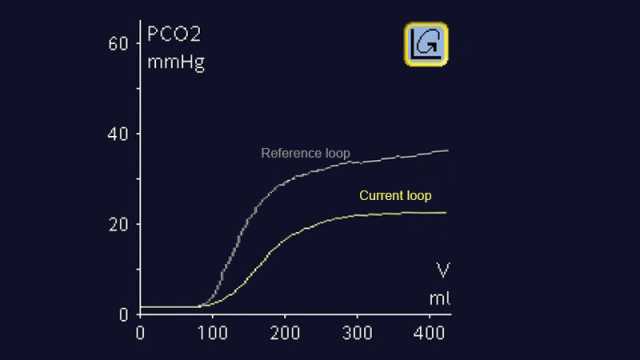
Why is the current volumetric capnogram loop different from the reference loop?

Test your IntelliVence (Vol 15 Issue 4)

Answer

Pulmonary embolism (PE). In the case of PE, there is an increase in alveolar dead space (VDalv) caused by a decrease of blood flow to alveoli that are well ventilated. This gas with low CO2 content is expired in synchrony with gas from normally perfused alveoli. This contrasts with pulmonary diseases affecting the airway, which are characterized by nonsynchronous emptying of compartments with an uneven ventilation/perfusion relationship (Eriksson L, Wollmer P, Olsson CG, et al. Diagnosis of pulmonary embolism based upon alveolar dead space analysis. Chest. 1989;96(2):357-362. doi:10.1378/chest.96.2.3571​). 
 

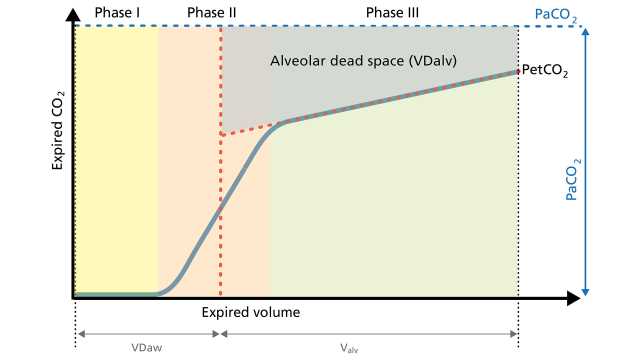
Representative image of capnogram showing three phases, flatter plateau in Phase III
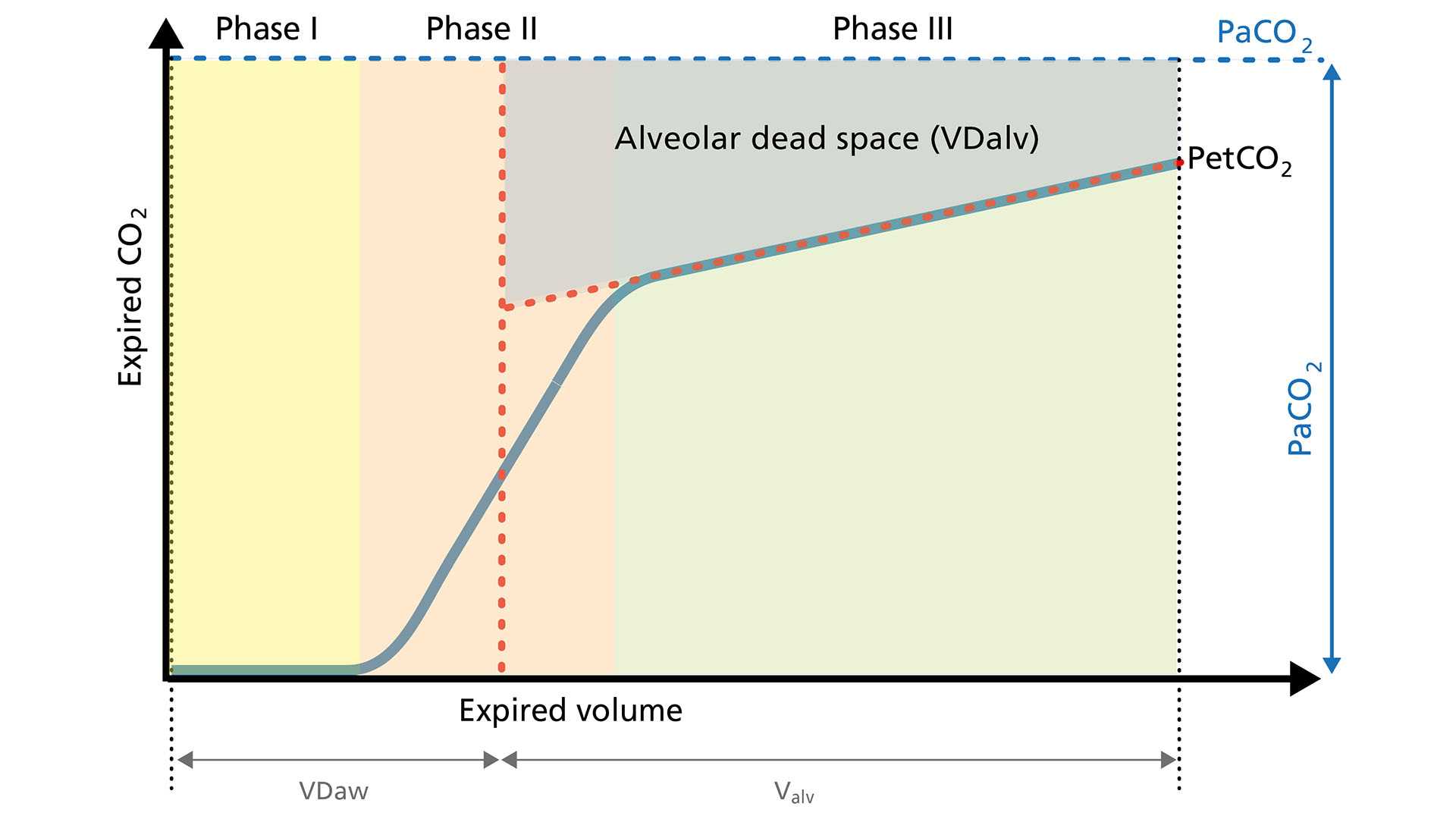
Normal volumetric capnogram showing Phases I, II and III, and VDalv
Representative image of capnogram showing three phases, flatter plateau in Phase III
Normal volumetric capnogram showing Phases I, II and III, and VDalv

As VDalv increases, the CO2 content of the exhaled gas therefore decreases and causes a consecutive drop in VCO2. The volumetric capnogram loop is characterized by significantly lower PetCO2 and a flatter plateau in Phase III. In addition, the slope in Phase II is less steep.

Diagnosis of pulmonary embolism based upon alveolar dead space analysis.

Eriksson L, Wollmer P, Olsson CG, et al. Diagnosis of pulmonary embolism based upon alveolar dead space analysis. Chest. 1989;96(2):357-362. doi:10.1378/chest.96.2.357

Pulmonary embolism (PE) leads to an abnormal alveolar deadspace that is expired in synchrony with gas from normally perfused alveoli. This feature of PE separates it from pulmonary diseases affecting the airways, which are characterized by nonsynchronous emptying of compartments with an uneven ventilation/perfusion relationship. An analysis of the single breath test (SBT) for CO2, SBT-CO2, focusing on the late tidal expirate, was made in order to evaluate the feasibility to use the SBT-CO2 for the diagnosis of PE. The test was evaluated in 38 patients with suspected PE where pulmonary angiography showed that nine had PE and 29 did not. It was also tested in a reference population consisting of patients with normal lung function, obstructive lung disease and interstitial lung disease. Previously suggested gas exchange measurements for the diagnosis of PE, ie, the physiologic deadspace fraction, VDphys/VT, and the arterial-to-end-tidal CO2 gradient, P(a-E')CO2, were also evaluated in the groups. SBT-CO2 achieved a nearly complete separation between the patients with PE and those without. The other measurements, however, showed a substantial overlap between patients with PE and those with obstructive or interstitial lung disease. The SBT-CO2 is simple and potentially widely available and warrants further study as a routine technique for the diagnosis of PE.