

Retour

La méthode de la forme d'ondes pour détecter une activité chez le patient : aussi efficace que la Pes ?

Article

Auteur: Caroline Brown, Giorgio Iotti

Date: 08.07.2022

Les asynchronies entre le patient et le ventilateur sont fréquentes chez les patients ventilés mécaniquement (1, 2).

La méthode de la forme d'ondes pour détecter une activité chez le patient : aussi efficace que la Pes ?

Messages à retenir

  • Le concept visant à analyser les formes d'ondes de pression et de débit pour détecter des efforts respiratoires a été décrit pour la première fois il y a plusieurs décennies, mais les données plus récentes sur la fiabilité de cette approche ne sont pas claires.
  • Dans une étude récente, des investigateurs ont évalué une méthode systématique d'analyse des formes d'ondes pour l'analyse de l'activité du patient et de l'interaction patient-ventilateur au chevet du patient, en se servant d'une courbe Pes comme référence.
  • La méthode de la forme d'ondes a permis aux médecins de détecter un pourcentage extrêmement élevé d'efforts spontanés et s'est révélée être un moyen très fiable et hautement reproductible pour identifier les asynchronies même mineures.

Un élément important du traitement

Ce décalage entre les temps inspiratoires et expiratoires du patient et le ventilateur peut prendre différentes formes, comme un cyclage précoce ou tardif, un déclenchement automatique, un déclenchement double ou des efforts inefficaces, et s'est avéré avoir un impact sur les résultats du patient (de Wit M, Miller KB, Green DA, Ostman HE, Gennings C, Epstein SK. Ineffective triggering predicts increased duration of mechanical ventilation. Crit Care Med. 2009;37(10):2740-2745. doi:10.1097/ccm.0b013e3181a98a053​, Blanch L, Villagra A, Sales B, et al. Asynchronies during mechanical ventilation are associated with mortality. Intensive Care Med. 2015;41(4):633-641. doi:10.1007/s00134-015-3692-64​). Un élément important du traitement consiste donc à pouvoir reconnaître ces asynchronies et à ajuster les réglages du ventilateur en conséquence pour améliorer l'interaction patient-ventilateur.

Le concept visant à analyser les formes d'ondes de débit et de pression des voies aériennes pour détecter des efforts respiratoires et leur minutage a été décrit pour la première fois il y a presque trois décennies (Fabry B, Guttmann J, Eberhard L, Bauer T, Haberthür C, Wolff G. An analysis of desynchronization between the spontaneously breathing patient and ventilator during inspiratory pressure support. Chest. 1995;107(5):1387-1394. doi:10.1378/chest.107.5.13875​, Giannouli E, Webster K, Roberts D, Younes M. Response of ventilator-dependent patients to different levels of pressure support and proportional assist. Am J Respir Crit Care Med. 1999;159(6):1716-1725. doi:10.1164/ajrccm.159.6.97040256​), mais les données plus récentes sur la fiabilité de cette approche ne sont pas claires (Thille AW, Rodriguez P, Cabello B, Lellouche F, Brochard L. Patient-ventilator asynchrony during assisted mechanical ventilation. Intensive Care Med. 2006;32(10):1515-1522. doi:10.1007/s00134-006-0301-82​, Colombo D, Cammarota G, Alemani M, et al. Efficacy of ventilator waveforms observation in detecting patient-ventilator asynchrony. Crit Care Med. 2011;39(11):2452-2457. doi:10.1097/CCM.0b013e318225753c7​). Il est généralement admis que la mesure de la pression œsophagienne est nécessaire. Cependant, cela nécessite un équipement spécial et ne fait pas partie de la pratique clinique normale. Une étude récente portant sur 16 patients a examiné si l'analyse des formes d'ondes était une méthode fiable et reproductible permettant de détecter l'activité des muscles respiratoires d'un patient à son chevet (Mojoli F, Pozzi M, Orlando A, et al. Timing of inspiratory muscle activity detected from airway pressure and flow during pressure support ventilation: the waveform method. Crit Care. 2022;26(1):32. Published 2022 Jan 30. doi:10.1186/s13054-022-03895-48​).

Application de la méthode de la forme d'ondes

Un élément clé de cet essai a consisté à utiliser une méthode systématique visant à analyser les formes d'ondes de débit et de pression des voies aériennes, qui comprenait cinq principes physiologiques généraux et un ensemble de règles spécifiques définies au préalable (« Méthode de la forme d'ondes »). Tous les patients étaient ventilés en mode avec aide inspiratoire et avec un cathéter œsophagien en place. La méthode a été appliquée aux formes d'ondes de débit et de pression des voies aériennes obtenues à l'aide d'un capteur proximal, et la pression œsophagienne (Pes) a été utilisée comme référence. Pour chaque patient, trois chercheurs d'une équipe de quatre personnes (trois médecins-chefs et un interne) ont analysé les formes d'ondes de débit et de pression uniquement, tandis qu'un autre chercheur a analysé des formes d'ondes de débit et de pression, ainsi que le tracé de la Pes. Les cycles ont été répertoriés comme assistés « normalement », déclenchés automatiquement, à double déclenchement ou comme des efforts inefficaces. Dans le cas des cycles assistés normalement, des asynchronies mineures (retard de déclenchement, cyclage précoce et cyclage tardif) ont également été évaluées.

Critères d'évaluation et résultats

Le critère d'évaluation principal était le pourcentage d'efforts spontanés détectés à l'aide de la méthode de la forme d'ondes. Les critères d'évaluation secondaires comprenaient la concordance entre les méthodes de la forme d'ondes et de référence pour la détection d'asynchronies mineures et majeures, ainsi que le consensus entre les évaluateurs pour la méthode de la forme d'ondes.

Un total de 4 426 cycles ont été enregistrés. À l'aide des mesures de la Pes de référence, 77,8 % de ces cycles ont été identifiés comme des cycles correctement détectés par le ventilateur, 22,1 % comme des efforts inefficaces, et 0,1 % comme des cycles déclenchés automatiquement. La méthode de la forme d'ondes a permis de détecter 99,5 % des efforts spontanés et tous les cycles déclenchés automatiquement, sauf un. De même, la concordance entre les méthodes de référence et de formes d'ondes pour l'identification des cycles comme étant assistés, déclenchés automatiquement, à double déclenchement ou inefficaces était très élevée. L'indice d'asynchronie, calculé comme la somme des cycles déclenchés automatiquement, inefficaces et à déclenchement double, divisée par le nombre total de cycles, était de 5,9 % et n'a pas changé lors de l'évaluation à l'aide de la méthode de la forme d'ondes versus la pression œsophagienne. La durée totale d'asynchronie, calculée comme la durée pendant laquelle le ventilateur et le patient ne sont pas synchrones divisée par la durée totale d'enregistrement, était de 22,4 %, dont 92,1 % de ce chiffre représentaient des asynchronies mineures. Le consensus entre les différents utilisateurs en matière de classification des cycles était également très élevé.

Dans plus de 90 % des cas, la méthode de la forme d'ondes a permis aux chercheurs d'identifier le début et la fin des efforts respiratoires avec suffisamment de précision pour que l'identification correcte des asynchronies « mineures » - retard de déclenchement, cyclage précoce et cyclage tardif - soit également possible.

Que nous enseignent ces résultats ?

Cette étude présente quelques résultats importants. Les investigateurs montrent que la méthode de la forme d'ondes permet aux médecins de détecter un pourcentage extrêmement élevé d'efforts spontanés et d'évaluer précisément le minutage de l'activité du patient. Même dans le cas d'asynchronies mineures, la méthode de la forme d'ondes est très fiable et reproductible. L'importance de ce résultat est soulignée par un autre résultat de l'étude, à savoir que la majeure partie de la durée d'asynchronie en PSV était associée à des asynchronies mineures.

Ces résultats montrent non seulement la reproductibilité de la méthode de la forme d'ondes (consensus élevé entre les utilisateurs ) mais également que la formation à l'analyse des formes d'ondes suivant une méthode systématique prédéfinie joue un rôle clé. Les données ont montré que l'expérience clinique relative au traitement des patients ventilés mécaniquement n'implique pas nécessairement l'aptitude à reconnaître des asynchronies, qui est généralement assez faible chez les médecins USI (Ramirez II, Arellano DH, Adasme RS, et al. Ability of ICU Health-Care Professionals to Identify Patient-Ventilator Asynchrony Using Waveform Analysis. Respir Care. 2017;62(2):144-149. doi:10.4187/respcare.047509​). Dans la présente étude, l'un des utilisateurs était alors seulement interne, mais tous les utilisateurs avaient au moins deux ans d'expérience en analyse des formes d'ondes et utilisaient une méthode systématique avec des règles spécifiques. Les auteurs citent cet exemple comme l'une des explications possibles de la différence entre leurs résultats et ceux de Colombo et al. (Colombo D, Cammarota G, Alemani M, et al. Efficacy of ventilator waveforms observation in detecting patient-ventilator asynchrony. Crit Care Med. 2011;39(11):2452-2457. doi:10.1097/CCM.0b013e318225753c7), qui ont décelé une bonne spécificité mais une faible sensibilité dans la détection des asynchronies majeures à partir des formes d'ondes.

Les auteurs ont conclu que les formes d'ondes proximales de débit et de pression des voies aériennes incluaient suffisamment d'informations pour évaluer précisément l'activité du patient et l'interaction patient-ventilateur, en supposant qu'une méthode d'analyse systématique appropriée telle que la « méthode de la forme d'ondes » soit adoptée.

Analyse continue avec l'IntelliSync+

La technologie IntelliSync®+ intégrée aux ventilateurs Hamilton Medical (IntelliSync+ est disponible en option sur les ventilateurs mécaniques HAMILTON-C6 et HAMILTON-G5 et comme fonctionnalité standard sur le HAMILTON-S1.A​) analyse en continu le débit proximal et la pression des voies aériennes conformément aux principes similaires à ceux de la « méthode de la forme d'ondes ». Cela permet d'identifier les signes précoces d'un effort inspiratoire ou d'un relâchement du patient et de démarrer une inspiration et un cyclage jusqu'à l'expiration. Il est possible d'activer cette option pour automatiser le réglage du déclenchement inspiratoire ou expiratoire seul, ou les deux ensemble.


Citations complètes ci-dessous : (Chao DC, Scheinhorn DJ, Stearn-Hassenpflug M. Patient-ventilator trigger asynchrony in prolonged mechanical ventilation. Chest. 1997;112(6):1592-1599. doi:10.1378/chest.112.6.15921​)

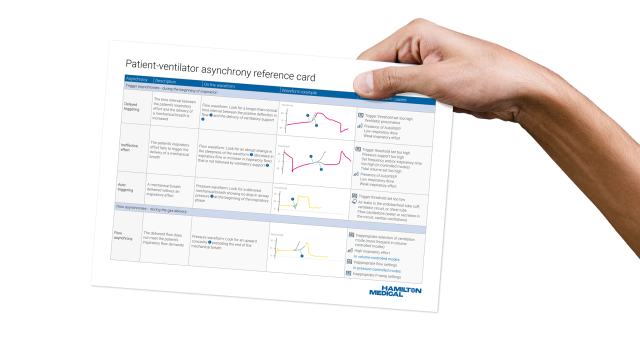
Carte de référence des asynchronies

Apprendre à repérer les asynchronies courantes ! Carte de référence gratuite

Notre carte de référence des asynchronies fournit un aperçu des types d'asynchronies les plus courantes, leurs causes et comment les détecter.
Notes en bas de page

  • A. L'IntelliSync+ est disponible en option sur les ventilateurs mécaniques HAMILTON-C6 et HAMILTON-G5, et comme fonctionnalité standard sur le HAMILTON-S1.

Références

  1. 1. Chao DC, Scheinhorn DJ, Stearn-Hassenpflug M. Patient-ventilator trigger asynchrony in prolonged mechanical ventilation. Chest. 1997;112(6):1592-1599. doi:10.1378/chest.112.6.1592
  2. 2. Thille AW, Rodriguez P, Cabello B, Lellouche F, Brochard L. Patient-ventilator asynchrony during assisted mechanical ventilation. Intensive Care Med. 2006;32(10):1515-1522. doi:10.1007/s00134-006-0301-8
  3. 3. de Wit M, Miller KB, Green DA, Ostman HE, Gennings C, Epstein SK. Ineffective triggering predicts increased duration of mechanical ventilation. Crit Care Med. 2009;37(10):2740-2745. doi:10.1097/ccm.0b013e3181a98a05
  4. 4. Blanch L, Villagra A, Sales B, et al. Asynchronies during mechanical ventilation are associated with mortality. Intensive Care Med. 2015;41(4):633-641. doi:10.1007/s00134-015-3692-6
  5. 5. Fabry B, Guttmann J, Eberhard L, Bauer T, Haberthür C, Wolff G. An analysis of desynchronization between the spontaneously breathing patient and ventilator during inspiratory pressure support. Chest. 1995;107(5):1387-1394. doi:10.1378/chest.107.5.1387
  6. 6. Giannouli E, Webster K, Roberts D, Younes M. Response of ventilator-dependent patients to different levels of pressure support and proportional assist. Am J Respir Crit Care Med. 1999;159(6):1716-1725. doi:10.1164/ajrccm.159.6.9704025
  7. 7. Colombo D, Cammarota G, Alemani M, et al. Efficacy of ventilator waveforms observation in detecting patient-ventilator asynchrony. Crit Care Med. 2011;39(11):2452-2457. doi:10.1097/CCM.0b013e318225753c
  8. 8. Mojoli F, Pozzi M, Orlando A, et al. Timing of inspiratory muscle activity detected from airway pressure and flow during pressure support ventilation: the waveform method. Crit Care. 2022;26(1):32. Published 2022 Jan 30. doi:10.1186/s13054-022-03895-4
  9. 9. Ramirez II, Arellano DH, Adasme RS, et al. Ability of ICU Health-Care Professionals to Identify Patient-Ventilator Asynchrony Using Waveform Analysis. Respir Care. 2017;62(2):144-149. doi:10.4187/respcare.04750

Patient-ventilator trigger asynchrony in prolonged mechanical ventilation.

Chao DC, Scheinhorn DJ, Stearn-Hassenpflug M. Patient-ventilator trigger asynchrony in prolonged mechanical ventilation. Chest. 1997;112(6):1592-1599. doi:10.1378/chest.112.6.1592

STUDY OBJECTIVE To investigate patient-ventilator trigger asynchrony (TA), its prevalence, physiologic basis, and clinical implications in patients requiring prolonged mechanical ventilation (PMV). STUDY DESIGN Descriptive and prospective cohort study. SETTING Barlow Respiratory Hospital (BRH), a regional weaning center. PATIENTS Two hundred consecutive ventilator-dependent patients, transferred to BRH over an 18-month period for attempted weaning from PMV. METHODS AND INTERVENTIONS Patients were assessed clinically for TA within the first week of hospital admission, or once they were in hemodynamically stable condition, by observation of uncoupling of accessory respiratory muscle efforts and onset of machine breaths. Patients were excluded if they had weaned by the time of assessment or if they never achieved hemodynamic stability. Ventilator mode was patient triggered, flow control, volume cycled, with a tidal volume of 7 to 10 mL/kg. Esophageal pressure (Peso), airway-opening pressure, and airflow were measured in patients with TA who consented to esophageal catheter insertion. Attempts to decrease TA in each patient included application of positive end-expiratory pressure (PEEP) stepwise to 10 cm H2O, flow triggering, and reduction of ventilator support in pressure support (PS) mode. Patients were followed up until hospital discharge, when outcomes were scored as weaned (defined as >7 days of ventilator independence), failed to wean, or died. RESULTS Of the 200 patients screened, 26 were excluded and 19 were found to have TA. Patients with TA were older, carried the diagnosis of COPD more frequently, and had more severe hypercapnia than their counterparts without TA. Only 3 of 19 patients (16%), all with intermittent TA, weaned from mechanical ventilation, after 70, 72, and 108 days, respectively. This is in contrast to a weaning success rate of 57%, with a median (range) time to wean of 33 (3 to 182) days in patients without TA. Observation of uncoupling of accessory respiratory muscle movement and onset of machine breaths was accurate in identifying patients with TA, which was confirmed in all seven patients consenting to Peso monitoring. TA appeared to result from high auto-PEEP and severe pump failure. Adjusting trigger sensitivity and application of flow triggering were unsuccessful in eliminating TA; external PEEP improved but rarely led to elimination of TA that was transient in duration. Reduction of ventilator support in PS mode, with resultant increased respiratory pump output and lower tidal volumes, uniformly succeeded in eliminating TA. However, this approach imposed a fatiguing load on the respiratory muscles and was poorly tolerated. CONCLUSION TA can be easily identified clinically, and when it occurs in the patient in stable condition with PMV, is associated with poor outcome.

Patient-ventilator asynchrony during assisted mechanical ventilation.

Thille AW, Rodriguez P, Cabello B, Lellouche F, Brochard L. Patient-ventilator asynchrony during assisted mechanical ventilation. Intensive Care Med. 2006;32(10):1515-1522. doi:10.1007/s00134-006-0301-8

OBJECTIVE The incidence, pathophysiology, and consequences of patient-ventilator asynchrony are poorly known. We assessed the incidence of patient-ventilator asynchrony during assisted mechanical ventilation and we identified associated factors. METHODS Sixty-two consecutive patients requiring mechanical ventilation for more than 24 h were included prospectively as soon as they triggered all ventilator breaths: assist-control ventilation (ACV) in 11 and pressure-support ventilation (PSV) in 51. MEASUREMENTS Gross asynchrony detected visually on 30-min recordings of flow and airway pressure was quantified using an asynchrony index. RESULTS Fifteen patients (24%) had an asynchrony index greater than 10% of respiratory efforts. Ineffective triggering and double-triggering were the two main asynchrony patterns. Asynchrony existed during both ACV and PSV, with a median number of episodes per patient of 72 (range 13-215) vs. 16 (4-47) in 30 min, respectively (p=0.04). Double-triggering was more common during ACV than during PSV, but no difference was found for ineffective triggering. Ineffective triggering was associated with a less sensitive inspiratory trigger, higher level of pressure support (15 cmH(2)O, IQR 12-16, vs. 17.5, IQR 16-20), higher tidal volume, and higher pH. A high incidence of asynchrony was also associated with a longer duration of mechanical ventilation (7.5 days, IQR 3-20, vs. 25.5, IQR 9.5-42.5). CONCLUSIONS One-fourth of patients exhibit a high incidence of asynchrony during assisted ventilation. Such a high incidence is associated with a prolonged duration of mechanical ventilation. Patients with frequent ineffective triggering may receive excessive levels of ventilatory support.

Ineffective triggering predicts increased duration of mechanical ventilation.

de Wit M, Miller KB, Green DA, Ostman HE, Gennings C, Epstein SK. Ineffective triggering predicts increased duration of mechanical ventilation. Crit Care Med. 2009;37(10):2740-2745. doi:10.1097/ccm.0b013e3181a98a05

OBJECTIVES To determine whether high rates of ineffective triggering within the first 24 hrs of mechanical ventilation (MV) are associated with longer MV duration and shorter ventilator-free survival (VFS). DESIGN Prospective cohort study. SETTING Medical intensive care unit (ICU) at an academic medical center. PATIENTS Sixty patients requiring invasive MV. INTERVENTIONS None. MEASUREMENTS Patients had pressure-time and flow-time waveforms recorded for 10 mins within the first 24 hrs of MV initiation. Ineffective triggering index (ITI) was calculated by dividing the number of ineffectively triggered breaths by the total number of breaths (triggered and ineffectively triggered). A priori, patients were classified into ITI >or=10% or ITI <10%. Patient demographics, MV reason, codiagnosis of chronic obstructive pulmonary disease (COPD), sedation levels, and ventilator parameters were recorded. MEASUREMENTS AND MAIN RESULTS Sixteen of 60 patients had ITI >or=10%. The two groups had similar characteristics, including COPD frequency and ventilation parameters, except that patients with ITI >or=10% were more likely to have pressured triggered breaths (56% vs. 16%, p = .003) and had a higher intrinsic respiratory rate (22 breaths/min vs. 18, p = .03), but the set ventilator rate was the same in both groups (9 breaths/min vs. 9, p = .78). Multivariable analyses adjusting for pressure triggering also demonstrated that ITI >or=10% was an independent predictor of longer MV duration (10 days vs. 4, p = .0004) and shorter VFS (14 days vs. 21, p = .03). Patients with ITI >or=10% had a longer ICU length of stay (8 days vs. 4, p = .01) and hospital length of stay (21 days vs. 8, p = .03). Mortality was the same in the two groups, but patients with ITI >or=10% were less likely to be discharged home (44% vs. 73%, p = .04). CONCLUSIONS Ineffective triggering is a common problem early in the course of MV and is associated with increased morbidity, including longer MV duration, shorter VFS, longer length of stay, and lower likelihood of home discharge.

Asynchronies during mechanical ventilation are associated with mortality.

Blanch L, Villagra A, Sales B, et al. Asynchronies during mechanical ventilation are associated with mortality. Intensive Care Med. 2015;41(4):633-641. doi:10.1007/s00134-015-3692-6

PURPOSE This study aimed to assess the prevalence and time course of asynchronies during mechanical ventilation (MV). METHODS Prospective, noninterventional observational study of 50 patients admitted to intensive care unit (ICU) beds equipped with Better Care™ software throughout MV. The software distinguished ventilatory modes and detected ineffective inspiratory efforts during expiration (IEE), double-triggering, aborted inspirations, and short and prolonged cycling to compute the asynchrony index (AI) for each hour. We analyzed 7,027 h of MV comprising 8,731,981 breaths. RESULTS Asynchronies were detected in all patients and in all ventilator modes. The median AI was 3.41 % [IQR 1.95-5.77]; the most common asynchrony overall and in each mode was IEE [2.38 % (IQR 1.36-3.61)]. Asynchronies were less frequent from 12 pm to 6 am [1.69 % (IQR 0.47-4.78)]. In the hours where more than 90 % of breaths were machine-triggered, the median AI decreased, but asynchronies were still present. When we compared patients with AI > 10 vs AI ≤ 10 %, we found similar reintubation and tracheostomy rates but higher ICU and hospital mortality and a trend toward longer duration of MV in patients with an AI above the cutoff. CONCLUSIONS Asynchronies are common throughout MV, occurring in all MV modes, and more frequently during the daytime. Further studies should determine whether asynchronies are a marker for or a cause of mortality.

An analysis of desynchronization between the spontaneously breathing patient and ventilator during inspiratory pressure support.

Fabry B, Guttmann J, Eberhard L, Bauer T, Haberthür C, Wolff G. An analysis of desynchronization between the spontaneously breathing patient and ventilator during inspiratory pressure support. Chest. 1995;107(5):1387-1394. doi:10.1378/chest.107.5.1387

It is common practice to convert patients with acute respiratory insufficiency (ARI) from controlled mechanical ventilation to some form of assisted spontaneous breathing as early as possible. A widely used mode of assisted spontaneous breathing is patient-triggered inspiratory pressure support (IPS). We investigated 11 patients with ARI during weaning from mechanical ventilation using IPS and found that in 9 of these patients, desynchronization between patient and ventilator occurred, ie, that the ventilator did not detect and support all the patients' breathing efforts. Five of these 9 patients displayed severe desynchronization lasting at least 5 min and with less than half of all breathing efforts being supported by the ventilator. We present the analysis of gas flow, volume, esophageal pressure, airway pressure, and tracheal pressure of 1 patient with ARI displaying desynchronization under IPS. Our results imply that desynchronization can occur due to the following: (1) inspiratory response delays caused by the inspiratory triggering mechanisms and the demand flow characteristics of the ventilator; (2) a mismatch between the patient's completion of the inspiration effort and the ventilator's criterion for terminating pressure support; and (3) restriction of expiration due to resistance from patient's airways, endotracheal tube, and expiratory valve. From our analysis, we have made proposals for reducing desynchronization in clinical practice.

Response of ventilator-dependent patients to different levels of pressure support and proportional assist.

Giannouli E, Webster K, Roberts D, Younes M. Response of ventilator-dependent patients to different levels of pressure support and proportional assist. Am J Respir Crit Care Med. 1999;159(6):1716-1725. doi:10.1164/ajrccm.159.6.9704025

The ventilator's response to the patient's effort is quite different in proportional assist ventilation (PAV) and pressure support ventilation (PSV). We wished to determine whether this results in different ventilatory and breathing pattern responses to alterations in level of support and, if so, whether there are any gas exchange consequences. Fourteen patients were studied. Average elastance (E) was 22.8 (range, 14 -36) cm H2O/L and average resistance (R) was 15. 7 (range, 9-21) cm H2O/L/s. The highest PSV support (PSVmax) was that associated with a tidal volume (VT) of 10 ml/kg (20.4 +/- 3.2 cm H2O), and the highest level of PAV assist (PAVmax) was 78 +/- 7% of E and 76 +/- 7% of R. Level of assist was decreased in steps to the lowest tolerable level (PSVmin, PAVmin). Minute ventilation, VT, ventilator rate (RRvent), and arterial gas tensions were measured at each level. We also determined the patient's respiratory rate (RRpat) by adding the number of ineffective efforts (DeltaRR) to RRvent. There was no difference between PSVmin and PAVmin in any of the variables. At PSVmax, VT was significantly higher (0.90 +/- 0.30 versus 0.51 +/- 0.16 L) and RRvent was significantly lower (13.2 +/- 3.9 versus 27.6 +/- 10.5 min-1) than at PAVmax. The difference in RRvent was largely related to a progressive increase in ineffective efforts on PSV as level increased (DeltaRR 12.1 +/- 10.1 vs 1.4 +/- 2.1 with PAVmax); there was no significant difference in RRpat. The differences in breathing pattern had no consequence on arterial blood gas tensions. We conclude that substantial differences in breathing pattern may occur between PSV and PAV and that these are largely artifactual and related to different patient-ventilator interactions.

Efficacy of ventilator waveforms observation in detecting patient-ventilator asynchrony.

Colombo D, Cammarota G, Alemani M, et al. Efficacy of ventilator waveforms observation in detecting patient-ventilator asynchrony. Crit Care Med. 2011;39(11):2452-2457. doi:10.1097/CCM.0b013e318225753c

OBJECTIVES The value of visual inspection of ventilator waveforms in detecting patient-ventilator asynchronies in the intensive care unit has never been systematically evaluated. This study aims to assess intensive care unit physicians' ability to identify patient-ventilator asynchronies through ventilator waveforms. DESIGN Prospective observational study. SETTING Intensive care unit of a University Hospital. PATIENTS Twenty-four patients receiving mechanical ventilation for acute respiratory failure. INTERVENTION Forty-three 5-min reports displaying flow-time and airway pressure-time tracings were evaluated by 10 expert and 10 nonexpert, i.e., residents, intensive care unit physicians. The asynchronies identified by experts and nonexperts were compared with those ascertained by three independent examiners who evaluated the same reports displaying, additionally, tracings of diaphragm electrical activity. MEASUREMENTS AND MAIN RESULTS Data were examined according to both breath-by-breath analysis and overall report analysis. Sensitivity, specificity, and positive and negative predictive values were determined. Sensitivity and positive predictive value were very low with breath-by-breath analysis (22% and 32%, respectively) and fairly increased with report analysis (55% and 44%, respectively). Conversely, specificity and negative predictive value were high with breath-by-breath analysis (91% and 86%, respectively) and slightly lower with report analysis (76% and 82%, respectively). Sensitivity was significantly higher for experts than for nonexperts for breath-by-breath analysis (28% vs. 16%, p < .05), but not for report analysis (63% vs. 46%, p = .15). The prevalence of asynchronies increased at higher ventilator assistance and tidal volumes (p < .001 for both), whereas it decreased at higher respiratory rates and diaphragm electrical activity (p < .001 for both). At higher prevalence, sensitivity decreased significantly (p < .001). CONCLUSIONS The ability of intensive care unit physicians to recognize patient-ventilator asynchronies was overall quite low and decreased at higher prevalence; expertise significantly increased sensitivity for breath-by-breath analysis, whereas it only produced a trend toward improvement for report analysis.

Timing of inspiratory muscle activity detected from airway pressure and flow during pressure support ventilation: the waveform method.

Mojoli F, Pozzi M, Orlando A, et al. Timing of inspiratory muscle activity detected from airway pressure and flow during pressure support ventilation: the waveform method. Crit Care. 2022;26(1):32. Published 2022 Jan 30. doi:10.1186/s13054-022-03895-4

BACKGROUND Whether respiratory efforts and their timing can be reliably detected during pressure support ventilation using standard ventilator waveforms is unclear. This would give the opportunity to assess and improve patient-ventilator interaction without the need of special equipment. METHODS In 16 patients under invasive pressure support ventilation, flow and pressure waveforms were obtained from proximal sensors and analyzed by three trained physicians and one resident to assess patient's spontaneous activity. A systematic method (the waveform method) based on explicit rules was adopted. Esophageal pressure tracings were analyzed independently and used as reference. Breaths were classified as assisted or auto-triggered, double-triggered or ineffective. For assisted breaths, trigger delay, early and late cycling (minor asynchronies) were diagnosed. The percentage of breaths with major asynchronies (asynchrony index) and total asynchrony time were computed. RESULTS Out of 4426 analyzed breaths, 94.1% (70.4-99.4) were assisted, 0.0% (0.0-0.2) auto-triggered and 5.8% (0.4-29.6) ineffective. Asynchrony index was 5.9% (0.6-29.6). Total asynchrony time represented 22.4% (16.3-30.1) of recording time and was mainly due to minor asynchronies. Applying the waveform method resulted in an inter-operator agreement of 0.99 (0.98-0.99); 99.5% of efforts were detected on waveforms and agreement with the reference in detecting major asynchronies was 0.99 (0.98-0.99). Timing of respiratory efforts was accurately detected on waveforms: AUC for trigger delay, cycling delay and early cycling was 0.865 (0.853-0.876), 0.903 (0.892-0.914) and 0.983 (0.970-0.991), respectively. CONCLUSIONS Ventilator waveforms can be used alone to reliably assess patient's spontaneous activity and patient-ventilator interaction provided that a systematic method is adopted.

Ability of ICU Health-Care Professionals to Identify Patient-Ventilator Asynchrony Using Waveform Analysis.

Ramirez II, Arellano DH, Adasme RS, et al. Ability of ICU Health-Care Professionals to Identify Patient-Ventilator Asynchrony Using Waveform Analysis. Respir Care. 2017;62(2):144-149. doi:10.4187/respcare.04750

BACKGROUND Waveform analysis by visual inspection can be a reliable, noninvasive, and useful tool for detecting patient-ventilator asynchrony. However, it is a skill that requires a properly trained professional. METHODS This observational study was conducted in 17 urban ICUs. Health-care professionals (HCPs) working in these ICUs were asked to recognize different types of asynchrony shown in 3 evaluation videos. The health-care professionals were categorized according to years of experience, prior training in mechanical ventilation, profession, and number of asynchronies identified correctly. RESULTS A total of 366 HCPs were evaluated. Statistically significant differences were found when HCPs with and without prior training in mechanical ventilation (trained vs non-trained HCPs) were compared according to the number of asynchronies detected correctly (of the HCPs who identified 3 asynchronies, 63 [81%] trained vs 15 [19%] non-trained, P < .001; 2 asynchronies, 72 [65%] trained vs 39 [35%] non-trained, P = .034; 1 asynchrony, 55 [47%] trained vs 61 [53%] non-trained, P = .02; 0 asynchronies, 17 [28%] trained vs 44 [72%] non-trained, P < .001). HCPs who had prior training in mechanical ventilation also increased, nearly 4-fold, their odds of identifying ≥2 asynchronies correctly (odds ratio 3.67, 95% CI 1.93-6.96, P < .001). However, neither years of experience nor profession were associated with the ability of HCPs to identify asynchrony. CONCLUSIONS HCPs who have specific training in mechanical ventilation increase their ability to identify asynchrony using waveform analysis. Neither experience nor profession proved to be a relevant factor to identify asynchrony correctly using waveform analysis.

Related articles. Get a deeper look