

Voltar

Journal Club: A non-invasive method to detect excessively high respiratory effort and dynamic transpulmonary driving pressure during MV

Artigo

Autor: Màrcia Santos

Data da primeira publicação: 15.07.2021

Última alteração: 20.02.2023

Changed categorization to exclude Application

Patient efforts during mechanical ventilation can have both beneficial and deleterious effects. Vigorous efforts generate pendelluft and amplify regional lung stress and strain, causing regional lung injury which may induce P-SILI.

Journal Club: A non-invasive method to detect excessively high respiratory effort and dynamic transpulmonary driving pressure during MV

ΔPocc to detect high respiratory effort and stress

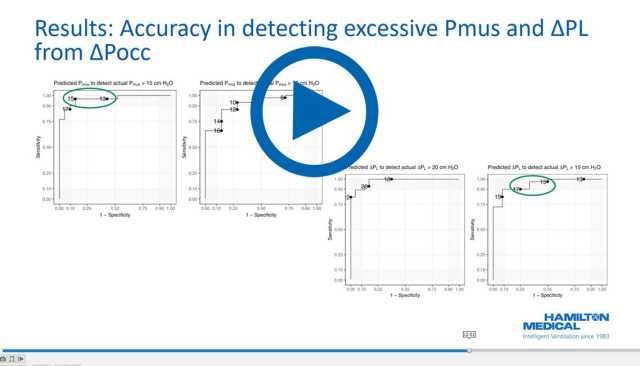
This Journal Club presentation looks at a study from Canada, which investigated whether swings in airway pressure generated by the inspiratory muscles under assisted ventilation when the airway is occluded (ΔPocc) could be used to screen for high respiratory effort and high dynamic lung stress. The authors found that both inspiratory effort and dynamic lung stress frequently exceeded safe thresholds and that the measurement of ΔPocc from end-expiratory occlusion maneuvers was able to detect excessive levels of both with high sensitivity and specificity. In addition, the magnitude of dynamic lung stress during spontaneous breathing was often seriously underestimated by airway pressures available on the ventilator. Watch the video presentation available below.

Full citations below: (Bertoni M, Telias I, Urner M, et al. A novel non-invasive method to detect excessively high respiratory effort and dynamic transpulmonary driving pressure during mechanical ventilation. Crit Care. 2019;23(1):346. Published 2019 Nov 6. doi:10.1186/s13054-019-2617-01​)

A novel non-invasive method to detect excessively high respiratory effort and dynamic transpulmonary driving pressure during mechanical ventilation.

Bertoni M, Telias I, Urner M, et al. A novel non-invasive method to detect excessively high respiratory effort and dynamic transpulmonary driving pressure during mechanical ventilation. Crit Care. 2019;23(1):346. Published 2019 Nov 6. doi:10.1186/s13054-019-2617-0

BACKGROUND Excessive respiratory muscle effort during mechanical ventilation may cause patient self-inflicted lung injury and load-induced diaphragm myotrauma, but there are no non-invasive methods to reliably detect elevated transpulmonary driving pressure and elevated respiratory muscle effort during assisted ventilation. We hypothesized that the swing in airway pressure generated by respiratory muscle effort under assisted ventilation when the airway is briefly occluded (ΔPocc) could be used as a highly feasible non-invasive technique to screen for these conditions. METHODS Respiratory muscle pressure (Pmus), dynamic transpulmonary driving pressure (ΔPL,dyn, the difference between peak and end-expiratory transpulmonary pressure), and ΔPocc were measured daily in mechanically ventilated patients in two ICUs in Toronto, Canada. A conversion factor to predict ΔPL,dyn and Pmus from ΔPocc was derived and validated using cross-validation. External validity was assessed in an independent cohort (Nanjing, China). RESULTS Fifty-two daily recordings were collected in 16 patients. In this sample, Pmus and ΔPL were frequently excessively high: Pmus exceeded 10 cm H2O on 84% of study days and ΔPL,dyn exceeded 15 cm H2O on 53% of study days. ΔPocc measurements accurately detected Pmus > 10 cm H2O (AUROC 0.92, 95% CI 0.83-0.97) and ΔPL,dyn > 15 cm H2O (AUROC 0.93, 95% CI 0.86-0.99). In the external validation cohort (n = 12), estimating Pmus and ΔPL,dyn from ΔPocc measurements detected excessively high Pmus and ΔPL,dyn with similar accuracy (AUROC ≥ 0.94). CONCLUSIONS Measuring ΔPocc enables accurate non-invasive detection of elevated respiratory muscle pressure and transpulmonary driving pressure. Excessive respiratory effort and transpulmonary driving pressure may be frequent in spontaneously breathing ventilated patients.

Downloads for Journal Club: A non-invasive method to detect excessively high respiratory effort and dynamic transpulmonary driving pressure during MV

Video Journal Club: A non-invasive method to detect high respiratory effort and dynamic ΔPL during MV
inglês