


Autor: Marcela Rodriguez Jimenez
Data da primeira publicação: 06.02.2024
Última alteração: 04.04.2024
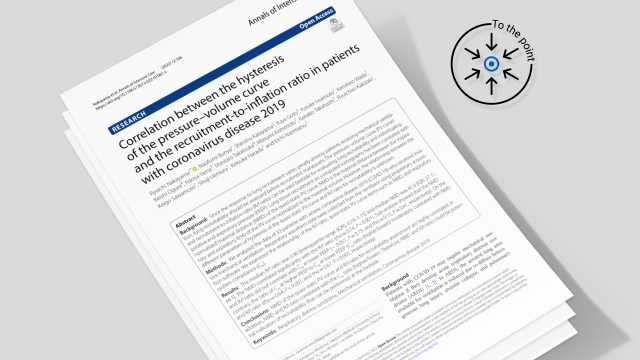
Removal of linked article on assessing recruitability - no new revisionThe authors' point? The normalized maximum distance on a quasi-static PV curve and the recruitment-to-inflation ratio can be used at the bedside as potential indicators of lung recruitability.
In mechanically ventilated COVID-19 patients, what is the relationship between lung recruitability assessments based on the low-flow quasi-static pressure-volume (PV) curve and the recruitment-to-inflation (R/I) ratio?
|
Inclusion criteria |
Exclusion criteria |
|
Aged 18 years or older |
Under 18 years of age |
|
Diagnosis of COVID-19 confirmed by polymerase chain reaction or quantitative antigen testing of nasal swabs |
No recording of respiratory data by Datalogger 5.00 |
|
Simultaneous evaluation of the quasi-static PV curve and the R/I ratio using Datalogger 5.00 |
|
Interventions |
||
|
Quasi-static PV curve |
R/I ratio (Recruitment-to-inflation ratio) |
Recruitability assessment |
|
|
|
Measurements and main results |
||
|
Enrollment and baseline characteristics |
Correlation between NMD and R/I ratio |
Relationship between compliance and recruitability items |
|
|
|
There is a strong correlation between NMD of the quasi-static PV curve and the R/I ratio for recruitability assessment. In addition, NMD and the R/I ratio correlate with the Crs ratio (higher/lower). Therefore, NMD and the R/I ratio could be potential indicators of recruitability that can be performed at the bedside.
Hamilton Medical offers an extensive range of educational material on use of the P/V Tool for assessing recruitability, performing recruitment maneuvers, and setting PEEP. Follow the link below to access articles, videos, e-learning modules, and more.
Apresentamos-lhe as principais conclusões de artigos importantes.
Saiba tudo sobre os marcos da pesquisa médica. Leia os principais fatos e descobertas dos artigos mais importantes em‑um‑formato fácil de digerir.