


Autor: Jean-Michel Arnal, Senior Intensivist, Hôpital Sainte Musse, Toulon, France
Data da primeira publicação: 23.04.2019
Última alteração: 10.06.2026
Typo correctionPEEP is used to keep the lung aerated and prevent lung collapse at the end of expiration. However, PEEP may over-distend the normally aerated lung and impair lung perfusion. Therefore, any change in PEEP may affect the overall ventilation/perfusion ratio in an unpredictable way.
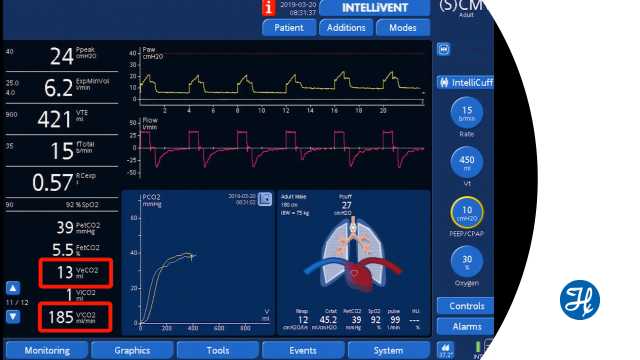
Volumetric capnography measures the volume of CO2 exhaled breath-by-breath (VeCO2). After a change in PEEP, assuming that the cardiovascular function and tidal volume are stable, an increase in VeCO2 means that the overall ventilation/perfusion ratio has improved. Conversely, a decrease in VeCO2 means that the ventilation/perfusion ratio is worsening. VeCO2 changes rapidly and returns to the baseline after a few minutes.
The limitation to this method is that the clinician monitors rapid changes to the ventilation/perfusion ratio, such as those due to lung over-distension and lung-perfusion impairment or improvement.
After a change in PEEP, recruitment or derecruitment may take a longer time to occur and cannot be assessed by this method.
Watch the video below to see a demonstration during ventilation with a Hamilton Medical ventilator.
Full citations below: (
Saiba como interpretar um capnograma volumétrico e obtenha uma visão geral dos benefícios e das aplicações clínicas da capnografia volumétrica. Inclui um autoteste!