Назад

Методы оценки (де)рекрутируемости в клинических условиях

Статья

Автор: Giorgio A. Iotti, Caroline Brown

Дата: 29.04.2025

Что такое рекрутируемость и как ее измерить?

Основные идеи

  • Одной из ключевых задач во время лечения пациентов с острым респираторным дистресс-синдромом (ARDS) является обеспечение адекватного газообмена (оксигенации и элиминации CO2) при минимизации риска дальнейшего повреждения легочной ткани.
  • Так как оптимальный уровень PEEP зависит от способности легких к рекрутменту, оценка степени рекрутируемости может помочь в выборе подходящих параметров PEEP.
  • Один из двух методов оценки рекрутируемости, основанный на измерениях механики дыхания в клинических условиях, – это соотношение рекрутмента к инфляции (R/I), которое можно рассчитать по параметрам мониторинга на аппарате ИВЛ.
  • Чем ниже соотношение R/I, тем меньше потенциал для рекрутмента.

Типы легких и влияние PEEP

Одновременная балансировка этих двух аспектов – одна из ключевых задач при лечении пациентов с ARDS. При остром повреждении легких альвеолы можно условно разделить на три группы: альвеолы, которые остаются открытыми и стабильными даже при низком давлении (как в нормальном легком); спавшиеся альвеолы, которые можно открыть и поддерживать в открытом состоянии при безопасном уровне положительного давления (рекрутируемые легкие); спавшиеся или консолидированные альвеолы, которые невозможно открыть (нерекрутируемые легкие). В зависимости от соотношения этих групп легкие можно классифицировать на данный момент как: механически близкие к нормальным, рекрутируемые, нерекрутируемые. При рекрутируемых легких применение вентиляционной стратегии с соответствующим уровнем положительного давления в конце выдоха (PEEP) считается защитным. С одной стороны, PEEP повышает инспираторное давление, способствуя рекрутменту спавшихся альвеол и обеспечивая их безопасное участие в дыхании. С другой стороны, адекватный уровень PEEP действует как механический стабилизатор, препятствуя циклическому дерекрутменту альвеол во время экспирации и снижая риск ателектотравмы. Для нерекрутируемых или механически близких к нормальным легких высокий уровень PEEP будет избыточным и неэффективным.

Самый простой способ установить PEEP при ARDS – повышать его, оценивая улучшение оксигенации. Однако этот подход оправдан только для «пациентов-респондеров» и может привести к перераздуванию, особенно у тех, чей организм плохо отвечает на PEEP. Оценка рекрутируемости может дать важную дополнительную информацию для оптимального подбора уровня PEEP.


Что такое рекрутируемость и как ее измерить?

Что такое рекрутируемость? Альвеолярная нестабильность и способность реагировать на положительное давление – ключевые условия для рекрутируемости. Очевидно, что легкие с потенциалом для рекрутмента также имеют потенциал для дерекрутмента. Это означает, что нестабильные альвеолы могут снова спадаться при снижении давления в дыхательных путях ниже определенного замыкающего давления. 

Среди методов оценки рекрутируемости в клинических условиях можно выделить визуализацию с помощью ультразвука легких или электроимпедансной томографии. Методы, основанные на измерениях механики дыхания в ходе специальных маневров, включают следующее: анализ статической петли давления-объема (PV) дыхательной системы и соотношение R/I. Оба метода требуют инвазивной вентиляции и полной релаксации пациента.

Статическая петля давления-объема (PV-петля)

Первый метод – анализ статической PV-петли – предполагает использование специального инструмента на аппарате ИВЛ для записи объема в зависимости от давления в дыхательных путях во время медленного контролируемого раздувания и спада легких. Типичный маневр включает постепенное повышение давления с постоянной скоростью 2 смH2O/с от 5 до 40 смH2O и обратное снижение. Альтернативный вариант – запуск и завершение маневра при нулевом давлении. Эти маневры позволяют оценить два процесса: потенциальный рекрутмент альвеол при медленном повышении давления и возможный дерекрутмент при медленном снижении давления. На графике маневра с Рдп по оси X и объемом (V) по оси Y обычно наблюдается некоторая гистерезисная разница между фазами раздувания и спада: фаза спада находится выше фазы раздувания. Чем больше расхождение между этими фазами, тем выше степень гистерезиса. Исследования показали, что больший гистерезис (широкая PV-петля) коррелирует с высокой рекрутируемостью, а меньший гистерезис (узкая PV-петля) свидетельствует о низком потенциале рекрутмента (Demory D, Arnal JM, Wysocki M, et al. Recruitability of the lung estimated by the pressure volume curve hysteresis in ARDS patients. Intensive Care Med. 2008;34(11):2019-2025. doi:10.1007/s00134-008-1167-81​, Chiumello D, Arnal JM, Umbrello M, et al. Hysteresis and Lung Recruitment in Acute Respiratory Distress Syndrome Patients: A CT Scan Study [published correction appears in Crit Care Med. 2022 Mar 1;50(3):e339]. Crit Care Med. 2020;48(10):1494-1502. doi:10.1097/CCM.00000000000045182​). Степень гистерезиса может быть выражена как нормализованное максимальное расстояние (НМР), то есть соотношение максимального расстояния между двумя кривыми и максимального объема, достигнутого во время маневра. Значение НМР 0,41 соответствует средней способности к рекрутменту и служит для различения условий с низким или высоким потенциалом для рекрутмента (Chiumello D, Arnal JM, Umbrello M, et al. Hysteresis and Lung Recruitment in Acute Respiratory Distress Syndrome Patients: A CT Scan Study [published correction appears in Crit Care Med. 2022 Mar 1;50(3):e339]. Crit Care Med. 2020;48(10):1494-1502. doi:10.1097/CCM.00000000000045182​).

Соотношение рекрутмента к инфляции (R/I)

Второй метод – соотношение R/I, также известный как «упрощенная методика дерекрутмента», – был предложен Chen и соавторами (Chen L, Del Sorbo L, Grieco DL, et al. Potential for Lung Recruitment Estimated by the Recruitment-to-Inflation Ratio in Acute Respiratory Distress Syndrome. A Clinical Trial. Am J Respir Crit Care Med. 2020;201(2):178-187. doi:10.1164/rccm.201902-0334OC3​, Chen L, Chen GQ, Shore K, et al. Implementing a bedside assessment of respiratory mechanics in patients with acute respiratory distress syndrome. Crit Care. 2017;21(1):84. Published 2017 Apr 4. doi:10.1186/s13054-017-1671-84​). В работе изучается возможный дерекрутмент, который происходит во время традиционной вентиляции с контролем по объему (CMV), когда PEEP резко уменьшается на 10 смH2O с высокого уровня (от 15 до 18 смH2O, поддерживаемого не менее 30 минут) до низкого уровня (от 5 до 8 смH2O). Переходное дыхание, во время которого вдох начинается при высоком показателе PEEP, а выдох заканчивается при низком показателе PEEP, приводит к большему объему выдоха по сравнению с предыдущими вдохами. Дополнительный объем выдоха состоит из двух совершенно разных компонентов. Первый (обозначаемый как «дефлированный объем») зависит от реакции на дефляцию альвеол, которые остаются стабильными при низком уровне PEEP. Дефлированный объем отражает влияние изменений давления на инфляцию (I) и дефляцию легкого ребенка и связан с его размером. Второй компонент (обозначаемый как «дерекрутированный объем») зависит от дерекрутмента нестабильных альвеол, которые немедленно коллапсируют и полностью освобождают свое газовое содержимое при переключении PEEP на низкий уровень. Дерекрутированный объем отражает влияние изменений давления на рекрутмент (R) и дерекрутмент. Соотношение R/I соответствует отношению дерекрутированного объема к дефлированному объему. На практике этот индекс нормализует наблюдаемый дерекрутмент относительно размера легкого ребенка и, таким образом, выражает степень рекрутируемости. 

Как рассчитать соотношение?

Расчет соотношения R/I относительно прост, поскольку основан на данных, которые можно считать с системы мониторинга аппарата ИВЛ: объем выдоха при высоком PEEP, объем выдоха во время дыхания при переходе PEEP, податливость дыхательной системы при низком PEEP. Чем ниже соотношение R/I, тем меньше потенциал для рекрутмента, причем ноль означает полное отсутствие рекрутируемости. Промежуточные значения составляют около 0,5 (медианное значение в исследуемой Chen и соавторами популяции), а значения более 0,6 считаются свидетельством высокой рекрутируемости (Chen L, Del Sorbo L, Grieco DL, et al. Potential for Lung Recruitment Estimated by the Recruitment-to-Inflation Ratio in Acute Respiratory Distress Syndrome. A Clinical Trial. Am J Respir Crit Care Med. 2020;201(2):178-187. doi:10.1164/rccm.201902-0334OC3​). Эти результаты, полученные с использованием соотношения R/I, было сопоставлено с гистерезисом на статических PV-петлях, в результате чего было установлено их хорошее соответствие (Nakayama R, Bunya N, Katayama S, et al. Correlation between the hysteresis of the pressure-volume curve and the recruitment-to-inflation ratio in patients with coronavirus disease 2019. Ann Intensive Care. 2022;12(1):106. Published 2022 Nov 12. doi:10.1186/s13613-022-01081-x5​). 

Что это говорит нам о настройке PEEP?

После того как либо гистерезис на одной статической PV-петле, либо соотношение R/I, рассчитанное при маневре дерекрутмента на 10 смH2O, определили состояние высокой, средней или низкой рекрутируемости, как следует настраивать PEEP в клинической практике? Низкий PEEP обычно является правильным выбором при низкой рекрутируемости. Даже если высокая рекрутируемость традиционно считается хорошим показанием для высокого PEEP, важно учитывать недавние предостережения по этому поводу (Gattinoni L, Collino F, Camporota L. Assessing lung recruitability: does it help with PEEP settings?. Intensive Care Med. 2024;50(5):749-751. doi:10.1007/s00134-024-07351-56​). А как насчет средней рекрутируемости? Интересно, что для точного подбора оптимального уровня PEEP, способного рекрутировать и механически стабилизировать нестабильные альвеолы, была предложена оценка гистерезиса на нескольких статических PV-петлях во время пробного снижения PEEP (Mojoli F, Pozzi M, Arisi E. Setting positive end-expiratory pressure: using the pressure-volume curve. Curr Opin Crit Care. 2024;30(1):35-42. doi:10.1097/MCC.00000000000011277​). Аналогичным образом метод соотношения R/I также применялся для детальной оценки дерекрутмента во время пробного снижения PEEP, но в этом случае необходимая технология очень сложна, поскольку требуется измерение конечно-экспираторного объема легких методом разведения азота (Grieco DL, Pintaudi G, Bongiovanni F, et al. Recruitment-to-inflation Ratio Assessed through Sequential End-expiratory Lung Volume Measurement in Acute Respiratory Distress Syndrome. Anesthesiology. 2023;139(6):801-814. doi:10.1097/ALN.00000000000047168​) 

На вашем аппарате ИВЛ

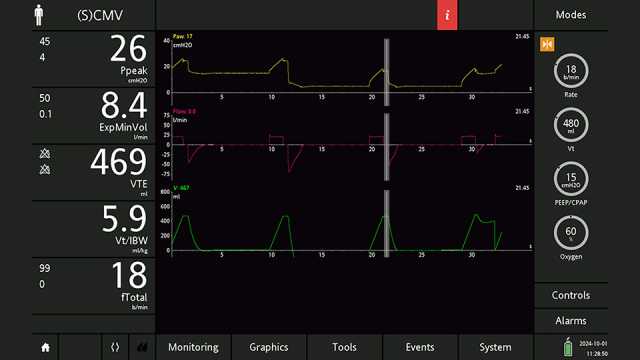
Соотношение R/I позволяет оценивать степень рекрутируемости в клинических условиях, используя стандартные параметры мониторинга на аппаратах ИВЛ Hamilton Medical. Другой метод, включающий статическую PV-петлю, можно применять с помощью инструмента P/V Tool, доступного на аппаратах ИВЛ HAMILTON‑C3/C6 и HAMILTON‑G5/S1 (Опционально для аппаратов ИВЛ HAMILTON-G5 и HAMILTON-C3/C6A, Стандартно для аппарата ИВЛ HAMILTON-S1B​). В этом случае рекрутируемость можно оценить непосредственно по кривой давления-объема в ходе одного диагностического маневра. Инструмент P/V Tool также может использоваться для выполнения маневров рекрутмента или для определения оптимального уровня PEEP на основе детальной оценки гистерезиса, проведенной в ходе нескольких диагностических маневров.
 

Сноски

  • A. Доступно как дополнительная опция на аппаратах ИВЛ HAMILTON-G5 и HAMILTON-C3/C6
  • B. Входит в стандартную комплектацию аппарата ИВЛ HAMILTON-S1

Список литературы

  1. 1. Demory D, Arnal JM, Wysocki M, et al. Recruitability of the lung estimated by the pressure volume curve hysteresis in ARDS patients. Intensive Care Med. 2008;34(11):2019-2025. doi:10.1007/s00134-008-1167-8
  2. 2. Chiumello D, Arnal JM, Umbrello M, et al. Hysteresis and Lung Recruitment in Acute Respiratory Distress Syndrome Patients: A CT Scan Study [published correction appears in Crit Care Med. 2022 Mar 1;50(3):e339]. Crit Care Med. 2020;48(10):1494-1502. doi:10.1097/CCM.0000000000004518
  3. 3. Chen L, Del Sorbo L, Grieco DL, et al. Potential for Lung Recruitment Estimated by the Recruitment-to-Inflation Ratio in Acute Respiratory Distress Syndrome. A Clinical Trial. Am J Respir Crit Care Med. 2020;201(2):178-187. doi:10.1164/rccm.201902-0334OC
  4. 4. Chen L, Chen GQ, Shore K, et al. Implementing a bedside assessment of respiratory mechanics in patients with acute respiratory distress syndrome. Crit Care. 2017;21(1):84. Published 2017 Apr 4. doi:10.1186/s13054-017-1671-8
  5. 5. Nakayama R, Bunya N, Katayama S, et al. Correlation between the hysteresis of the pressure-volume curve and the recruitment-to-inflation ratio in patients with coronavirus disease 2019. Ann Intensive Care. 2022;12(1):106. Published 2022 Nov 12. doi:10.1186/s13613-022-01081-x
  6. 6. Gattinoni L, Collino F, Camporota L. Assessing lung recruitability: does it help with PEEP settings?. Intensive Care Med. 2024;50(5):749-751. doi:10.1007/s00134-024-07351-5
  7. 7. Mojoli F, Pozzi M, Arisi E. Setting positive end-expiratory pressure: using the pressure-volume curve. Curr Opin Crit Care. 2024;30(1):35-42. doi:10.1097/MCC.0000000000001127
  8. 8. Grieco DL, Pintaudi G, Bongiovanni F, et al. Recruitment-to-inflation Ratio Assessed through Sequential End-expiratory Lung Volume Measurement in Acute Respiratory Distress Syndrome. Anesthesiology. 2023;139(6):801-814. doi:10.1097/ALN.0000000000004716

Recruitability of the lung estimated by the pressure volume curve hysteresis in ARDS patients.

Demory D, Arnal JM, Wysocki M, et al. Recruitability of the lung estimated by the pressure volume curve hysteresis in ARDS patients. Intensive Care Med. 2008;34(11):2019-2025. doi:10.1007/s00134-008-1167-8

OBJECTIVE To assess the hysteresis of the pressure-volume curve (PV curve) as to estimate, easily and at the bedside, the recruitability of the lung in ARDS patients. DESIGN Prospective study. SETTING Twelve medico-surgical ICU beds of a general hospital. PATIENTS Twenty-six patients within the first 24 h from meeting ARDS criteria. INTERVENTION A Quasi-static inflation and deflation PV curve from 0 to 40 cmH(2)O and a 40 cmH(2)O recruitment maneuver (RM) maintained for 10 s were successively done with an interval of 30 min in between. RECORDINGS AND CALCULATION: Hysteresis of the PV curve (H(PV)) was calculated as the ratio of the area enclosed by the pressure volume loop divided by the predicted body weight (PBW). The volume increase during the RM (V(RM)) was measured by integration of the flow required to maintain the pressure at 40 cmH(2)O and divided by PBW, as an estimation of the volume recruited during the RM. RESULTS A positive linear correlation was found between H(PV) and V(RM) (r = 0.81, P < 0.0001). CONCLUSIONS The results suggest using the hysteresis of the PV curve to assess the recruitability of the lung.

Hysteresis and Lung Recruitment in Acute Respiratory Distress Syndrome Patients: A CT Scan Study.

Chiumello D, Arnal JM, Umbrello M, et al. Hysteresis and Lung Recruitment in Acute Respiratory Distress Syndrome Patients: A CT Scan Study [published correction appears in Crit Care Med. 2022 Mar 1;50(3):e339]. Crit Care Med. 2020;48(10):1494-1502. doi:10.1097/CCM.0000000000004518

OBJECTIVES Hysteresis of the respiratory system pressure-volume curve is related to alveolar surface forces, lung stress relaxation, and tidal reexpansion/collapse. Hysteresis has been suggested as a means of assessing lung recruitment. The objective of this study was to determine the relationship between hysteresis, mechanical characteristics of the respiratory system, and lung recruitment assessed by a CT scan in mechanically ventilated acute respiratory distress syndrome patients. DESIGN Prospective observational study. SETTING General ICU of a university hospital. PATIENTS Twenty-five consecutive sedated and paralyzed patients with acute respiratory distress syndrome (age 64 ± 15 yr, body mass index 26 ± 6 kg/m, PaO2/FIO2 147 ± 42, and positive end-expiratory pressure 9.3 ± 1.4 cm H2O) were enrolled. INTERVENTIONS A low-flow inflation and deflation pressure-volume curve (5-45 cm H2O) and a sustained inflation recruitment maneuver (45 cm H2O for 30 s) were performed. A lung CT scan was performed during breath-holding pressure at 5 cm H2O and during the recruitment maneuver at 45 cm H2O. MEASUREMENTS AND MAIN RESULTS Lung recruitment was computed as the difference in noninflated tissue and in gas volume measured at 5 and at 45 cm H2O. Hysteresis was calculated as the ratio of the area enclosed by the pressure-volume curve and expressed as the hysteresis ratio. Hysteresis was correlated with respiratory system compliance computed at 5 cm H2O and the lung gas volume entering the lung during inflation of the pressure-volume curve (R = 0.749, p < 0.001 and R = 0.851, p < 0.001). The hysteresis ratio was related to both lung tissue and gas recruitment (R = 0.266, p = 0.008, R = 0.357, p = 0.002, respectively). Receiver operating characteristic analysis showed that the optimal cutoff value to predict lung tissue recruitment for the hysteresis ratio was 28% (area under the receiver operating characteristic curve, 0.80; 95% CI, 0.62-0.98), with sensitivity and specificity of 0.75 and 0.77, respectively. CONCLUSIONS Hysteresis of the respiratory system computed by low-flow pressure-volume curve is related to the anatomical lung characteristics and has an acceptable accuracy to predict lung recruitment.

Potential for Lung Recruitment Estimated by the Recruitment-to-Inflation Ratio in Acute Respiratory Distress Syndrome. A Clinical Trial.

Chen L, Del Sorbo L, Grieco DL, et al. Potential for Lung Recruitment Estimated by the Recruitment-to-Inflation Ratio in Acute Respiratory Distress Syndrome. A Clinical Trial. Am J Respir Crit Care Med. 2020;201(2):178-187. doi:10.1164/rccm.201902-0334OC

Rationale: Response to positive end-expiratory pressure (PEEP) in acute respiratory distress syndrome depends on recruitability. We propose a bedside approach to estimate recruitability accounting for the presence of complete airway closure.Objectives: To validate a single-breath method for measuring recruited volume and test whether it differentiates patients with different responses to PEEP.Methods: Patients with acute respiratory distress syndrome were ventilated at 15 and 5 cm H2O of PEEP. Multiple pressure-volume curves were compared with a single-breath technique. Abruptly releasing PEEP (from 15 to 5 cm H2O) increases expired volume: the difference between this volume and the volume predicted by compliance at low PEEP (or above airway opening pressure) estimated the recruited volume by PEEP. This recruited volume divided by the effective pressure change gave the compliance of the recruited lung; the ratio of this compliance to the compliance at low PEEP gave the recruitment-to-inflation ratio. Response to PEEP was compared between high and low recruiters based on this ratio.Measurements and Main Results: Forty-five patients were enrolled. Four patients had airway closure higher than high PEEP, and thus recruitment could not be assessed. In others, recruited volume measured by the experimental and the reference methods were strongly correlated (R2 = 0.798; P < 0.0001) with small bias (-21 ml). The recruitment-to-inflation ratio (median, 0.5; range, 0-2.0) correlated with both oxygenation at low PEEP and the oxygenation response; at PEEP 15, high recruiters had better oxygenation (P = 0.004), whereas low recruiters experienced lower systolic arterial pressure (P = 0.008).Conclusions: A single-breath method quantifies recruited volume. The recruitment-to-inflation ratio might help to characterize lung recruitability at the bedside.Clinical trial registered with www.clinicaltrials.gov (NCT02457741).

Implementing a bedside assessment of respiratory mechanics in patients with acute respiratory distress syndrome.

Chen L, Chen GQ, Shore K, et al. Implementing a bedside assessment of respiratory mechanics in patients with acute respiratory distress syndrome. Crit Care. 2017;21(1):84. Published 2017 Apr 4. doi:10.1186/s13054-017-1671-8

BACKGROUND Despite their potential interest for clinical management, measurements of respiratory mechanics in patients with acute respiratory distress syndrome (ARDS) are seldom performed in routine practice. We introduced a systematic assessment of respiratory mechanics in our clinical practice. After the first year of clinical use, we retrospectively assessed whether these measurements had any influence on clinical management and physiological parameters associated with clinical outcomes by comparing their value before and after performing the test. METHODS The respiratory mechanics assessment constituted a set of bedside measurements to determine passive lung and chest wall mechanics, response to positive end-expiratory pressure, and alveolar derecruitment. It was obtained early after ARDS diagnosis. The results were provided to the clinical team to be used at their own discretion. We compared ventilator settings and physiological variables before and after the test. The physiological endpoints were oxygenation index, dead space, and plateau and driving pressures. RESULTS Sixty-one consecutive patients with ARDS were enrolled. Esophageal pressure was measured in 53 patients (86.9%). In 41 patients (67.2%), ventilator settings were changed after the measurements, often by reducing positive end-expiratory pressure or by switching pressure-targeted mode to volume-targeted mode. Following changes, the oxygenation index, airway plateau, and driving pressures were significantly improved, whereas the dead-space fraction remained unchanged. The oxygenation index continued to improve in the next 48 h. CONCLUSIONS Implementing a systematic respiratory mechanics test leads to frequent individual adaptations of ventilator settings and allows improvement in oxygenation indexes and reduction of the risk of overdistention at the same time. TRIAL REGISTRATION The present study involves data from our ongoing registry for respiratory mechanics (ClinicalTrials.gov identifier: NCT02623192 . Registered 30 July 2015).

Correlation between the hysteresis of the pressure-volume curve and the recruitment-to-inflation ratio in patients with coronavirus disease 2019.

Nakayama R, Bunya N, Katayama S, et al. Correlation between the hysteresis of the pressure-volume curve and the recruitment-to-inflation ratio in patients with coronavirus disease 2019. Ann Intensive Care. 2022;12(1):106. Published 2022 Nov 12. doi:10.1186/s13613-022-01081-x

BACKGROUND Since the response to lung recruitment varies greatly among patients receiving mechanical ventilation, lung recruitability should be assessed before recruitment maneuvers. The pressure-volume curve (PV curve) and recruitment-to-inflation ratio (R/I ratio) can be used bedside for evaluating lung recruitability and individualing positive end-expiratory pressure (PEEP). Lung tissue recruitment on computed tomography has been correlated with normalized maximal distance (NMD) of the quasi-static PV curve. NMD is the maximal distance between the inspiratory and expiratory limb of the PV curve normalized to the maximal volume. However, the relationship between the different parameters of hysteresis of the quasi-static PV curve and R/I ratio for recruitability is unknown. METHODS We analyzed the data of 33 patients with severe coronavirus disease 2019 (COVID-19) who received invasive mechanical ventilation. Respiratory waveform data were collected from the ventilator using proprietary acquisition software. We examined the relationship of the R/I ratio, quasi-static PV curve items such as NMD, and respiratory system compliance (Crs). RESULTS The median R/I ratio was 0.90 [interquartile range (IQR), 0.70-1.15] and median NMD was 41.0 [IQR, 37.1-44.1]. The NMD correlated significantly with the R/I ratio (rho = 0.74, P < 0.001). Sub-analysis showed that the NMD and R/I ratio did not correlate with Crs at lower PEEP (- 0.057, P = 0.75; and rho = 0.15, P = 0.41, respectively). On the contrary, the ratio of Crs at higher PEEP to Crs at lower PEEP (Crs ratio (higher/lower)) moderately correlated with NMD and R/I ratio (rho = 0.64, P < 0.001; and rho = 0.67, P < 0.001, respectively). CONCLUSIONS NMD of the quasi-static PV curve and R/I ratio for recruitability assessment are highly correlated. In addition, NMD and R/I ratio correlated with the Crs ratio (higher/lower). Therefore, NMD and R/I ratio could be potential indicators of recruitability that can be performed at the bedside.

Assessing lung recruitability: does it help with PEEP settings?

Gattinoni L, Collino F, Camporota L. Assessing lung recruitability: does it help with PEEP settings?. Intensive Care Med. 2024;50(5):749-751. doi:10.1007/s00134-024-07351-5

Setting positive end-expiratory pressure: using the pressure-volume curve.

Mojoli F, Pozzi M, Arisi E. Setting positive end-expiratory pressure: using the pressure-volume curve. Curr Opin Crit Care. 2024;30(1):35-42. doi:10.1097/MCC.0000000000001127

PURPOSE OF REVIEW To discuss the role of pressure-volume curve (PV curve) in exploring elastic properties of the respiratory system and setting mechanical ventilator to reduce ventilator-induced lung injury. RECENT FINDINGS Nowadays, quasi-static PV curves and loops can be easily obtained and analyzed at the bedside without disconnection of the patient from the ventilator. It is shown that this tool can provide useful information to optimize ventilator setting. For example, PV curves can assess for patient's individual potential for lung recruitability and also evaluate the risk for lung injury of the ongoing mechanical ventilation setting. SUMMARY In conclusion, PV curve is an easily available bedside tool: its correct interpretation can be extremely valuable to enlighten potential for lung recruitability and select a high or low positive end-expiratory pressure (PEEP) strategy. Furthermore, recent studies have shown that PV curve can play a significant role in PEEP and driving pressure fine tuning: clinical studies are needed to prove whether this technique will improve outcome.

Recruitment-to-inflation Ratio Assessed through Sequential End-expiratory Lung Volume Measurement in Acute Respiratory Distress Syndrome.

Grieco DL, Pintaudi G, Bongiovanni F, et al. Recruitment-to-inflation Ratio Assessed through Sequential End-expiratory Lung Volume Measurement in Acute Respiratory Distress Syndrome. Anesthesiology. 2023;139(6):801-814. doi:10.1097/ALN.0000000000004716

BACKGROUND Positive end-expiratory pressure (PEEP) benefits in acute respiratory distress syndrome are driven by lung dynamic strain reduction. This depends on the variable extent of alveolar recruitment. The recruitment-to-inflation ratio estimates recruitability across a 10-cm H2O PEEP range through a simplified maneuver. Whether recruitability is uniform or not across this range is unknown. The hypotheses of this study are that the recruitment-to-inflation ratio represents an accurate estimate of PEEP-induced changes in dynamic strain, but may show nonuniform behavior across the conventionally tested PEEP range (15 to 5 cm H2O). METHODS Twenty patients with moderate-to-severe COVID-19 acute respiratory distress syndrome underwent a decremental PEEP trial (PEEP 15 to 13 to 10 to 8 to 5 cm H2O). Respiratory mechanics and end-expiratory lung volume by nitrogen dilution were measured the end of each step. Gas exchange, recruited volume, recruitment-to-inflation ratio, and changes in dynamic, static, and total strain were computed between 15 and 5 cm H2O (global recruitment-to-inflation ratio) and within narrower PEEP ranges (granular recruitment-to-inflation ratio). RESULTS Between 15 and 5 cm H2O, median [interquartile range] global recruitment-to-inflation ratio was 1.27 [0.40 to 1.69] and displayed a linear correlation with PEEP-induced dynamic strain reduction (r = -0.94; P < 0.001). Intraindividual recruitment-to-inflation ratio variability within the narrower ranges was high (85% [70 to 109]). The relationship between granular recruitment-to-inflation ratio and PEEP was mathematically described by a nonlinear, quadratic equation (R2 = 0.96). Granular recruitment-to-inflation ratio across the narrower PEEP ranges itself had a linear correlation with PEEP-induced reduction in dynamic strain (r = -0.89; P < 0.001). CONCLUSIONS Both global and granular recruitment-to-inflation ratio accurately estimate PEEP-induced changes in lung dynamic strain. However, the effect of 10 cm H2O of PEEP on lung strain may be nonuniform. Granular recruitment-to-inflation ratio assessment within narrower PEEP ranges guided by end-expiratory lung volume measurement may aid more precise PEEP selection, especially when the recruitment-to-inflation ratio obtained with the simplified maneuver between PEEP 15 and 5 cm H2O yields intermediate values that are difficult to interpret for a proper choice between a high and low PEEP strategy.

Related articles. Get a deeper look