

返回

自动循环以改善人机同步性

新闻

日期: 07.10.2022

最近的一项研究表明,基于波形实时分析的呼吸机循环自动控制提供了一种可靠的方法来改善机械通气病人的人机同步 (1)。
自动循环以改善人机同步性

这项前瞻性随机交叉研究是在意大利大学重症监护室进行的,研究对象是 15 名肺力学指标正常或阻塞的正接受压力支持通气且难以撤机的病人。研究人员比较了基线和高压力支持(增加 50%)下的自动控制循环与标准循环设置(ETS 设置为吸气峰值流量的 25%),以及基线和高压力支持下由专家临床医生优化的循环。 

减少循环延迟和无效的呼吸次数

结果显示,在基线压力支持下,自动设置与标准设置相比,循环延迟明显减少了 85% 以上(407 毫秒对 59 毫秒),超过了减少值为 75% 的主要终点。无效的呼吸次数减少了 75% 以上(12.5% 对 2.8%),超过了减少值为 50% 的次要终点。

在基线压力和高压力支持下,自动设置的循环延迟也比专家的优化短。在高压力支持下,循环延迟在专家优化组中增加,甚至在第二次优化后仍明显延长,但在自动设置组中没有。 

在两个压力支持级别,自动设置的异步时间明显低于专家优化。同样,潮气量随着两个级别的自动设置而减少。 

自动设置对比专家优化

作者发现,在改善人机交互方面,自动循环与专家优化一样好,甚至更好,并且在减少循环延迟方面更胜一筹。这可能是由于呼气触发实时适应病人的努力,而不是由专家优化时的固定但个性化的灵敏度。

见下面的完整引用 (Mojoli F, Orlando A, Bianchi IM, et al.Waveforms-guided cycling-off during pressure support ventilation improves both inspiratory and expiratory patient-ventilator synchronisation [提前在线发布,2022 年 9 月 6 日].Anaesth Crit Care Pain Med.2022;41(6):101153. doi:10.1016/j.accpm.2022.1011531​).


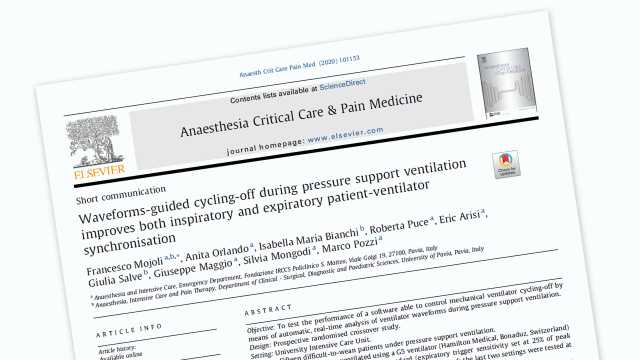
Waveforms-guided cycling-off during pressure support ventilation improves both inspiratory and expiratory patient-ventilator synchronisation.

Mojoli F, Orlando A, Bianchi IM, et al. Waveforms-guided cycling-off during pressure support ventilation improves both inspiratory and expiratory patient-ventilator synchronisation [published online ahead of print, 2022 Sep 6]. Anaesth Crit Care Pain Med. 2022;41(6):101153. doi:10.1016/j.accpm.2022.101153

OBJECTIVE To test the performance of a software able to control mechanical ventilator cycling-off by means of automatic, real-time analysis of ventilator waveforms during pressure support ventilation. DESIGN Prospective randomised crossover study. SETTING University Intensive Care Unit. PATIENTS Fifteen difficult-to-wean patients under pressure support ventilation. INTERVENTIONS Patients were ventilated using a G5 ventilator (Hamilton Medical, Bonaduz, Switzerland) with three different cycling-off settings: standard (expiratory trigger sensitivity set at 25% of peak inspiratory flow), optimised by an expert clinician and automated; the last two settings were tested at baseline pressure support and after a 50% increase in pressure support. MEASUREMENTS AND MAIN RESULTS Ventilator waveforms were recorded and analysed by four physicians experts in waveforms analysis. Major and minor asynchronies were detected and total asynchrony time computed. Automation compared to standard setting reduced cycling delay from 407 ms [257-567] to 59 ms [22-111] and ineffective efforts from 12.5% [3.4-46.4] to 2.8% [1.9-4.6]) at baseline support (p < 0.001); expert optimisation performed similarly. At high support both cycling delay and ineffective efforts increased, mainly in the case of expert setting, with the need of reoptimisation of expiratory trigger sensitivity. At baseline support, asynchrony time decreased from 39.9% [27.4-58.7] with standard setting to 32% [22.3-39.4] with expert optimisation (p < 0.01) and to 24.4% [19.6-32.5] with automation (p < 0.001). Both at baseline and at high support, asynchrony time was lower with automation than with expert setting. CONCLUSIONS Cycling-off guided by automated real-time waveforms analysis seems a reliable solution to improve synchronisation in difficult-to-wean patients under pressure support ventilation.