


Session expired

Due to inactivity your session has expired. Please login again.


Zu Vereinigte Staaten wechseln
 Technologien

ASV – Adaptive Support Ventilation®.

Unterstützt Sie und Ihre Patienten

"" ""

Mehr als nur ein Modus. Das ist ASV

ASV ist ein intelligenter Modus für die invasive Beatmung sowohl pädiatrischer als auch erwachsener Patienten. Mit einem Closed-Loop-Algorithmus passt er die Beatmungsparameter fortlaufend in Echtzeit an, um exakt die Unterstützung zu liefern, die der Patient gerade braucht. Nicht mehr und nicht weniger.

ASV setzt den Fokus auf Schnelligkeit und Sicherheit und kombiniert dabei evidenzbasierte Beatmung mit Echtzeit-Anpassungen. Wenn in hektischen Situationen jede Sekunde zählt, sorgt ASV für klinische Präzision und lässt Sie beruhigt arbeiten.

Die Vorteile von ASV in der präklinischen Versorgung

Vielseitig einsetzbar bei verschiedenen Patiententypen

Unterstützt erwachsene und pädiatrische Patienten im gesamten Spektrum zwischen Spontanatmung und vollständig unterstützter Atmung.

Höhere Patientensicherheit

Zu ASV gehören Sicherheitsmechanismen zur Vorbeugung von Zuständen wie Hyperventilation, Hypoventilation und Apnoe (Arnal JM, Wysocki M, Novotni D, et al. Safety and efficacy of a fully closed-loop control ventilation (IntelliVent-ASV®) in sedated ICU patients with acute respiratory failure: a prospective randomized crossover study. Intensive Care Med. 2012;38(5):781-787. doi:10.1007/s00134-012-2548-61​, Kirakli C, Naz I, Ediboglu O, Tatar D, Budak A, Tellioglu E. A randomized controlled trial comparing the ventilation duration between adaptive support ventilation and pressure assist/control ventilation in medical patients in the ICU. Chest. 2015;147(6):1503-1509. doi:10.1378/chest.14-25992​, Brunner JX, Iotti GA. Adaptive Support Ventilation (ASV). Minerva Anestesiol. 2002;68(5):365-368. 3​). 

Dies trägt auch zur Vorbeugung von Komplikationen wie Tachypnoe, AutoPEEP und übermässiger Totraumbeatmung bei (Sulemanji D, Marchese A, Garbarini P, Wysocki M, Kacmarek RM. Adaptive support ventilation: an appropriate mechanical ventilation strategy for acute respiratory distress syndrome?. Anesthesiology. 2009;111(4):863-870. doi:10.1097/ALN.0b013e3181b55f8f4​).

Reduziert die kognitive Belastung

Reduziert die Anzahl notwendiger Änderungen an den Einstellungen des Beatmungsgerätes, sodass Sie sich auf andere wichtige Aspekte der Patientenversorgung konzentrieren können (Kirakli C, Naz I, Ediboglu O, Tatar D, Budak A, Tellioglu E. A randomized controlled trial comparing the ventilation duration between adaptive support ventilation and pressure assist/control ventilation in medical patients in the ICU. Chest. 2015;147(6):1503-1509. doi:10.1378/chest.14-25992​, Moradian ST, Saeid Y, Ebadi A, Hemmat A, Ghiasi MS. Adaptive Support Ventilation Reduces the Incidence of Atelectasis in Patients Undergoing Coronary Artery Bypass Grafting: A Randomized Clinical Trial. Anesth Pain Med. 2017;7(3):e44619. Published 2017 Apr 22. doi:10.5812/aapm.446195​).

Fortlaufende Anpassung an Ihren Patienten

Wenn sich der Zustand eines Patienten verschlechtert, passt ASV das Mass der Unterstützung automatisch an:

Die Unterstützung wird erhöht, wenn der Patient kämpft, und reduziert, wenn er wieder effektiver selbstständig atmen kann.

""

Kinderleicht. Der ASV-Ablauf in 4 Schritten

  1. Einfache Einrichtung: Sie stellen Geschlecht und Grösse des Patienten sowie das gewünschte Minutenvolumen ein.
  2. Kontinuierliche Überwachung: ASV überwacht das Tidalvolumen, die Atemfrequenz, den Atemwegsdruck und weitere Parameter.
  3. Automatische Anpassung: ASV moduliert Druck und Frequenz der Inspiration, um die angestrebte Beatmung sicherzustellen.
  4. Adaptive Reaktion: ASV reduziert die Unterstützung, wenn die spontanen Atembemühungen stärker werden, oder fährt sie bei Bedarf hoch.
     
Kyle Driesse

Kundenstimmen

ASV ist bei Traumapatienten, bei denen so viele akute Verletzungen gleichzeitig zu behandeln sind, ein echter Vorteil. Es ist eine immense Entlastung, wenn man ASV die Beatmung anvertrauen kann. Die Einrichtung ist ziemlich einfach.

Kyle Driesse

Notfallsanitäter bei der Luftrettung
Life Link III, Minnesota, USA

Verfügbarkeit

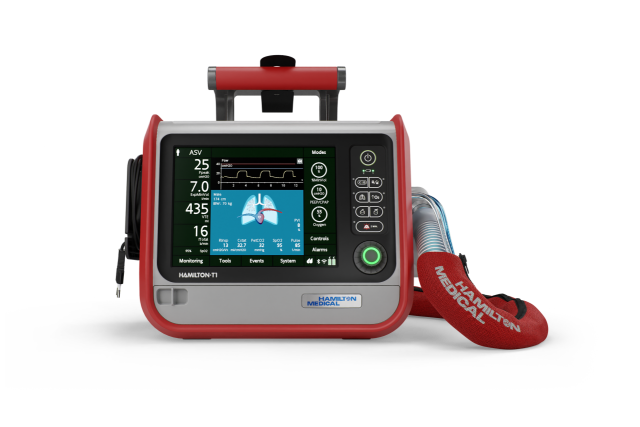
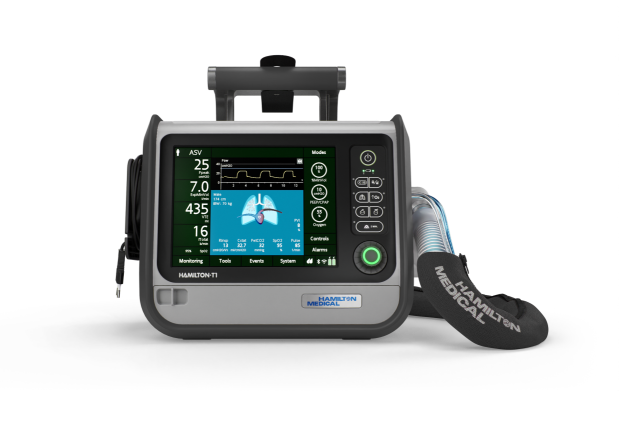
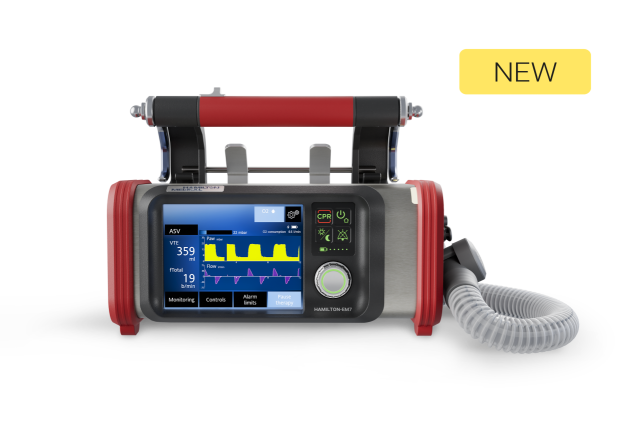
ASV ist als Standardmodus auf allen HAMILTON-T1- und HAMILTON-EM7-Geräten verfügbar.

Safety and efficacy of a fully closed-loop control ventilation (IntelliVent-ASV®) in sedated ICU patients with acute respiratory failure: a prospective randomized crossover study.

Arnal JM, Wysocki M, Novotni D, et al. Safety and efficacy of a fully closed-loop control ventilation (IntelliVent-ASV®) in sedated ICU patients with acute respiratory failure: a prospective randomized crossover study. Intensive Care Med. 2012;38(5):781-787. doi:10.1007/s00134-012-2548-6

PURPOSE IntelliVent-ASV(®) is a development of adaptive support ventilation (ASV) that automatically adjusts ventilation and oxygenation parameters. This study assessed the safety and efficacy of IntelliVent-ASV(®) in sedated intensive care unit (ICU) patients with acute respiratory failure. METHODS This prospective randomized crossover comparative study was conducted in a 12-bed ICU in a general hospital. Two periods of 2 h of ventilation in randomly applied ASV or IntelliVent-ASV(®) were compared in 50 sedated, passively ventilated patients. Tidal volume (V(T)), respiratory rate (RR), inspiratory pressure (P(INSP)), SpO(2) and E(T)CO(2) were continuously monitored and recorded breath by breath. Mean values over the 2-h period were calculated. Respiratory mechanics, plateau pressure (P(PLAT)) and blood gas exchanges were measured at the end of each period. RESULTS There was no safety issue requiring premature interruption of IntelliVent-ASV(®). Minute ventilation (MV) and V(T) decreased from 7.6 (6.5-9.5) to 6.8 (6.0-8.0) L/min (p < 0.001) and from 8.3 (7.8-9.0) to 8.1 (7.7-8.6) mL/kg PBW (p = 0.003) during IntelliVent-ASV(®) as compared to ASV. P(PLAT) and FiO(2) decreased from 24 (20-29) to 20 (19-25) cmH(2)O (p = 0.005) and from 40 (30-50) to 30 (30-39) % (p < 0.001) during IntelliVent-ASV(®) as compared to ASV. RR, P(INSP), and PEEP decreased as well during IntelliVent-ASV(®) as compared to ASV. Respiratory mechanics, pH, PaO(2) and PaO(2)/FiO(2) ratio were not different but PaCO(2) was slightly higher during IntelliVent-ASV(®) as compared to ASV. CONCLUSIONS In passive patients with acute respiratory failure, IntelliVent-ASV(®) was safe and able to ventilate patients with less pressure, volume and FiO(2) while producing the same results in terms of oxygenation.

A randomized controlled trial comparing the ventilation duration between adaptive support ventilation and pressure assist/control ventilation in medical patients in the ICU.

Kirakli C, Naz I, Ediboglu O, Tatar D, Budak A, Tellioglu E. A randomized controlled trial comparing the ventilation duration between adaptive support ventilation and pressure assist/control ventilation in medical patients in the ICU. Chest. 2015;147(6):1503-1509. doi:10.1378/chest.14-2599

BACKGROUND Adaptive support ventilation (ASV) is a closed loop mode of mechanical ventilation (MV) that provides a target minute ventilation by automatically adapting inspiratory pressure and respiratory rate with the minimum work of breathing on the part of the patient. The aim of this study was to determine the effect of ASV on total MV duration when compared with pressure assist/control ventilation. METHODS Adult medical patients intubated and mechanically ventilated for > 24 h in a medical ICU were randomized to either ASV or pressure assist/control ventilation. Sedation and medical treatment were standardized for each group. Primary outcome was the total MV duration. Secondary outcomes were the weaning duration, number of manual settings of the ventilator, and weaning success rates. RESULTS Two hundred twenty-nine patients were included. Median MV duration until weaning, weaning duration, and total MV duration were significantly shorter in the ASV group (67 [43-94] h vs 92 [61-165] h, P = .003; 2 [2-2] h vs 2 [2-80] h, P = .001; and 4 [2-6] days vs 4 [3-9] days, P = .016, respectively). Patients in the ASV group required fewer total number of manual settings on the ventilator to reach the desired pH and Paco2 levels (2 [1-2] vs 3 [2-5], P < .001). The number of patients extubated successfully on the first attempt was significantly higher in the ASV group (P = .001). Weaning success and mortality at day 28 were comparable between the two groups. CONCLUSIONS In medical patients in the ICU, ASV may shorten the duration of weaning and total MV duration with a fewer number of manual ventilator settings. TRIAL REGISTRY ClinicalTrials.gov; No.: NCT01472302; URL: www.clinicaltrials.gov.

Adaptive Support Ventilation Reduces the Incidence of Atelectasis in Patients Undergoing Coronary Artery Bypass Grafting: A Randomized Clinical Trial.

Moradian ST, Saeid Y, Ebadi A, Hemmat A, Ghiasi MS. Adaptive Support Ventilation Reduces the Incidence of Atelectasis in Patients Undergoing Coronary Artery Bypass Grafting: A Randomized Clinical Trial. Anesth Pain Med. 2017;7(3):e44619. Published 2017 Apr 22. doi:10.5812/aapm.44619

BACKGROUND Pulmonary complications are common following cardiac surgery and can lead to increased morbidity, mortality, and healthcare costs. Atelectasis is the most common respiratory complication following cardiac surgery. One of the most important methods for reducing pulmonary complications is supportive care with protective ventilation strategies. In this study, we aimed to assess the effect of adaptive support ventilation (ASV) on atelectasis in patients undergoing cardiac surgery. METHODS In this single-blind randomized clinical trial, 115 patients, undergoing coronary artery bypass grafting, were randomly allocated into 2 groups: 57 patients in the intervention and 58 patients in the control group. Patients in the intervention group were weaned with ASV, while patients in the control group were managed using synchronized intermittent mandatory ventilation (SIMV) and pressure support. The incidence of atelectasis, duration of mechanical ventilation, manual ventilator setting, arterial blood gas measurements, and length of hospital stay were compared between the groups. RESULTS The incidence of atelectasis, number of changes in the manual ventilator setting, number of alarms, and length of hospital stay reduced in the intervention group. However, duration of mechanical ventilation and number of ABG measurements were not significantly different between the groups. CONCLUSIONS The ASV mode could reduce the incidence of atelectasis and length of hospital stay. However, it did not reduce the duration of mechanical ventilation. It seems that ASV is not a superior mode for faster extubation.