


Session expired

Due to inactivity your session has expired. Please login again.

 Tecnologías

INTELLiVENT®-ASV®.

Su asistente sobre el terreno

"" ""

Ventilación inteligente durante los traslados. Así es INTELLiVENT-ASV

El control de la ventilación durante los traslados es una tarea muy exigente. El estado de los pacientes puede empeorar rápidamente y cualquier ajuste requiere un tiempo muy valioso. INTELLiVENT-ASV asiste a los pacientes adultos y pediátricos intubados mediante el control automático de la ventilación y la oxigenación teniendo en cuenta las mediciones de SpO2 y etCO2 en tiempo real.

Las ventajas de INTELLiVENT-ASV para la atención prehospitalaria

Adapta los ajustes automáticamente

INTELLiVENT-ASV ajusta constantemente el volumen tidal, la presión inspiratoria, la PEEP y el oxígeno, y cambia entre ventilación controlada y asistida a partir de los datos fisiológicos que se evalúan con cada respiración (Bialais E, Wittebole X, Vignaux L, et al. Closed-loop ventilation mode (IntelliVent®-ASV) in intensive care unit: a randomized trial. Minerva Anestesiol. 2016;82(6):657-668. 1, Fot EV, Izotova NN, Yudina AS, Smetkin AA, Kuzkov VV, Kirov MY. Automated Weaning from Mechanical Ventilation after Off-Pump Coronary Artery Bypass Grafting. Front Med (Lausanne). 2017;4:31. Published 2017 Mar 21. doi:10.3389/fmed.2017.000312, Arnal JM, Saoli M, Garnero A. Airway and transpulmonary driving pressures and mechanical powers selected by INTELLiVENT-ASV in passive, mechanically ventilated ICU patients. Heart Lung. 2020;49(4):427-434. doi:10.1016/j.hrtlng.2019.11.0013).

Ahorra tiempo y reduce la carga de trabajo

INTELLiVENT‑ASV requiere menos ajustes manuales que la ventilación convencional, por lo que reduce la carga de trabajo para que pueda centrarse en el paciente (Bialais E, Wittebole X, Vignaux L, et al. Closed-loop ventilation mode (IntelliVent®-ASV) in intensive care unit: a randomized trial. Minerva Anestesiol. 2016;82(6):657-668. 1, Fot EV, Izotova NN, Yudina AS, Smetkin AA, Kuzkov VV, Kirov MY. Automated Weaning from Mechanical Ventilation after Off-Pump Coronary Artery Bypass Grafting. Front Med (Lausanne). 2017;4:31. Published 2017 Mar 21. doi:10.3389/fmed.2017.000312, Beijers AJ, Roos AN, Bindels AJ. Fully automated closed-loop ventilation is safe and effective in post-cardiac surgery patients. Intensive Care Med. 2014;40(5):752-753. doi:10.1007/s00134-014-3234-74).

Mejora la seguridad del paciente

Mantiene la ventilación con protección pulmonar, lo que reduce el riesgo de hiperoxia o de hipoventilación e hiperventilación (Bialais E, Wittebole X, Vignaux L, et al. Closed-loop ventilation mode (IntelliVent®-ASV) in intensive care unit: a randomized trial. Minerva Anestesiol. 2016;82(6):657-668. 1, Fot EV, Izotova NN, Yudina AS, Smetkin AA, Kuzkov VV, Kirov MY. Automated Weaning from Mechanical Ventilation after Off-Pump Coronary Artery Bypass Grafting. Front Med (Lausanne). 2017;4:31. Published 2017 Mar 21. doi:10.3389/fmed.2017.000312, Arnal JM, Saoli M, Garnero A. Airway and transpulmonary driving pressures and mechanical powers selected by INTELLiVENT-ASV in passive, mechanically ventilated ICU patients. Heart Lung. 2020;49(4):427-434. doi:10.1016/j.hrtlng.2019.11.0013).

Simplifica la complejidad

Es especialmente útil durante traslados de pacientes críticos y para usuarios con distintos niveles de experiencia.

""

Así de sencillo. El flujo de trabajo de INTELLiVENT-ASV en 4 pasos

  1. Defina los parámetros básicos: introduzca el sexo, la altura y la afección del paciente, si procede (p. ej., SDRA, lesión cerebral o hipercapnia).
  2. Defina los valores objetivo: seleccione los intervalos de oxigenación (SpO2) y ventilación (etCO2) para el paciente.
  3. Inicie la ventilación: INTELLiVENT-ASV ajusta automáticamente el volumen tidal, la frecuencia respiratoria y la PEEP para alcanzar estos valores objetivo y adapta de forma continua los ajustes con cada respiración teniendo en cuenta los niveles de SpO2 y etCO2, y la mecánica pulmonar.
  4. Defina estos ajustes con precisión si es necesario: puede configurar cualquiera de los tres controladores en el modo manual, en el caso de que prefiera gestionar usted mismo estos parámetros (VolMin, Oxígeno o PEEP).
Dr. João Alves

Testimonios de clientes

Desde el punto de vista de los cuidados clínicos, INTELLIVENT-ASV nos permite realizar el trabajo que no se ve en un paciente mientras atendemos otras obligaciones más críticas relacionadas con la toma de decisiones.

Dr. João Alves

Intensivista, medicina interna y servicio de urgencias desde 2018
Hospital Central Universitario de Lisboa, Lisboa, Portugal

Disponibilidad

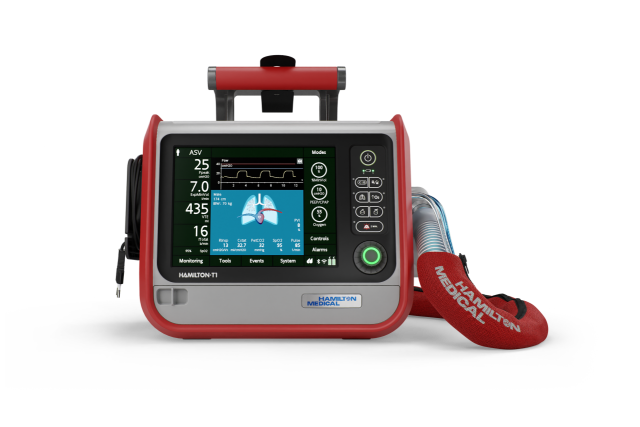
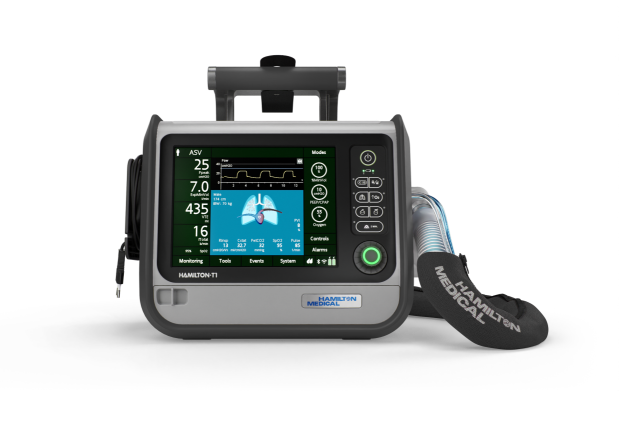
INTELLiVENT-ASV está disponible como modo estándar en todos los dispositivos HAMILTON-T1.

Closed-loop ventilation mode (IntelliVent®-ASV) in intensive care unit: a randomized trial.

Bialais E, Wittebole X, Vignaux L, et al. Closed-loop ventilation mode (IntelliVent®-ASV) in intensive care unit: a randomized trial. Minerva Anestesiol. 2016;82(6):657-668.

BACKGROUND Closed-loop modes automatically adjust ventilation settings, delivering individualized ventilation over short periods of time. The objective of this randomized controlled trial was to compare safety, efficacy and workload for the health care team between IntelliVent®-ASV and conventional modes over a 48-hour period. METHODS ICU patients admitted with an expected duration of mechanical ventilation of more than 48 hours were randomized to IntelliVent®-ASV or conventional ventilation modes. All ventilation parameters were recorded breath-by-breath. The number of manual adjustments assesses workload for the healthcare team. Safety and efficacy were assessed by calculating the time spent within previously defined ranges of non-optimal and optimal ventilation, respectively. RESULTS Eighty patients were analyzed. The median values of ventilation parameters over 48 hours were similar in both groups except for PEEP (7[4] cmH2O versus 6[3] cmH2O with IntelliVent®-ASV and conventional ventilation, respectively, P=0.028) and PETCO2 (36±7 mmHg with IntelliVent®-ASV versus 40±8 mmHg with conventional ventilation, P=0.041). Safety was similar between IntelliVent®-ASV and conventional ventilation for all parameters except for PMAX, which was more often non-optimal with IntelliVent®-ASV (P=0.001). Efficacy was comparable between the 2 ventilation strategies, except for SpO2 and VT, which were more often optimal with IntelliVent®-ASV (P=0.005, P=0.016, respectively). IntelliVent®-ASV required less manual adjustments than conventional ventilation (P<0.001) for a higher total number of adjustments (P<0.001). The coefficient of variation over 48 hours was larger with IntelliVent®-ASV in regard of maximum pressure, inspiratory pressure (PINSP), and PEEP as compared to conventional ventilation. CONCLUSIONS IntelliVent®-ASV required less manual intervention and delivered more variable PEEP and PINSP, while delivering ventilation safe and effective ventilation in terms of VT, RR, SpO2 and PETCO2.

Automated Weaning from Mechanical Ventilation after Off-Pump Coronary Artery Bypass Grafting.

Fot EV, Izotova NN, Yudina AS, Smetkin AA, Kuzkov VV, Kirov MY. Automated Weaning from Mechanical Ventilation after Off-Pump Coronary Artery Bypass Grafting. Front Med (Lausanne). 2017;4:31. Published 2017 Mar 21. doi:10.3389/fmed.2017.00031

BACKGROUND The discontinuation of mechanical ventilation after coronary surgery may prolong and significantly increase the load on intensive care unit personnel. We hypothesized that automated mode using INTELLiVENT-ASV can decrease duration of postoperative mechanical ventilation, reduce workload on medical staff, and provide safe ventilation after off-pump coronary artery bypass grafting (OPCAB). The primary endpoint of our study was to assess the duration of postoperative mechanical ventilation during different modes of weaning from respiratory support (RS) after OPCAB. The secondary endpoint was to assess safety of the automated weaning mode and the number of manual interventions to the ventilator settings during the weaning process in comparison with the protocolized weaning mode. MATERIALS AND METHODS Forty adult patients undergoing elective OPCAB were enrolled into a prospective single-center study. Patients were randomized into two groups: automated weaning (n = 20) using INTELLiVENT-ASV mode with quick-wean option; and protocolized weaning (n = 20), using conventional synchronized intermittent mandatory ventilation (SIMV) + pressure support (PS) mode. We assessed the duration of postoperative ventilation, incidence and duration of unacceptable RS, and the load on medical staff. We also performed the retrospective analysis of 102 patients (standard weaning) who were weaned from ventilator with SIMV + PS mode based on physician's experience without prearranged algorithm. RESULTS AND DISCUSSION Realization of the automated weaning protocol required change in respiratory settings in 2 patients vs. 7 (5-9) adjustments per patient in the protocolized weaning group. Both incidence and duration of unacceptable RS were reduced significantly by means of the automated weaning approach. The FiO2 during spontaneous breathing trials was significantly lower in the automated weaning group: 30 (30-35) vs. 40 (40-45) % in the protocolized weaning group (p < 0.01). The average time until tracheal extubation did not differ in the automated weaning and the protocolized weaning groups: 193 (115-309) and 197 (158-253) min, respectively, but increased to 290 (210-411) min in the standard weaning group. CONCLUSION The automated weaning system after off-pump coronary surgery might provide postoperative ventilation in a more protective way, reduces the workload on medical staff, and does not prolong the duration of weaning from ventilator. The use of automated or protocolized weaning can reduce the duration of postoperative mechanical ventilation in comparison with non-protocolized weaning based on the physician's decision.

Airway and transpulmonary driving pressures and mechanical powers selected by INTELLiVENT-ASV in passive, mechanically ventilated ICU patients.

Arnal JM, Saoli M, Garnero A. Airway and transpulmonary driving pressures and mechanical powers selected by INTELLiVENT-ASV in passive, mechanically ventilated ICU patients. Heart Lung. 2020;49(4):427-434. doi:10.1016/j.hrtlng.2019.11.001

BACKGROUND Driving pressure (ΔP) and mechanical power (MP) are predictors of the risk of ventilation- induced lung injuries (VILI) in mechanically ventilated patients. INTELLiVENT-ASV® is a closed-loop ventilation mode that automatically adjusts respiratory rate and tidal volume, according to the patient's respiratory mechanics. OBJECTIVES This prospective observational study investigated ΔP and MP (and also transpulmonary ΔP (ΔPL) and MP (MPL) for a subgroup of patients) delivered by INTELLiVENT-ASV. METHODS Adult patients admitted to the ICU were included if they were sedated and met the criteria for a single lung condition (normal lungs, COPD, or ARDS). INTELLiVENT-ASV was used with default target settings. If PEEP was above 16 cmH2O, the recruitment strategy used transpulmonary pressure as a reference, and ΔPL and MPL were computed. Measurements were made once for each patient. RESULTS Of the 255 patients included, 98 patients were classified as normal-lungs, 28 as COPD, and 129 as ARDS patients. The median ΔP was 8 (7 - 10), 10 (8 - 12), and 9 (8 - 11) cmH2O for normal-lungs, COPD, and ARDS patients, respectively. The median MP was 9.1 (4.9 - 13.5), 11.8 (8.6 - 16.5), and 8.8 (5.6 - 13.8) J/min for normal-lungs, COPD, and ARDS patients, respectively. For the 19 patients managed with transpulmonary pressure ΔPL was 6 (4 - 7) cmH2O and MPL was 3.6 (3.1 - 4.4) J/min. CONCLUSIONS In this short term observation study, INTELLiVENT-ASV selected ΔP and MP considered in safe ranges for lung protection. In a subgroup of ARDS patients, the combination of a recruitment strategy and INTELLiVENT-ASV resulted in an apparently safe ΔPL and MPL.

Fully automated closed-loop ventilation is safe and effective in post-cardiac surgery patients.

Beijers AJ, Roos AN, Bindels AJ. Fully automated closed-loop ventilation is safe and effective in post-cardiac surgery patients. Intensive Care Med. 2014;40(5):752-753. doi:10.1007/s00134-014-3234-7