

Back

メカニカルパワーと人工呼吸器誘発肺傷害

Article

Author: Jean-Pierre Revelly、Giorgio Iotti

Date of first publication: 03.04.2023

この記事では、メカニカルパワーを構成する要素、臨床状況におけるその関連性、およびモニタリングパラメータとしてのメカニカルパワーの使い方について詳しく見ていきます。

メカニカルパワーと人工呼吸器誘発肺傷害

この議論の範囲はコントロール換気の吸気フェーズ中のメカニカルパワー(MP)に限定されており、患者の呼吸努力はないと仮定しています。

物理学では、 

  • 機械的仕事とは、ある位置から別の位置への移動に沿って力をかけることで物体に(または物体から)伝達されるエネルギーを意味します。
  • パワーとは、単位時間あたりに伝達されるエネルギーの量のことです。

人工呼吸では、吸気中に人工呼吸器から呼吸器系に伝達されるパワーは、人工呼吸器誘発肺傷害(VILI)を引き起こす可能性のある要素を組み合わせた統合変数です(Gattinoni L, Tonetti T, Cressoni M, et al. Ventilator-related causes of lung injury: the mechanical power. Intensive Care Med. 2016;42(10):1567-1575. doi:10.1007/s00134-016-4505-21)。

CMV中のメカニカルパワー

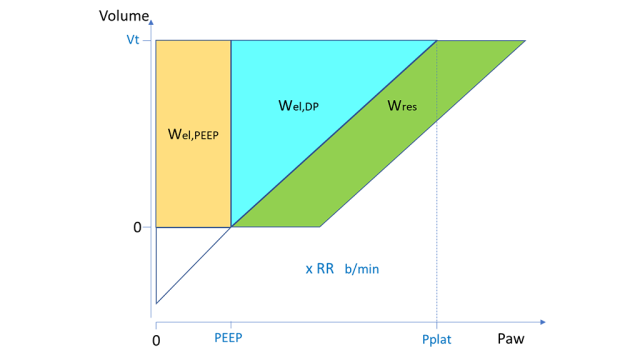
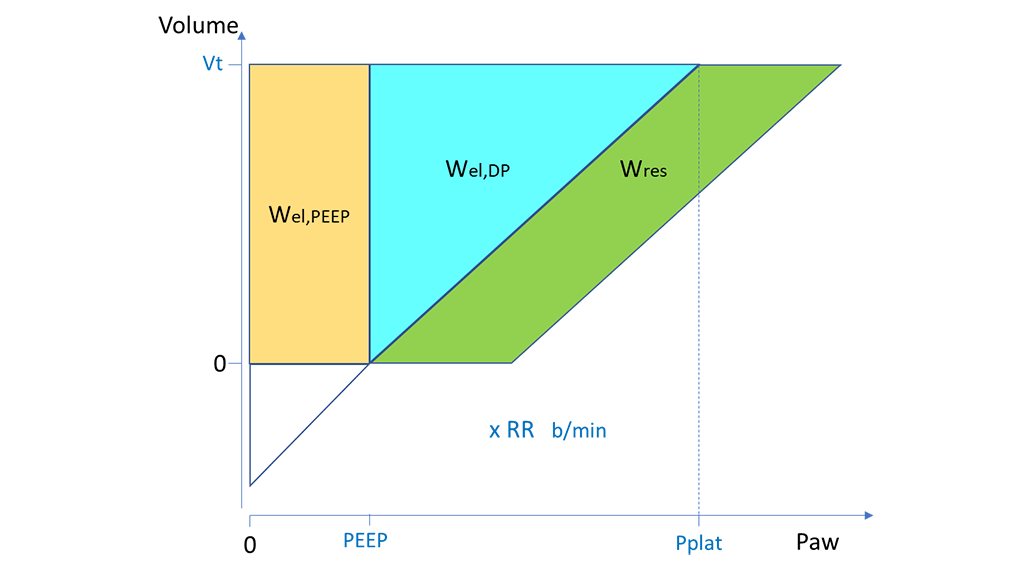
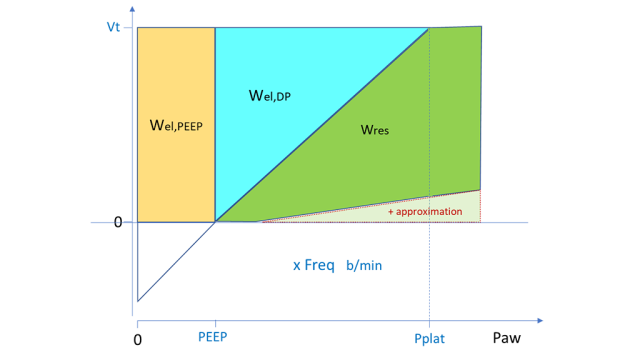
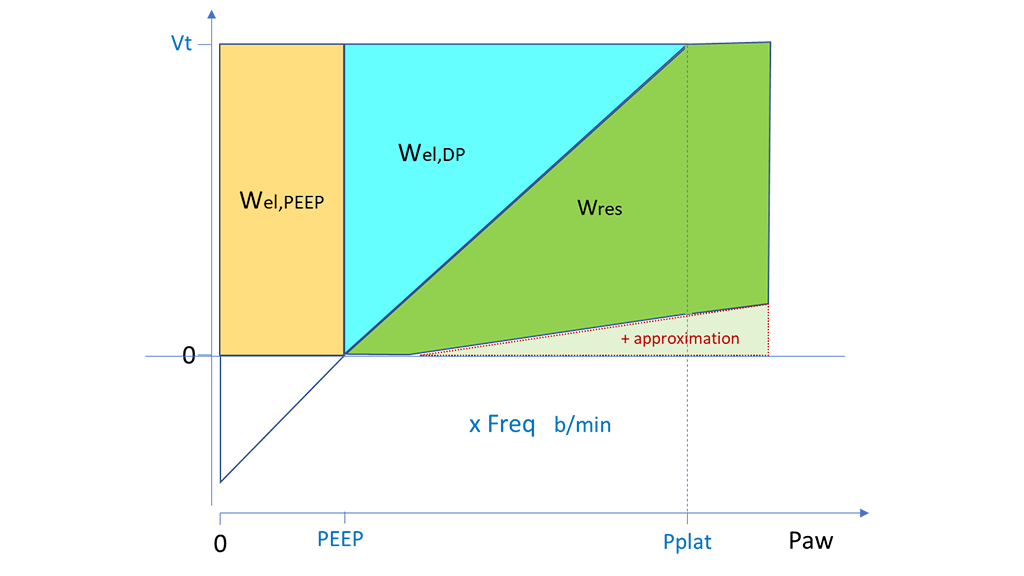
一定流量の適応調節強制換気(CMV)において、MPは呼吸あたりの仕事量(W)×呼吸回数(RR)で表すことができます(図1)(Costa ELV, Slutsky AS, Brochard LJ, et al. Ventilatory Variables and Mechanical Power in Patients with Acute Respiratory Distress Syndrome. Am J Respir Crit Care Med. 2021;204(3):303-311. doi:10.1164/rccm.202009-3467OC2)。

ここで、

  • Wel,PEEPは弾性静的要素、すなわちPEEPに関連するMPの要素を表します。 
  • Wel,DPは(周期的な)弾性動的要素、すなわち周期的な拡張に関連するMPの要素を表します。これは直角三角形の形をしており、縦の辺は一回換気量(Vt)、横の辺はドライビングプレッシャー(DP)にそれぞれ対応します。斜辺の傾きはコンプライアンスに対応します。 
  • Wresは抵抗要素、すなわち呼吸器系の抵抗性と粘性に打ち勝つために各吸気中に消散されるエネルギーです。Wresは、底辺がピーク圧(Ppeak)とプラトー圧(Pplat)の差、高さがVtにそれぞれ対応する平行四辺形で表されます。
メカニカルパワーの3つの要素を示す図
図1:メカニカルパワーの各要素を表すプレッシャーボリューム図(説明は本文を参照)
メカニカルパワーの3つの要素を示す図
図1:メカニカルパワーの各要素を表すプレッシャーボリューム図(説明は本文を参照)

PCV中のメカニカルパワー

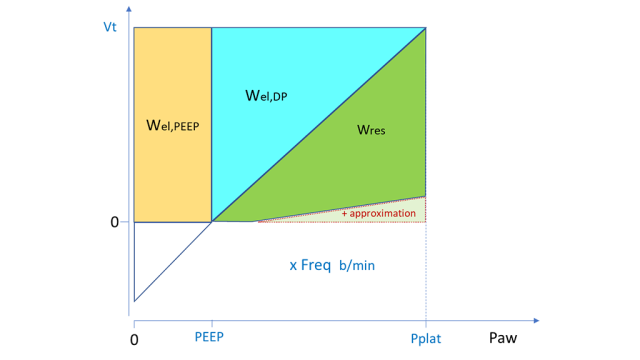
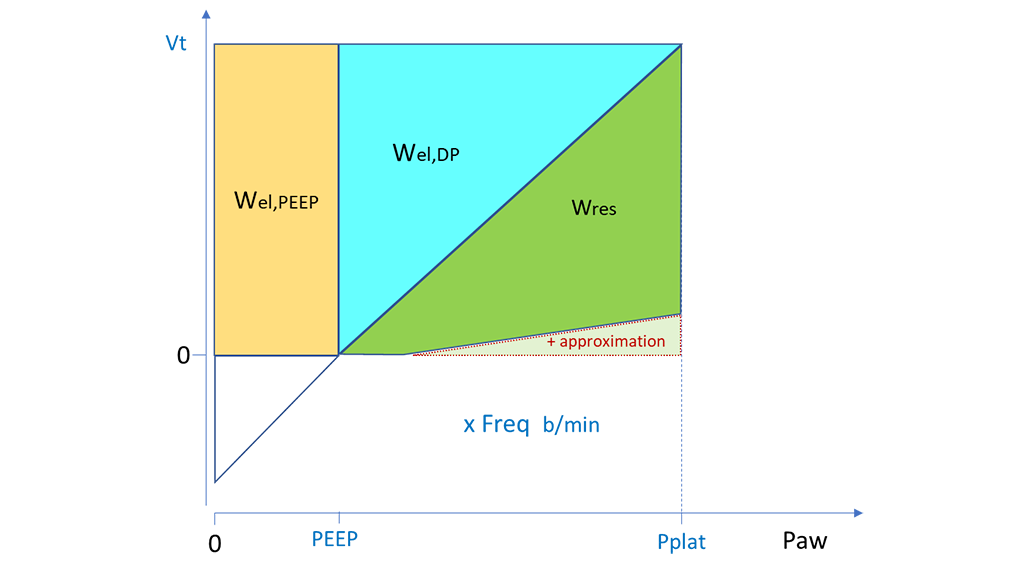
プレッシャーコントロール換気(PCV)では、Vt、PEEP、DPからのWel,PEEPとWel,DPの計算については同様のアプローチをとることができます。Wresについては、Ppeak - PEEPを底辺、Vtを高さとする四角形の面積を計算し、そこからWel,DPに対応する三角形を減算することで、概算できます。このWresの計算は、PpeakがPplatと等しい場合(図2)またはPplatより高い場合(図3)に同じように適用できます。前者は吸気終末流量がゼロである場合、後者は正である場合をそれぞれ示します。この計算方法は概算なので、どちらの場合もWres(したがって、人工呼吸器の真の総仕事量)は若干過大評価されます(Becher T, van der Staay M, Schädler D, Frerichs I, Weiler N. Calculation of mechanical power for pressure-controlled ventilation. Intensive Care Med. 2019;45(9):1321-1323. doi:10.1007/s00134-019-05636-83)。

PpeakがPplatと等しい場合の概算を示す図
図2:PCVにおいてPpeakがPplatと等しい場合のWresの概算
PpeakがPplatと等しい場合の概算を示す図
図2:PCVにおいてPpeakがPplatと等しい場合のWresの概算
PpeakがPplatより高い場合の概算を示す図
図3: PCVにおいてPpeakがPplatより高い場合のWresの概算
PpeakがPplatより高い場合の概算を示す図
図3: PCVにおいてPpeakがPplatより高い場合のWresの概算

メカニカルパワーは臨床的に意味があるか

これまでかなりの数の研究者が、ARDSを持つICU患者(Costa ELV, Slutsky AS, Brochard LJ, et al. Ventilatory Variables and Mechanical Power in Patients with Acute Respiratory Distress Syndrome. Am J Respir Crit Care Med. 2021;204(3):303-311. doi:10.1164/rccm.202009-3467OC2Tonna JE, Peltan I, Brown SM, Herrick JS, Keenan HT; University of Utah Mechanical Power Study Group. Mechanical power and driving pressure as predictors of mortality among patients with ARDS. Intensive Care Med. 2020;46(10):1941-1943. doi:10.1007/s00134-020-06130-24Robba C, Badenes R, Battaglini D, et al. Ventilatory settings in the initial 72 h and their association with outcome in out-of-hospital cardiac arrest patients: a preplanned secondary analysis of the targeted hypothermia versus targeted normothermia after out-of-hospital cardiac arrest (TTM2) trial. Intensive Care Med. 2022;48(8):1024-1038. doi:10.1007/s00134-022-06756-45)またはARDSを持たないICU患者(Serpa Neto A, Deliberato RO, Johnson AEW, et al. Mechanical power of ventilation is associated with mortality in critically ill patients: an analysis of patients in two observational cohorts. Intensive Care Med. 2018;44(11):1914-1922. doi:10.1007/s00134-018-5375-66Robba C, Badenes R, Battaglini D, et al. Ventilatory settings in the initial 72 h and their association with outcome in out-of-hospital cardiac arrest patients: a preplanned secondary analysis of the targeted hypothermia versus targeted normothermia after out-of-hospital cardiac arrest (TTM2) trial. Intensive Care Med. 2022;48(8):1024-1038. doi:10.1007/s00134-022-06756-47、 van Meenen DMP, Algera AG, Schuijt MTU, et al. Effect of mechanical power on mortality in invasively ventilated ICU patients without the acute respiratory distress syndrome: An analysis of three randomised clinical trials. Eur J Anaesthesiol. 2023;40(1):21-28. doi:10.1097/EJA.00000000000017788)の換気試験のデータからMPを計算してきました。 
これらの分析の結果は次のとおりでした。 

  • 非生存者が受けたMPは生存者より有意に大きかった
  • MPの増加は、ICUおよび院内死亡率、人工呼吸器離脱日数の減少、ICU滞在期間および入院期間の増加と統計的に相関関係があった 

全体的に見て、これらの後ろ向き研究は、臨床転帰不良がVILIにある程度関連していると仮定した場合、過度のMPは避けるべきであることを示唆しています。

すべての患者にとって安全なMP値は存在するか

MPの計算方法を適切に解釈するため、公表された研究でMPがどのように計算されているかを慎重に読む必要があります。MPのどの要素が含まれている、または除外されているかは、使用可能なデータによって異なる場合があります。また、異なる患者を比較する最適な手順についても議論が続いています。患者の体格(予想体重)、コンプライアンス、または呼気終末肺容量について正規化することが提案されています。 

ただし、一般的に言えば、MP計算の標準化されたアプローチはまだ確立されておらず、推定MPに対する広く受け入れられた安全値もありません。

メカニカルパワーは継続的なモニタリングの対象として使える状況にあるか

人工呼吸器の設定の個別の変更は、換気メカニクスの他の変数に複雑な影響を与えます。MPの概念は、「すべての換気変数がVILIに対して直線的な関係を持ち、VILIに同じように寄与する」という暗黙の前提に基づいています。しかし、これは明らかに事実とは異なります。たとえば、PEEPはVILIに対して曲線的な(J字型の)関係を持ちます(Costa ELV, Slutsky AS, Brochard LJ, et al. Ventilatory Variables and Mechanical Power in Patients with Acute Respiratory Distress Syndrome. Am J Respir Crit Care Med. 2021;204(3):303-311. doi:10.1164/rccm.202009-3467OC2)。吸気中にはおそらく、安全なボリューム、閾値、および到達してはならない危険ゾーンが存在します(Marini JJ, Rocco PRM. Which component of mechanical power is most important in causing VILI?. Crit Care. 2020;24(1):39. Published 2020 Feb 5. doi:10.1186/s13054-020-2747-49)。吸気フローパターンはMPでは考慮されていませんが、このパターンがVILIにおいて重要な役割を果たす場合があります(Marini JJ, Crooke PS, Gattinoni L. Intra-cycle power: is the flow profile a neglected component of lung protection?. Intensive Care Med. 2021;47(5):609-611. doi:10.1007/s00134-021-06375-510)。 

一連の未解決の問題が残ってはいるものの、総MPとその要素をモニタリングすることは、個々の患者の漸進的変化や換気設定の変更に対する反応を評価するうえで有用である可能性があります。MPは、他のいくつかの項目とともに、臨床判断や意思決定を行う際の新たな検討材料になる可能性があります。さらに、MPのモニタリングは、MPとVILIの関係について調べる前向き研究で質の高いデータを収集するために大いに役立ちます。 

換気設定によってVILIのリスクを軽減するにはどうすればよいか

これまでさまざまな研究者が、換気の最も有害な要素を特定しようと試みてきました。管理下試験に登録された4500例のARDS患者の換気データを集計したある後ろ向き研究で、MP、Vt、RR、DPの28日死亡率に対する関係が多変数モデルを使用して評価されました(Costa ELV, Slutsky AS, Brochard LJ, et al. Ventilatory Variables and Mechanical Power in Patients with Acute Respiratory Distress Syndrome. Am J Respir Crit Care Med. 2021;204(3):303-311. doi:10.1164/rccm.202009-3467OC2)。DPは、コンプライアンスについて正規化されたVtを表し、多くの研究者がVILIの主要な要素とみなしています(Amato MB, Meade MO, Slutsky AS, et al. Driving pressure and survival in the acute respiratory distress syndrome. N Engl J Med. 2015;372(8):747-755. doi:10.1056/NEJMsa141063911)。

この後ろ向き研究では、予想どおり、全体的MPが死亡率と相関していました。MPの各要素については、弾性動的要素(MPel,DP、すなわちWel,DPに依存するMP)だけが統計的有意性を示し、PEEPまたは抵抗に依存する要素は統計的に有意ではありませんでした。MPel,DPはとりわけ、CMVとPCVのどちらにおいても、ベッドサイドで計算しやすいという特徴があります。

  • MPel,DP = Vt x DP x RR / 2

さらに、DPとRRから計算される次の指標にも、死亡率について同等の予測性がありました。

  • 4DP+RR指標 = (4 x DP) + RR

著者らは、「メカニカルパワーはARDS患者の死亡率と関連性があったが、PとRRも同様に有益であり、ベッドサイドで評価しやすい。これらの変数に基づく換気戦略によって転帰が改善されるかどうかを無作為化対照試験で調べる必要がある」と結論付けています(Costa ELV, Slutsky AS, Brochard LJ, et al. Ventilatory Variables and Mechanical Power in Patients with Acute Respiratory Distress Syndrome. Am J Respir Crit Care Med. 2021;204(3):303-311. doi:10.1164/rccm.202009-3467OC2)。

Footnotes

References

  1. 1. Gattinoni L, Tonetti T, Cressoni M, et al. Ventilator-related causes of lung injury: the mechanical power. Intensive Care Med. 2016;42(10):1567-1575. doi:10.1007/s00134-016-4505-2
  2. 2. Costa ELV, Slutsky AS, Brochard LJ, et al. Ventilatory Variables and Mechanical Power in Patients with Acute Respiratory Distress Syndrome. Am J Respir Crit Care Med. 2021;204(3):303-311. doi:10.1164/rccm.202009-3467OC
  3. 3. Becher T, van der Staay M, Schädler D, Frerichs I, Weiler N. Calculation of mechanical power for pressure-controlled ventilation. Intensive Care Med. 2019;45(9):1321-1323. doi:10.1007/s00134-019-05636-8
  4. 4. Tonna JE, Peltan I, Brown SM, Herrick JS, Keenan HT; University of Utah Mechanical Power Study Group. Mechanical power and driving pressure as predictors of mortality among patients with ARDS. Intensive Care Med. 2020;46(10):1941-1943. doi:10.1007/s00134-020-06130-2
  5. 5. Coppola S, Caccioppola A, Froio S, et al. Effect of mechanical power on intensive care mortality in ARDS patients. Crit Care. 2020;24(1):246. Published 2020 May 24. doi:10.1186/s13054-020-02963-x
  6. 6. Serpa Neto A, Deliberato RO, Johnson AEW, et al. Mechanical power of ventilation is associated with mortality in critically ill patients: an analysis of patients in two observational cohorts. Intensive Care Med. 2018;44(11):1914-1922. doi:10.1007/s00134-018-5375-6
  7. 7. Robba C, Badenes R, Battaglini D, et al. Ventilatory settings in the initial 72 h and their association with outcome in out-of-hospital cardiac arrest patients: a preplanned secondary analysis of the targeted hypothermia versus targeted normothermia after out-of-hospital cardiac arrest (TTM2) trial. Intensive Care Med. 2022;48(8):1024-1038. doi:10.1007/s00134-022-06756-4
  8. 8. van Meenen DMP, Algera AG, Schuijt MTU, et al. Effect of mechanical power on mortality in invasively ventilated ICU patients without the acute respiratory distress syndrome: An analysis of three randomised clinical trials. Eur J Anaesthesiol. 2023;40(1):21-28. doi:10.1097/EJA.0000000000001778
  9. 9. Marini JJ, Rocco PRM. Which component of mechanical power is most important in causing VILI?. Crit Care. 2020;24(1):39. Published 2020 Feb 5. doi:10.1186/s13054-020-2747-4
  10. 10. Marini JJ, Crooke PS, Gattinoni L. Intra-cycle power: is the flow profile a neglected component of lung protection?. Intensive Care Med. 2021;47(5):609-611. doi:10.1007/s00134-021-06375-5
  11. 11. Amato MB, Meade MO, Slutsky AS, et al. Driving pressure and survival in the acute respiratory distress syndrome. N Engl J Med. 2015;372(8):747-755. doi:10.1056/NEJMsa1410639

Ventilator-related causes of lung injury: the mechanical power.

Gattinoni L, Tonetti T, Cressoni M, et al. Ventilator-related causes of lung injury: the mechanical power. Intensive Care Med. 2016;42(10):1567-1575. doi:10.1007/s00134-016-4505-2

PURPOSE We hypothesized that the ventilator-related causes of lung injury may be unified in a single variable: the mechanical power. We assessed whether the mechanical power measured by the pressure-volume loops can be computed from its components: tidal volume (TV)/driving pressure (∆P aw), flow, positive end-expiratory pressure (PEEP), and respiratory rate (RR). If so, the relative contributions of each variable to the mechanical power can be estimated. METHODS We computed the mechanical power by multiplying each component of the equation of motion by the variation of volume and RR: [Formula: see text]where ∆V is the tidal volume, ELrs is the elastance of the respiratory system, I:E is the inspiratory-to-expiratory time ratio, and R aw is the airway resistance. In 30 patients with normal lungs and in 50 ARDS patients, mechanical power was computed via the power equation and measured from the dynamic pressure-volume curve at 5 and 15 cmH2O PEEP and 6, 8, 10, and 12 ml/kg TV. We then computed the effects of the individual component variables on the mechanical power. RESULTS Computed and measured mechanical powers were similar at 5 and 15 cmH2O PEEP both in normal subjects and in ARDS patients (slopes = 0.96, 1.06, 1.01, 1.12 respectively, R (2) > 0.96 and p < 0.0001 for all). The mechanical power increases exponentially with TV, ∆P aw, and flow (exponent = 2) as well as with RR (exponent = 1.4) and linearly with PEEP. CONCLUSIONS The mechanical power equation may help estimate the contribution of the different ventilator-related causes of lung injury and of their variations. The equation can be easily implemented in every ventilator's software.

Ventilatory Variables and Mechanical Power in Patients with Acute Respiratory Distress Syndrome.

Costa ELV, Slutsky AS, Brochard LJ, et al. Ventilatory Variables and Mechanical Power in Patients with Acute Respiratory Distress Syndrome. Am J Respir Crit Care Med. 2021;204(3):303-311. doi:10.1164/rccm.202009-3467OC

Rationale: Mortality in acute respiratory distress syndrome (ARDS) has decreased after the adoption of lung-protective strategies. Lower Vt, lower driving pressure (ΔP), lower respiratory rates (RR), and higher end-expiratory pressure have all been suggested as key components of lung protection strategies. A unifying theoretical explanation has been proposed that attributes lung injury to the energy transfer rate (mechanical power) from the ventilator to the patient, calculated from a combination of several ventilator variables.Objectives: To assess the impact of mechanical power on mortality in patients with ARDS as compared with that of primary ventilator variables such as the ΔP, Vt, and RR.Methods: We obtained data on ventilatory variables and mechanical power from a pooled database of patients with ARDS who had participated in six randomized clinical trials of protective mechanical ventilation and one large observational cohort of patients with ARDS. The primary outcome was mortality at 28 days or 60 days.Measurements and Main Results: We included 4,549 patients (38% women; mean age, 55 ± 23 yr). The average mechanical power was 0.32 ± 0.14 J · min-1 · kg-1 of predicted body weight, the ΔP was 15.0 ± 5.8 cm H2O, and the RR was 25.7 ± 7.4 breaths/min. The driving pressure, RR, and mechanical power were significant predictors of mortality in adjusted analyses. The impact of the ΔP on mortality was four times as large as that of the RR.Conclusions: Mechanical power was associated with mortality during controlled mechanical ventilation in ARDS, but a simpler model using only the ΔP and RR was equivalent.

Calculation of mechanical power for pressure-controlled ventilation.

Becher T, van der Staay M, Schädler D, Frerichs I, Weiler N. Calculation of mechanical power for pressure-controlled ventilation. Intensive Care Med. 2019;45(9):1321-1323. doi:10.1007/s00134-019-05636-8

Mechanical power and driving pressure as predictors of mortality among patients with ARDS.

Tonna JE, Peltan I, Brown SM, Herrick JS, Keenan HT; University of Utah Mechanical Power Study Group. Mechanical power and driving pressure as predictors of mortality among patients with ARDS. Intensive Care Med. 2020;46(10):1941-1943. doi:10.1007/s00134-020-06130-2

Effect of mechanical power on intensive care mortality in ARDS patients.

Coppola S, Caccioppola A, Froio S, et al. Effect of mechanical power on intensive care mortality in ARDS patients. Crit Care. 2020;24(1):246. Published 2020 May 24. doi:10.1186/s13054-020-02963-x

BACKGROUND In ARDS patients, mechanical ventilation should minimize ventilator-induced lung injury. The mechanical power which is the energy per unit time released to the respiratory system according to the applied tidal volume, PEEP, respiratory rate, and flow should reflect the ventilator-induced lung injury. However, similar levels of mechanical power applied in different lung sizes could be associated to different effects. The aim of this study was to assess the role both of the mechanical power and of the transpulmonary mechanical power, normalized to predicted body weight, respiratory system compliance, lung volume, and amount of aerated tissue on intensive care mortality. METHODS Retrospective analysis of ARDS patients previously enrolled in seven published studies. All patients were sedated, paralyzed, and mechanically ventilated. After 20 min from a recruitment maneuver, partitioned respiratory mechanics measurements and blood gas analyses were performed with a PEEP of 5 cmH2O while the remaining setting was maintained unchanged from the baseline. A whole lung CT scan at 5 cmH2O of PEEP was performed to estimate the lung gas volume and the amount of well-inflated tissue. Univariate and multivariable Poisson regression models with robust standard error were used to calculate risk ratios and 95% confidence intervals of ICU mortality. RESULTS Two hundred twenty-two ARDS patients were included; 88 (40%) died in ICU. Mechanical power was not different between survivors and non-survivors 14.97 [11.51-18.44] vs. 15.46 [12.33-21.45] J/min and did not affect intensive care mortality. The multivariable robust regression models showed that the mechanical power normalized to well-inflated tissue (RR 2.69 [95% CI 1.10-6.56], p = 0.029) and the mechanical power normalized to respiratory system compliance (RR 1.79 [95% CI 1.16-2.76], p = 0.008) were independently associated with intensive care mortality after adjusting for age, SAPS II, and ARDS severity. Also, transpulmonary mechanical power normalized to respiratory system compliance and to well-inflated tissue significantly increased intensive care mortality (RR 1.74 [1.11-2.70], p = 0.015; RR 3.01 [1.15-7.91], p = 0.025). CONCLUSIONS In our ARDS population, there is not a causal relationship between the mechanical power itself and mortality, while mechanical power normalized to the compliance or to the amount of well-aerated tissue is independently associated to the intensive care mortality. Further studies are needed to confirm this data.

Mechanical power of ventilation is associated with mortality in critically ill patients: an analysis of patients in two observational cohorts.

Serpa Neto A, Deliberato RO, Johnson AEW, et al. Mechanical power of ventilation is associated with mortality in critically ill patients: an analysis of patients in two observational cohorts. Intensive Care Med. 2018;44(11):1914-1922. doi:10.1007/s00134-018-5375-6

PURPOSE Mechanical power (MP) may unify variables known to be related to development of ventilator-induced lung injury. The aim of this study is to examine the association between MP and mortality in critically ill patients receiving invasive ventilation for at least 48 h. METHODS This is an analysis of data stored in the databases of the MIMIC-III and eICU. Critically ill patients receiving invasive ventilation for at least 48 h were included. The exposure of interest was MP. The primary outcome was in-hospital mortality. RESULTS Data from 8207 patients were analyzed. Median MP during the second 24 h was 21.4 (16.2-28.1) J/min in MIMIC-III and 16.0 (11.7-22.1) J/min in eICU. MP was independently associated with in-hospital mortality [odds ratio per 5 J/min increase (OR) 1.06 (95% confidence interval (CI) 1.01-1.11); p = 0.021 in MIMIC-III, and 1.10 (1.02-1.18); p = 0.010 in eICU]. MP was also associated with ICU mortality, 30-day mortality, and with ventilator-free days, ICU and hospital length of stay. Even at low tidal volume, high MP was associated with in-hospital mortality [OR 1.70 (1.32-2.18); p < 0.001] and other secondary outcomes. Finally, there is a consistent increase in the risk of death with MP higher than 17.0 J/min. CONCLUSION High MP of ventilation is independently associated with higher in-hospital mortality and several other outcomes in ICU patients receiving invasive ventilation for at least 48 h.

Ventilatory settings in the initial 72 h and their association with outcome in out-of-hospital cardiac arrest patients: a preplanned secondary analysis of the targeted hypothermia versus targeted normothermia after out-of-hospital cardiac arrest (TTM2) trial.

Robba C, Badenes R, Battaglini D, et al. Ventilatory settings in the initial 72 h and their association with outcome in out-of-hospital cardiac arrest patients: a preplanned secondary analysis of the targeted hypothermia versus targeted normothermia after out-of-hospital cardiac arrest (TTM2) trial. Intensive Care Med. 2022;48(8):1024-1038. doi:10.1007/s00134-022-06756-4

PURPOSE The optimal ventilatory settings in patients after cardiac arrest and their association with outcome remain unclear. The aim of this study was to describe the ventilatory settings applied in the first 72 h of mechanical ventilation in patients after out-of-hospital cardiac arrest and their association with 6-month outcomes. METHODS Preplanned sub-analysis of the Target Temperature Management-2 trial. Clinical outcomes were mortality and functional status (assessed by the Modified Rankin Scale) 6 months after randomization. RESULTS A total of 1848 patients were included (mean age 64 [Standard Deviation, SD = 14] years). At 6 months, 950 (51%) patients were alive and 898 (49%) were dead. Median tidal volume (VT) was 7 (Interquartile range, IQR = 6.2-8.5) mL per Predicted Body Weight (PBW), positive end expiratory pressure (PEEP) was 7 (IQR = 5-9) cmH20, plateau pressure was 20 cmH20 (IQR = 17-23), driving pressure was 12 cmH20 (IQR = 10-15), mechanical power 16.2 J/min (IQR = 12.1-21.8), ventilatory ratio was 1.27 (IQR = 1.04-1.6), and respiratory rate was 17 breaths/minute (IQR = 14-20). Median partial pressure of oxygen was 87 mmHg (IQR = 75-105), and partial pressure of carbon dioxide was 40.5 mmHg (IQR = 36-45.7). Respiratory rate, driving pressure, and mechanical power were independently associated with 6-month mortality (omnibus p-values for their non-linear trajectories: p < 0.0001, p = 0.026, and p = 0.029, respectively). Respiratory rate and driving pressure were also independently associated with poor neurological outcome (odds ratio, OR = 1.035, 95% confidence interval, CI = 1.003-1.068, p = 0.030, and OR = 1.005, 95% CI = 1.001-1.036, p = 0.048). A composite formula calculated as [(4*driving pressure) + respiratory rate] was independently associated with mortality and poor neurological outcome. CONCLUSIONS Protective ventilation strategies are commonly applied in patients after cardiac arrest. Ventilator settings in the first 72 h after hospital admission, in particular driving pressure and respiratory rate, may influence 6-month outcomes.

Effect of mechanical power on mortality in invasively ventilated ICU patients without the acute respiratory distress syndrome: An analysis of three randomised clinical trials.

van Meenen DMP, Algera AG, Schuijt MTU, et al. Effect of mechanical power on mortality in invasively ventilated ICU patients without the acute respiratory distress syndrome: An analysis of three randomised clinical trials. Eur J Anaesthesiol. 2023;40(1):21-28. doi:10.1097/EJA.0000000000001778

BACKGROUND The mechanical power of ventilation (MP) has an association with outcome in invasively ventilated patients with the acute respiratory distress syndrome (ARDS). Whether a similar association exists in invasively ventilated patients without ARDS is less certain. OBJECTIVE To investigate the association of mechanical power with mortality in ICU patients without ARDS. DESIGN This was an individual patient data analysis that uses the data of three multicentre randomised trials. SETTING This study was performed in academic and nonacademic ICUs in the Netherlands. PATIENTS One thousand nine hundred and sixty-two invasively ventilated patients without ARDS were included in this analysis. The median [IQR] age was 67 [57 to 75] years, 706 (36%) were women. MAIN OUTCOME MEASURES The primary outcome was the all-cause mortality at day 28. Secondary outcomes were the all-cause mortality at day 90, and length of stay in ICU and hospital. RESULTS At day 28, 644 patients (33%) had died. Hazard ratios for mortality at day 28 were higher with an increasing MP, even when stratified for its individual components (driving pressure ( P  < 0.001), tidal volume ( P  < 0.001), respiratory rate ( P  < 0.001) and maximum airway pressure ( P  = 0.001). Similar associations of mechanical power (MP) were found with mortality at day 90, lengths of stay in ICU and hospital. Hazard ratios for mortality at day 28 were not significantly different if patients were stratified for MP, with increasing levels of each individual component. CONCLUSION In ICU patients receiving invasive ventilation for reasons other than ARDS, MP had an independent association with mortality. This finding suggests that MP holds an added predictive value over its individual components, making MP an attractive measure to monitor and possibly target in these patients. TRIAL REGISTRATION ClinicalTrials.gov Identifier: NCT02159196, ClinicalTrials.gov Identifier: NCT02153294, ClinicalTrials.gov Identifier: NCT03167580.

Which component of mechanical power is most important in causing VILI?

Marini JJ, Rocco PRM. Which component of mechanical power is most important in causing VILI?. Crit Care. 2020;24(1):39. Published 2020 Feb 5. doi:10.1186/s13054-020-2747-4

Intra-cycle power: is the flow profile a neglected component of lung protection?

Marini JJ, Crooke PS, Gattinoni L. Intra-cycle power: is the flow profile a neglected component of lung protection?. Intensive Care Med. 2021;47(5):609-611. doi:10.1007/s00134-021-06375-5

Driving pressure and survival in the acute respiratory distress syndrome.

Amato MB, Meade MO, Slutsky AS, et al. Driving pressure and survival in the acute respiratory distress syndrome. N Engl J Med. 2015;372(8):747-755. doi:10.1056/NEJMsa1410639

BACKGROUND Mechanical-ventilation strategies that use lower end-inspiratory (plateau) airway pressures, lower tidal volumes (VT), and higher positive end-expiratory pressures (PEEPs) can improve survival in patients with the acute respiratory distress syndrome (ARDS), but the relative importance of each of these components is uncertain. Because respiratory-system compliance (CRS) is strongly related to the volume of aerated remaining functional lung during disease (termed functional lung size), we hypothesized that driving pressure (ΔP=VT/CRS), in which VT is intrinsically normalized to functional lung size (instead of predicted lung size in healthy persons), would be an index more strongly associated with survival than VT or PEEP in patients who are not actively breathing. METHODS Using a statistical tool known as multilevel mediation analysis to analyze individual data from 3562 patients with ARDS enrolled in nine previously reported randomized trials, we examined ΔP as an independent variable associated with survival. In the mediation analysis, we estimated the isolated effects of changes in ΔP resulting from randomized ventilator settings while minimizing confounding due to the baseline severity of lung disease. RESULTS Among ventilation variables, ΔP was most strongly associated with survival. A 1-SD increment in ΔP (approximately 7 cm of water) was associated with increased mortality (relative risk, 1.41; 95% confidence interval [CI], 1.31 to 1.51; P<0.001), even in patients receiving "protective" plateau pressures and VT (relative risk, 1.36; 95% CI, 1.17 to 1.58; P<0.001). Individual changes in VT or PEEP after randomization were not independently associated with survival; they were associated only if they were among the changes that led to reductions in ΔP (mediation effects of ΔP, P=0.004 and P=0.001, respectively). CONCLUSIONS We found that ΔP was the ventilation variable that best stratified risk. Decreases in ΔP owing to changes in ventilator settings were strongly associated with increased survival. (Funded by Fundação de Amparo e Pesquisa do Estado de São Paulo and others.).