

Back

単一呼吸法を使用したR/I比の計算

Article

Author: Giorgio Iotti、Caroline Brown

Date of first publication: 29.04.2025

人工呼吸器のモニタリング値からリクルートメント対拡張比を計算する方法。

リクルートメント対拡張比(R/I)は、臨床医がベッドサイドで患者のリクルータビリティを評価し、その結果に応じてPEEPを設定する手段を提供します。Chenらが説明している単一呼吸法 (Chen L, Del Sorbo L, Grieco DL, et al. Potential for Lung Recruitment Estimated by the Recruitment-to-Inflation Ratio in Acute Respiratory Distress Syndrome. A Clinical Trial. Am J Respir Crit Care Med. 2020;201(2):178-187. doi:10.1164/rccm.201902-0334OC1​, Chen L, Chen GQ, Shore K, et al. Implementing a bedside assessment of respiratory mechanics in patients with acute respiratory distress syndrome. Crit Care. 2017;21(1):84. Published 2017 Apr 4. doi:10.1186/s13054-017-1671-82)を使用して、人工呼吸器のモニタリング画面のデータからR/I比を計算できます。

以下の手順では、HAMILTON-C6人工呼吸器でこれを行う方法を示します。

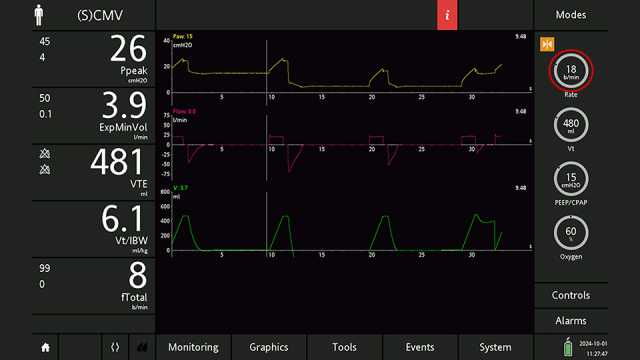
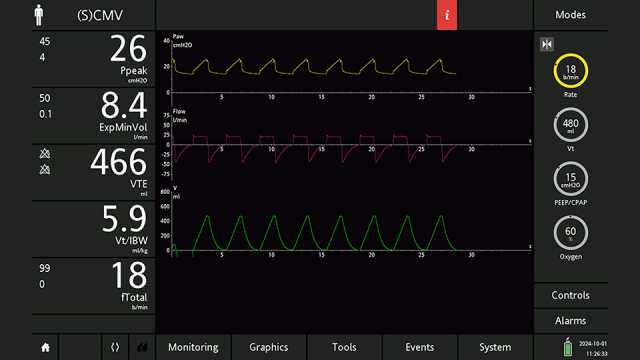
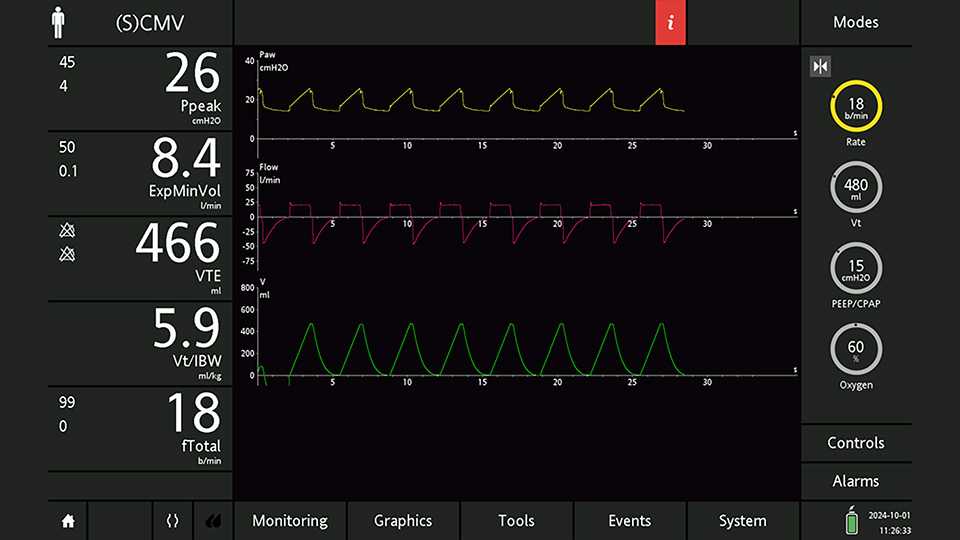
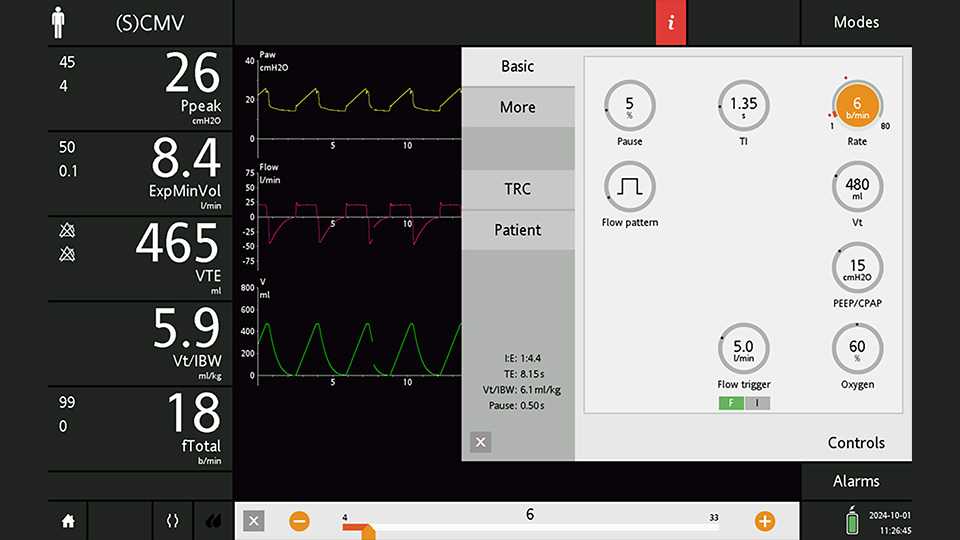
PEEPを15 cmH2Oに設定した(S)CMVモードで患者を30分換気します(図1を参照)。吸気ポーズは少なくとも5%に設定します。画面を静止する前に波形の該当する部分が流れてしまわないように、時間スケールを30秒に設定することを推奨します。
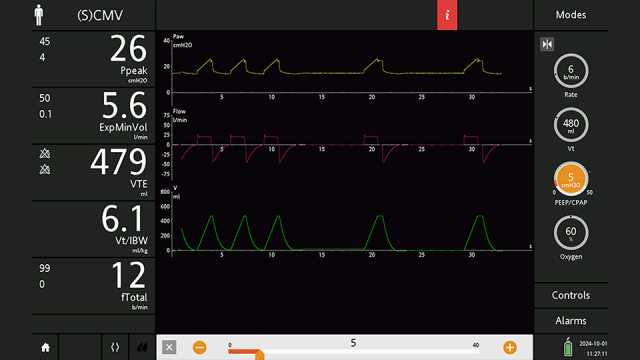
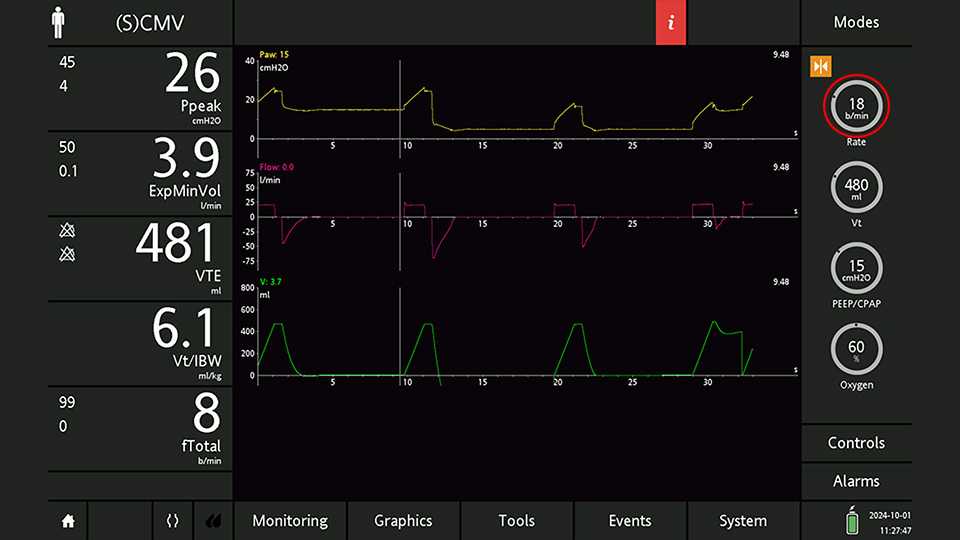
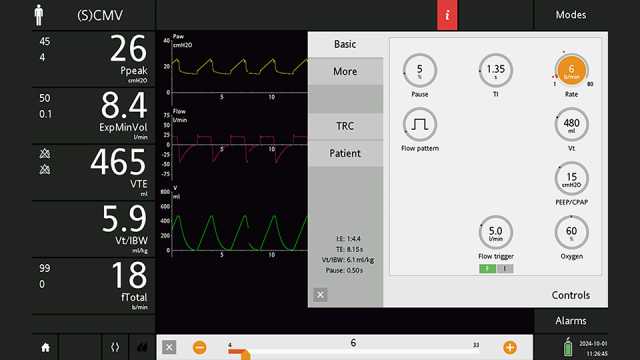
  • 30分後、呼吸回数を6 b/minに設定します(図2を参照)。
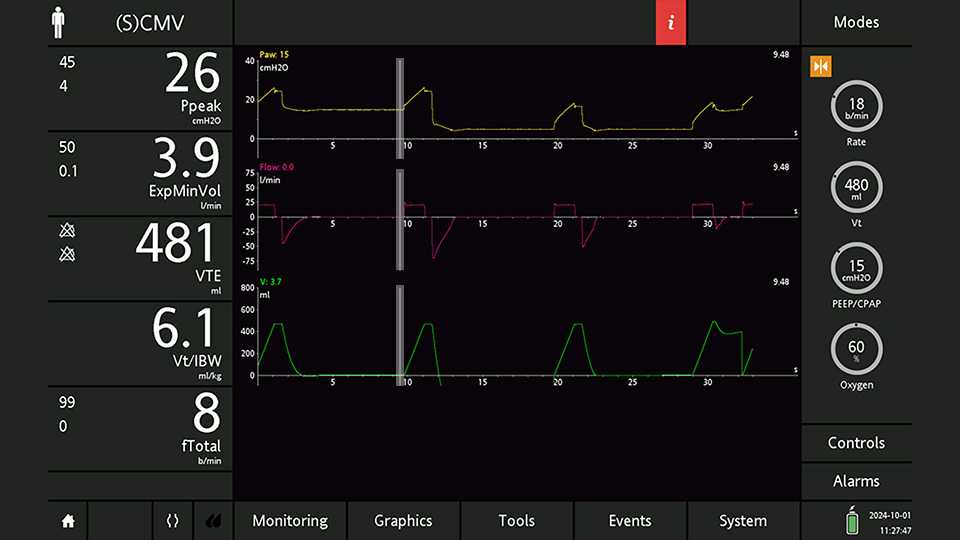
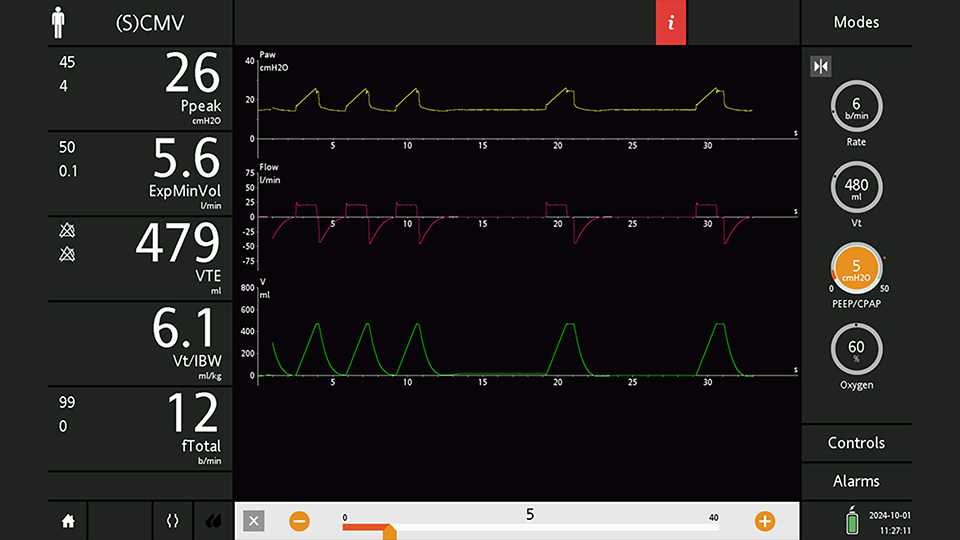
  • 次に、PEEPを5 cmH2Oに設定します(図3を参照)。
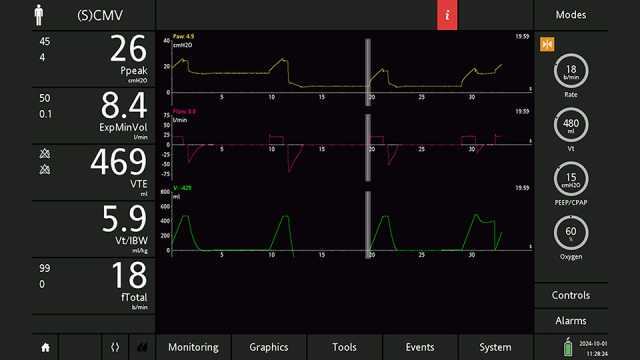
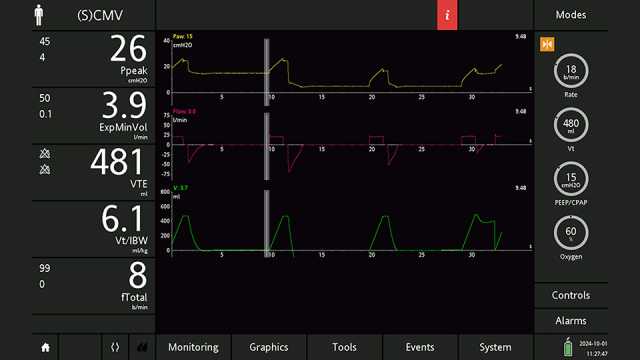
  • PEEPが5 cmH2Oまで低下している間に、呼吸回数を以前の値にすばやく再設定し、PEEPを15 cmH2Oに設定して、画面を静止します(図4を参照)。
PEEPを15に設定した(S)CMVモードの波形のスクリーンショット
図1
PEEPを15に設定した(S)CMVモードの波形のスクリーンショット
図1
呼吸回数を6に下げることを示すスクリーンショット
図2
呼吸回数を6に下げることを示すスクリーンショット
図2
PEEPを5 cmH2Oに下げることを示すスクリーンショット
図3
PEEPを5 cmH2Oに下げることを示すスクリーンショット
図3
PEEPが変化する前の最後の吸気の始まりにカーソルを合わせた静止画面を示すスクリーンショット
図4
PEEPが変化する前の最後の吸気の始まりにカーソルを合わせた静止画面を示すスクリーンショット
図4

ステップ1 - PEEP,high

カーソルを高い方のPEEPレベルでの最後の呼気の終わりに移動します(図5を参照)。
  • Paw = PEEP,high = 15 cmH2O


カーソルが適切に配置されていて、気道内圧が15であることを示すスクリーンショット
図5
カーソルが適切に配置されていて、気道内圧が15であることを示すスクリーンショット
図5

ステップ2 - PEEPの差

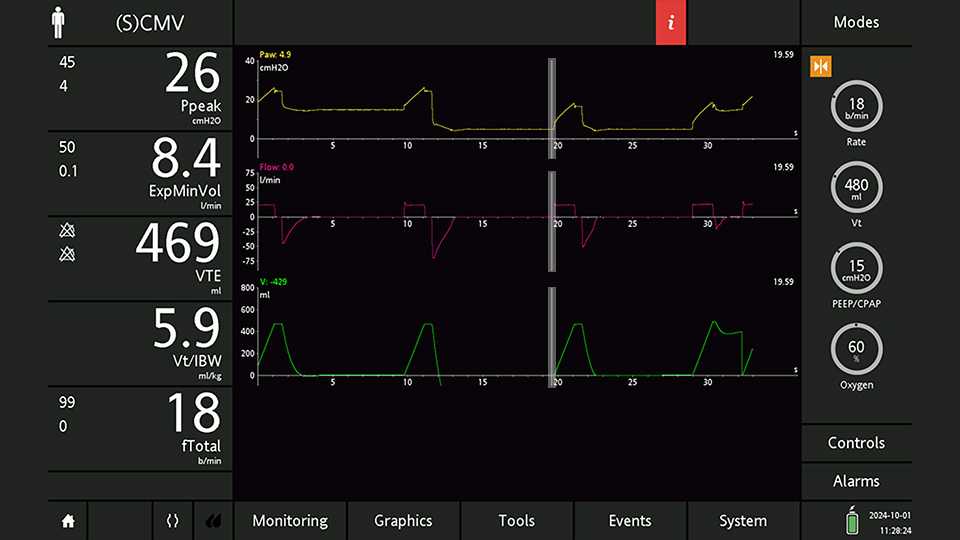
カーソルを低い方のPEEPレベルでの最初の呼気の終わりに移動します(図6を参照)。ここで、PEEP,lowの実際の値と、ベースラインに対する呼気終末量(End-exp Vol。波形上には表示されませんが、カーソルによって読み取ることができます)を測定します。収縮とデリクルートメントによる追加分の呼気VT(VTe,plus)は、End-exp Volの正負を反転させた数値です。

  • Paw = PEEP,low = 4.9 cmH2O
  • V  = End-exp Vol(呼気終末量) = -429 mL 
  • VTe,plus  = 429 mL
     

これでPEEPの差を計算できます。

  • PEEP,high = 15 cmH2O
  • PEEP,low  = 4.9 cmH2O
  • ΔPEEP      = 10.1 cmH2O


カーソルが適切に配置され、対応する値が示されているスクリーンショット
図6
カーソルが適切に配置され、対応する値が示されているスクリーンショット
図6

ステップ3 - 低い方のPEEPレベルでのドライビングプレッシャーとコンプライアンス

カーソルを低い方のPEEPレベルでの最初の吸気プラトーの終わりに移動します(図7を参照)。ここで、プラトー圧(Pplat,low)と吸気VT(VTi,low)を測定します。

  • Paw = Pplat,low = 17 cmH2O
  • V = VTi,low = 467 mL


これで、低い方のPEEPレベルでのドライビングプレッシャーとコンプライアンスを計算できます。 

  • ΔP,low = Pplat,low – PEEP,low = 17 – 4.9 = 12.1 
  • C,low = VTi,low/ΔP,low = 467/12.1 = 38.6

ステップ1、2、3でカーソル測定値をメモした後、忘れずにPEEP設定を確認してください。R/I比の測定に必要なのは、PEEPレベルを下げた状態での呼吸1回分だけです。PEEPレベルを下げた状態のまま長時間換気を続けると、肺胞が広範囲に虚脱し、結果的にガス交換が著しく悪化する可能性があります。
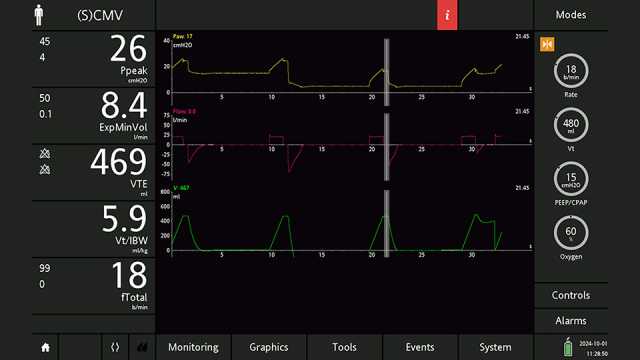
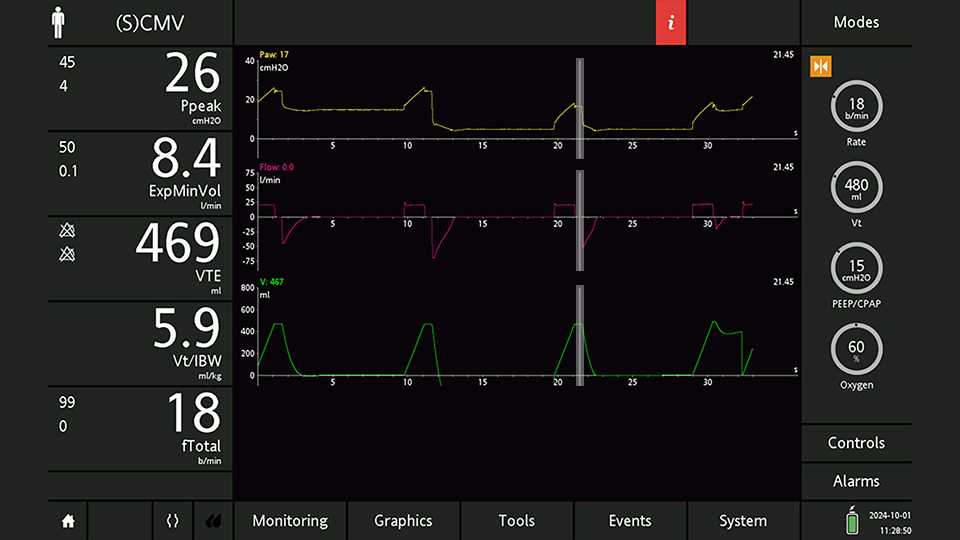
カーソルが適切に配置され、上記の値が示されているスクリーンショット
図7
カーソルが適切に配置され、上記の値が示されているスクリーンショット
図7

ステップ4 - 拡張量とリクルートメント量

メモした値を使用して、上記のステップで設定したPEEPの変化に伴う肺胞拡張によるボリュームの変化(Vinflated)と肺胞リクルートメントによるボリュームの変化(Vrecruited)を計算できます。

  • Vinflated = C,low x ΔPEEP = 38.6 x 10.1 = 390 mL
  • Vrecruited = VTe,plus – Vinflated = 429 – 390 = 39 mL

これら2つの値からリクルートメント対拡張比を計算します。

  • R/I = Vrecruited/Vinflated = 39/390 = 0.10 mL 

この値の意味

R/I比が0.3~0.4より低い場合は、リクルータビリティが低いことを示します。ここに示す例の場合は、PEEP設定を低くする(5~8 cmH2Oにする)のがより適しています。それに対して、R/I比が0.6~0.7より高い場合は、リクルータビリティが高いことを示します。この場合は、PEEPレベルを少なくとも12 cmH2Oに設定することが推奨されています。R/I比が0.5前後の場合は、中間のPEEPレベルが推奨されます(Rosà T, Bongiovanni F, Michi T, et al. Recruitment-to-inflation ratio for bedside PEEP selection in acute respiratory distress syndrome. Minerva Anestesiol.2024;90(7-8):694-706. doi:10.23736/S0375-9393.24.17982-53)。

Paw - 気道内圧
V - ボリューム
End-exp Vol - 呼気終末量
VTe,plus - PEEPの突然の低下に伴う追加の呼気一回換気量
Pplat,low - 低い方のPEEPレベルでのプラトー圧
VTi,low - 低い方のPEEPレベルでの吸気量
C,low - 低い方のPEEPレベルでのコンプライアンス

Potential for Lung Recruitment Estimated by the Recruitment-to-Inflation Ratio in Acute Respiratory Distress Syndrome. A Clinical Trial.

Chen L, Del Sorbo L, Grieco DL, et al. Potential for Lung Recruitment Estimated by the Recruitment-to-Inflation Ratio in Acute Respiratory Distress Syndrome. A Clinical Trial. Am J Respir Crit Care Med. 2020;201(2):178-187. doi:10.1164/rccm.201902-0334OC

Rationale: Response to positive end-expiratory pressure (PEEP) in acute respiratory distress syndrome depends on recruitability. We propose a bedside approach to estimate recruitability accounting for the presence of complete airway closure.Objectives: To validate a single-breath method for measuring recruited volume and test whether it differentiates patients with different responses to PEEP.Methods: Patients with acute respiratory distress syndrome were ventilated at 15 and 5 cm H2O of PEEP. Multiple pressure-volume curves were compared with a single-breath technique. Abruptly releasing PEEP (from 15 to 5 cm H2O) increases expired volume: the difference between this volume and the volume predicted by compliance at low PEEP (or above airway opening pressure) estimated the recruited volume by PEEP. This recruited volume divided by the effective pressure change gave the compliance of the recruited lung; the ratio of this compliance to the compliance at low PEEP gave the recruitment-to-inflation ratio. Response to PEEP was compared between high and low recruiters based on this ratio.Measurements and Main Results: Forty-five patients were enrolled. Four patients had airway closure higher than high PEEP, and thus recruitment could not be assessed. In others, recruited volume measured by the experimental and the reference methods were strongly correlated (R2 = 0.798; P < 0.0001) with small bias (-21 ml). The recruitment-to-inflation ratio (median, 0.5; range, 0-2.0) correlated with both oxygenation at low PEEP and the oxygenation response; at PEEP 15, high recruiters had better oxygenation (P = 0.004), whereas low recruiters experienced lower systolic arterial pressure (P = 0.008).Conclusions: A single-breath method quantifies recruited volume. The recruitment-to-inflation ratio might help to characterize lung recruitability at the bedside.Clinical trial registered with www.clinicaltrials.gov (NCT02457741).

Implementing a bedside assessment of respiratory mechanics in patients with acute respiratory distress syndrome.

Chen L, Chen GQ, Shore K, et al. Implementing a bedside assessment of respiratory mechanics in patients with acute respiratory distress syndrome. Crit Care. 2017;21(1):84. Published 2017 Apr 4. doi:10.1186/s13054-017-1671-8

BACKGROUND Despite their potential interest for clinical management, measurements of respiratory mechanics in patients with acute respiratory distress syndrome (ARDS) are seldom performed in routine practice. We introduced a systematic assessment of respiratory mechanics in our clinical practice. After the first year of clinical use, we retrospectively assessed whether these measurements had any influence on clinical management and physiological parameters associated with clinical outcomes by comparing their value before and after performing the test. METHODS The respiratory mechanics assessment constituted a set of bedside measurements to determine passive lung and chest wall mechanics, response to positive end-expiratory pressure, and alveolar derecruitment. It was obtained early after ARDS diagnosis. The results were provided to the clinical team to be used at their own discretion. We compared ventilator settings and physiological variables before and after the test. The physiological endpoints were oxygenation index, dead space, and plateau and driving pressures. RESULTS Sixty-one consecutive patients with ARDS were enrolled. Esophageal pressure was measured in 53 patients (86.9%). In 41 patients (67.2%), ventilator settings were changed after the measurements, often by reducing positive end-expiratory pressure or by switching pressure-targeted mode to volume-targeted mode. Following changes, the oxygenation index, airway plateau, and driving pressures were significantly improved, whereas the dead-space fraction remained unchanged. The oxygenation index continued to improve in the next 48 h. CONCLUSIONS Implementing a systematic respiratory mechanics test leads to frequent individual adaptations of ventilator settings and allows improvement in oxygenation indexes and reduction of the risk of overdistention at the same time. TRIAL REGISTRATION The present study involves data from our ongoing registry for respiratory mechanics (ClinicalTrials.gov identifier: NCT02623192 . Registered 30 July 2015).

Recruitment-to-inflation ratio for bedside PEEP selection in acute respiratory distress syndrome.

Rosà T, Bongiovanni F, Michi T, et al. Recruitment-to-inflation ratio for bedside PEEP selection in acute respiratory distress syndrome. Minerva Anestesiol. 2024;90(7-8):694-706. doi:10.23736/S0375-9393.24.17982-5

In acute respiratory distress syndrome, the role of positive end-expiratory pressure (PEEP) to prevent ventilator-induced lung injury is controversial. Randomized trials comparing higher versus lower PEEP strategies failed to demonstrate a clinical benefit. This may depend on the inter-individually variable potential for lung recruitment (i.e. recruitability), which would warrant PEEP individualization to balance alveolar recruitment and the unavoidable baby lung overinflation produced by high pressure. Many techniques have been used to assess recruitability, including lung imaging, multiple pressure-volume curves and lung volume measurement. The Recruitment-to-Inflation ratio (R/I) has been recently proposed to bedside assess recruitability without additional equipment. R/I assessment is a simplified technique based on the multiple pressure-volume curve concept: it is measured by monitoring respiratory mechanics and exhaled tidal volume during a 10-cmH2O one-breath derecruitment maneuver after a short high-PEEP test. R/I scales recruited volume to respiratory system compliance, and normalizes recruitment to a proxy of actual lung size. With modest R/I (<0.3-0.4), setting low PEEP (5-8 cmH2O) may be advisable; with R/I>0.6-0.7, high PEEP (≥15 cmH2O) can be considered, provided that airway and/or transpulmonary plateau pressure do not exceed safety limits. In case of intermediate R/I (≈0.5), a more granular assessment of recruitability may be needed. This could be accomplished with advanced monitoring tools, like sequential lung volume measurement with granular R/I assessment or electrical impedance tomography monitoring during a decremental PEEP trial. In this review, we discuss R/I rationale, applications and limits, providing insights on its clinical use for PEEP selection in moderate-to-severe acute respiratory distress syndrome.

Related articles. Get a deeper look