


Session expired

Due to inactivity your session has expired. Please login again.

 Tecnologias

ASV — Adaptive Support Ventilation®.

Suporte para você e seus pacientes

"" ""

Mais do que um modo. Isto é ASV

O ASV é um modo inteligente para ventilação invasiva em pacientes pediátricos e adultos. Os parâmetros de ventilação são continuamente ajustados em tempo real para fornecer exatamente o nível de suporte de que cada paciente necessita — nem mais, nem menos.

Concebido para rapidez e segurança, o ASV combina ventilação baseada em evidência com adaptação em tempo real. Em ambientes de elevada pressão, onde cada segundo conta, o ASV garante precisão clínica e proporciona tranquilidade.

Os benefícios do ASV em cuidados pré-hospitalares

Versátil para todos os tipos de pacientes

Suporta pacientes adultos e pediátricos, desde respiração espontânea até necessidade de suporte ventilatório total.

Aumenta a segurança do paciente

O ASV inclui mecanismos de segurança para prevenir situações como hiperventilação, hipoventilação e apneia (Arnal JM, Wysocki M, Novotni D, et al. Safety and efficacy of a fully closed-loop control ventilation (IntelliVent-ASV®) in sedated ICU patients with acute respiratory failure: a prospective randomized crossover study. Intensive Care Med. 2012;38(5):781-787. doi:10.1007/s00134-012-2548-61​, Kirakli C, Naz I, Ediboglu O, Tatar D, Budak A, Tellioglu E. A randomized controlled trial comparing the ventilation duration between adaptive support ventilation and pressure assist/control ventilation in medical patients in the ICU. Chest. 2015;147(6):1503-1509. doi:10.1378/chest.14-25992​, Brunner JX, Iotti GA. Adaptive Support Ventilation (ASV). Minerva Anestesiol. 2002;68(5):365-368. 3​). 

Também ajuda a prevenir complicações como taquipneia, AutoPEEP e ventilação excessiva de espaço morto (Sulemanji D, Marchese A, Garbarini P, Wysocki M, Kacmarek RM. Adaptive support ventilation: an appropriate mechanical ventilation strategy for acute respiratory distress syndrome?. Anesthesiology. 2009;111(4):863-870. doi:10.1097/ALN.0b013e3181b55f8f4​).

Reduz a carga cognitiva

Reduz a quantidade de ajustes nas configurações do respirador, permitindo que você se concentre em outros aspectos importantes do atendimento ao paciente (Kirakli C, Naz I, Ediboglu O, Tatar D, Budak A, Tellioglu E. A randomized controlled trial comparing the ventilation duration between adaptive support ventilation and pressure assist/control ventilation in medical patients in the ICU. Chest. 2015;147(6):1503-1509. doi:10.1378/chest.14-25992​, Moradian ST, Saeid Y, Ebadi A, Hemmat A, Ghiasi MS. Adaptive Support Ventilation Reduces the Incidence of Atelectasis in Patients Undergoing Coronary Artery Bypass Grafting: A Randomized Clinical Trial. Anesth Pain Med. 2017;7(3):e44619. Published 2017 Apr 22. doi:10.5812/aapm.446195​).

Adaptação contínua ao seu paciente

Quando a condição do paciente muda, o ASV adapta automaticamente o nível de suporte.
 

Aumenta a assistência quando o paciente apresenta dificuldade e reduz quando o paciente começa a respirar de forma mais eficaz por si próprio.

""

Muito fácil. Fluxo de trabalho do ASV em 4 passos

  1. Configuração simples: Definir o sexo, a altura do paciente e a ventilação minuto desejada.
  2. Monitorização contínua: O ASV monitora o volume corrente, a frequência respiratória, as pressões nas vias aéreas e muito mais.
  3. Ajuste automático: O ASV modula a pressão inspiratória e a frequência para manter a ventilação alvo.
  4. Resposta adaptativa: O ASV reduz o suporte à medida que o esforço espontâneo aumenta — ou aumenta-o se necessário.
     
Kyle Drisse

Customer voices

O ASV é realmente vantajoso em pacientes com trauma, em que há muitas situações críticas para gerenciar. É muito útil simplesmente configurar o respirador e permitir que o ASV gerencie o paciente do ponto de vista pulmonar. A configuração é bastante simples.

Kyle Drisse

Critical Care Flight Paramedic
Life Link III, Minnesota, USA

Disponibilidade

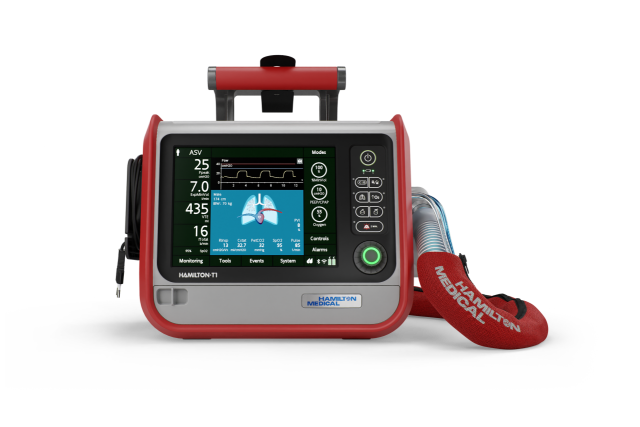
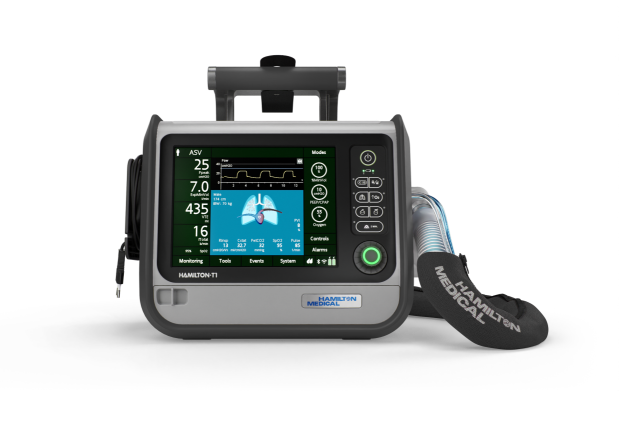
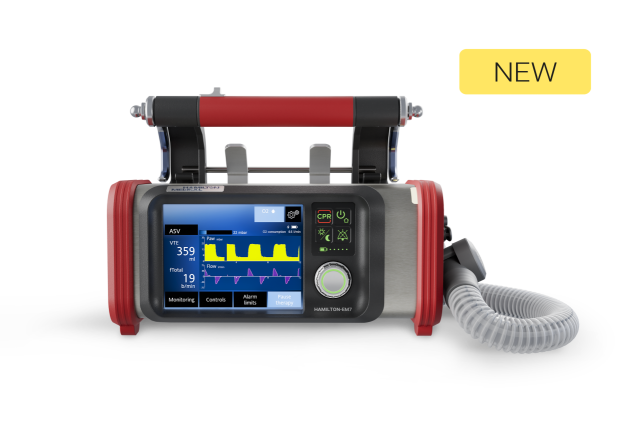
O ASV está disponível como modo padrão em todos os dispositivos HAMILTON-T1 e HAMILTON-EM7.

Safety and efficacy of a fully closed-loop control ventilation (IntelliVent-ASV®) in sedated ICU patients with acute respiratory failure: a prospective randomized crossover study.

Arnal JM, Wysocki M, Novotni D, et al. Safety and efficacy of a fully closed-loop control ventilation (IntelliVent-ASV®) in sedated ICU patients with acute respiratory failure: a prospective randomized crossover study. Intensive Care Med. 2012;38(5):781-787. doi:10.1007/s00134-012-2548-6

PURPOSE IntelliVent-ASV(®) is a development of adaptive support ventilation (ASV) that automatically adjusts ventilation and oxygenation parameters. This study assessed the safety and efficacy of IntelliVent-ASV(®) in sedated intensive care unit (ICU) patients with acute respiratory failure. METHODS This prospective randomized crossover comparative study was conducted in a 12-bed ICU in a general hospital. Two periods of 2 h of ventilation in randomly applied ASV or IntelliVent-ASV(®) were compared in 50 sedated, passively ventilated patients. Tidal volume (V(T)), respiratory rate (RR), inspiratory pressure (P(INSP)), SpO(2) and E(T)CO(2) were continuously monitored and recorded breath by breath. Mean values over the 2-h period were calculated. Respiratory mechanics, plateau pressure (P(PLAT)) and blood gas exchanges were measured at the end of each period. RESULTS There was no safety issue requiring premature interruption of IntelliVent-ASV(®). Minute ventilation (MV) and V(T) decreased from 7.6 (6.5-9.5) to 6.8 (6.0-8.0) L/min (p < 0.001) and from 8.3 (7.8-9.0) to 8.1 (7.7-8.6) mL/kg PBW (p = 0.003) during IntelliVent-ASV(®) as compared to ASV. P(PLAT) and FiO(2) decreased from 24 (20-29) to 20 (19-25) cmH(2)O (p = 0.005) and from 40 (30-50) to 30 (30-39) % (p < 0.001) during IntelliVent-ASV(®) as compared to ASV. RR, P(INSP), and PEEP decreased as well during IntelliVent-ASV(®) as compared to ASV. Respiratory mechanics, pH, PaO(2) and PaO(2)/FiO(2) ratio were not different but PaCO(2) was slightly higher during IntelliVent-ASV(®) as compared to ASV. CONCLUSIONS In passive patients with acute respiratory failure, IntelliVent-ASV(®) was safe and able to ventilate patients with less pressure, volume and FiO(2) while producing the same results in terms of oxygenation.

A randomized controlled trial comparing the ventilation duration between adaptive support ventilation and pressure assist/control ventilation in medical patients in the ICU.

Kirakli C, Naz I, Ediboglu O, Tatar D, Budak A, Tellioglu E. A randomized controlled trial comparing the ventilation duration between adaptive support ventilation and pressure assist/control ventilation in medical patients in the ICU. Chest. 2015;147(6):1503-1509. doi:10.1378/chest.14-2599

BACKGROUND Adaptive support ventilation (ASV) is a closed loop mode of mechanical ventilation (MV) that provides a target minute ventilation by automatically adapting inspiratory pressure and respiratory rate with the minimum work of breathing on the part of the patient. The aim of this study was to determine the effect of ASV on total MV duration when compared with pressure assist/control ventilation. METHODS Adult medical patients intubated and mechanically ventilated for > 24 h in a medical ICU were randomized to either ASV or pressure assist/control ventilation. Sedation and medical treatment were standardized for each group. Primary outcome was the total MV duration. Secondary outcomes were the weaning duration, number of manual settings of the ventilator, and weaning success rates. RESULTS Two hundred twenty-nine patients were included. Median MV duration until weaning, weaning duration, and total MV duration were significantly shorter in the ASV group (67 [43-94] h vs 92 [61-165] h, P = .003; 2 [2-2] h vs 2 [2-80] h, P = .001; and 4 [2-6] days vs 4 [3-9] days, P = .016, respectively). Patients in the ASV group required fewer total number of manual settings on the ventilator to reach the desired pH and Paco2 levels (2 [1-2] vs 3 [2-5], P < .001). The number of patients extubated successfully on the first attempt was significantly higher in the ASV group (P = .001). Weaning success and mortality at day 28 were comparable between the two groups. CONCLUSIONS In medical patients in the ICU, ASV may shorten the duration of weaning and total MV duration with a fewer number of manual ventilator settings. TRIAL REGISTRY ClinicalTrials.gov; No.: NCT01472302; URL: www.clinicaltrials.gov.

Adaptive Support Ventilation (ASV).

Brunner JX, Iotti GA. Adaptive Support Ventilation (ASV). Minerva Anestesiol. 2002;68(5):365-368.

Adaptive Support Ventilation is a novel ventilation mode, a closed-loop control mode that may switch automatically from a PCV-like behaviour to an SIMV-like or PSV-like behaviour, according to the patient status. The operating principles are based on pressure-controlled SIMV with pressure levels and SIMV rate automatically adjusted according to measured lung mechanics at each breath. ASV provided a safe and effective ventilation in patients with normal lungs, restrective or obstructive diseases. In cardiac surgery tracheal extrubation was faster in ASV patients then in controls. In the early weaning phase of acute ventilatory insufficiency the need of resetting ventilator parameters was decreased, suggesting potential benefit for patient care.

Adaptive support ventilation: an appropriate mechanical ventilation strategy for acute respiratory distress syndrome?

Sulemanji D, Marchese A, Garbarini P, Wysocki M, Kacmarek RM. Adaptive support ventilation: an appropriate mechanical ventilation strategy for acute respiratory distress syndrome?. Anesthesiology. 2009;111(4):863-870. doi:10.1097/ALN.0b013e3181b55f8f

BACKGROUND Adaptive support ventilation (ASV) allows the clinician to set a maximum plateau pressure (PP) and automatically adjusts tidal volume to keep PP below the set maximum. METHODS ASV was compared to a fixed tidal volume of 6 ml/kg. ASV determined the respiratory rate and tidal volume based on its algorithms. Maximum airway pressure limit was 28 cm H2O in ASV. Six sets of lung mechanics were simulated for two ideal body weights: 60 kg, Group I; 80 kg, Group II. Positive end expiratory pressure was 8, 12, and 16 cm H2O, and target minute volume 120%, 150%, and 200% of predicted minute volume. RESULTS ASV "sacrificed" tidal volume and minute ventilation to maintain PP in 9 (17%) of 54 scenarios in Group I and 20 (37%) of 54 scenarios in Group II. In Group I, the number of scenarios with PP of 28 cm H2O or more was 14 for ASV (26%) and 19 for 6 ml/kg (35%). In these scenarios, mean PP were ASV 28.8 +/- 0.86 cm H2O (min 28, max 30.3) and 6 ml/kg 33.01 +/- 3.48 cm H2O (min 28, max 37.8) (P = 0.000). In group II, the number of scenarios PP of 28 cm H2O or more was 10 for ASV (19%) and 21 for 6 ml/kg (39%). In these cases, mean PP values were ASV 28.78 +/- 0.54 cm H2O (min 28, max 29.6) and 6 ml/kg 32.66 +/- 3.37 cm H2O (min 28.2, max 38.2) (P = 0.000). CONCLUSION In a lung model with varying mechanics, ASV is better able to prevent the potential damaging effects of excessive PP (greater than 28 cm H2O) than a fixed tidal volume of 6 ml/kg by automatically adjusting airway pressure, resulting in a decreased tidal volume.

Adaptive Support Ventilation Reduces the Incidence of Atelectasis in Patients Undergoing Coronary Artery Bypass Grafting: A Randomized Clinical Trial.

Moradian ST, Saeid Y, Ebadi A, Hemmat A, Ghiasi MS. Adaptive Support Ventilation Reduces the Incidence of Atelectasis in Patients Undergoing Coronary Artery Bypass Grafting: A Randomized Clinical Trial. Anesth Pain Med. 2017;7(3):e44619. Published 2017 Apr 22. doi:10.5812/aapm.44619

BACKGROUND Pulmonary complications are common following cardiac surgery and can lead to increased morbidity, mortality, and healthcare costs. Atelectasis is the most common respiratory complication following cardiac surgery. One of the most important methods for reducing pulmonary complications is supportive care with protective ventilation strategies. In this study, we aimed to assess the effect of adaptive support ventilation (ASV) on atelectasis in patients undergoing cardiac surgery. METHODS In this single-blind randomized clinical trial, 115 patients, undergoing coronary artery bypass grafting, were randomly allocated into 2 groups: 57 patients in the intervention and 58 patients in the control group. Patients in the intervention group were weaned with ASV, while patients in the control group were managed using synchronized intermittent mandatory ventilation (SIMV) and pressure support. The incidence of atelectasis, duration of mechanical ventilation, manual ventilator setting, arterial blood gas measurements, and length of hospital stay were compared between the groups. RESULTS The incidence of atelectasis, number of changes in the manual ventilator setting, number of alarms, and length of hospital stay reduced in the intervention group. However, duration of mechanical ventilation and number of ABG measurements were not significantly different between the groups. CONCLUSIONS The ASV mode could reduce the incidence of atelectasis and length of hospital stay. However, it did not reduce the duration of mechanical ventilation. It seems that ASV is not a superior mode for faster extubation.