Zurück

Hilfsmittel zur Beurteilung der (De-)Rekrutierbarkeit am Patientenbett

Artikel

Autor: Giorgio A. Iotti, Caroline Brown

Datum: 29.04.2025

Was versteht man unter Rekrutierbarkeit und wie lässt sie sich messen?

Kernaussagen

  • Es ist eine der grössten Herausforderungen in der Behandlung von ARDS-Patienten, eine ausreichende Oxygenierung und CO2-Eliminierung sicherzustellen, ohne die Lunge weiter zu schädigen.
  • Da das angemessene zu verabreichende PEEP-Niveau vom Recruitmentpotenzial der Lunge abhängt, kann die Bewertung der Rekrutierbarkeit zur Einstellung des geeigneten PEEP-Werts herangezogen werden.
  • Eine von zwei am Patientenbett verwendeten Methoden zur Beurteilung der Rekrutierbarkeit anhand von Messungen der Atemmechanik ist das Verhältnis von Recruitment zu Inflation, das aus den Monitoring-Parametern des Beatmungsgerätes berechnet werden kann.
  • Ein niedrigeres R/I-Verhältnis weist auf ein geringeres Recruitmentpotenzial hin.

Lungentypen und Auswirkung des PEEP

Die richtige Abstimmung dieser beiden Aspekte stellt eine der grössten Herausforderungen bei der Behandlung von ARDS-Patienten dar. Bei akuten Lungenerkrankungen lassen sich die Alveolen schematisch in drei Gruppen unterteilen: Stabile Alveolen bleiben auch bei niedrigen Drücken offen (wie bei einer normalen Lunge). Rekrutierbare Alveolen können durch einen angemessen sicheren positiven Druck wiedereröffnet und offen gehalten werden (rekrutierbare Lunge). Nicht rekrutierbare Alveolen sind kollabiert oder konsolidiert und lassen sich nicht wiedereröffnen (nicht rekrutierbare Lunge). Je nach dem relativen Anteil dieser Gruppen zu einem bestimmten Zeitpunkt kann die Lunge als mechanisch nahezu normal, rekrutierbar oder nicht rekrutierbar eingestuft werden. Bei einer rekrutierbaren Lunge gilt eine auf Recruitment ausgerichtete Beatmung mit optimal eingestelltem positivem endexspiratorischem Druck (PEEP) als lungenschonende Massnahme. Einerseits erhöht der PEEP die Inspirationsdrücke, was das Recruitment kollabierter Alveolen fördert und es der Lunge erleichtert, das Tidalvolumen sicher aufzunehmen. Andererseits wirkt ein optimales PEEP-Niveau als mechanischer Stabilisator, der dem zyklischen De-Recruitment der Alveolen während der Exspiration und dem damit verbundenen Atelektrauma entgegenwirkt. Bei nicht rekruitierbaren oder mechanisch nahezu normalen Lungen ist die Situation jedoch anders: Ein hohes PEEP-Niveau wäre sowohl übermässig als auch ineffektiv.

Der einfachste Ansatz zur Einstellung des PEEP-Niveaus bei ARDS besteht darin, den Wert zu erhöhen, während man auf eine zufriedenstellende Verbesserung der Oxygenierung achtet. Dieser Ansatz ist jedoch nur bei Patienten sinnvoll, die auf die Behandlung reagieren, und kann insbesondere bei Patienten, die schlecht auf den PEEP ansprechen, zu einer Überdehnung führen. Die Messung der Rekrutierbarkeit könnte wertvolle Zusatzinformationen zur Ermittlung des optimalen PEEP-Werts liefern.


Was versteht man unter Rekrutierbarkeit und wie lässt sie sich messen?

Was genau bedeutet Rekrutierbarkeit? Alveoläre Instabilität und die Fähigkeit, auf positiven Druck zu reagieren, sind Voraussetzungen für die Rekrutierbarkeit. Es steht ausser Frage, dass jede Lunge mit Recruitmentpotenzial auch das Potenzial zum De-Recruitment besitzt, was bedeutet, dass instabile Alveolen wieder kollabieren können, wenn der Atemwegsdruck unter einen bestimmten Verschlussdruck fällt. 

Am Patientenbett kommen zur Beurteilung der Rekrutierbarkeit verschiedene Methoden zum Einsatz, von bildgebenden Verfahren wie Lungenultraschall oder elektrischer Impedanztomographie bis hin zu Ansätzen, die auf Messungen der Atemmechanik während spezieller Manöver basieren: die Analyse eines statischen Druck-Volumen-Loops (PV-Loop) des Atemsystems und das Verhältnis von Recruitment zu Inflation (R/I). Beide Methoden erfordern eine invasive Beatmung und vollständige Entspannung des Patienten.

Der statische PV-Loop

Bei der ersten Methode – dem statischen PV-Loop – kommt ein spezielles Tool am Beatmungsgerät zum Einsatz, um das Volumen in Relation zum Atemwegsdruck während eines langsamen, kontrollierten Ein- und Ausatmungsmanövers zu erfassen. Ein typisches Manöver besteht darin, das Atemsystem während eines langsamen, konstanten Druckanstiegs von 2 cmH2O/s von 5 bis 40 cmH2O und zurück zu untersuchen. Eine gängige Alternative ist es, bei null zu beginnen und zu enden. In der Praxis werden durch diese langsamen Manöver gleichzeitig zwei Aspekte untersucht: die möglichen Recruitment-Effekte durch langsam steigende Drücke und das mögliche De-Recruitment bei langsam sinkenden Drücken. In einem Diagramm mit Paw auf der X-Achse und Volumen auf der Y-Achse zeigt sich normalerweise eine Hysterese zwischen den Inflations- und Deflationskurven, wobei die Deflationskurve höher verläuft als die Inflationskurve. Je weiter die beiden Kurven auseinander liegen, desto ausgeprägter ist die Hysterese. Interessanterweise wurde eine grössere Hysterese (d. h. ein breiterer Loop) mit einem höheren Recruitmentpotenzial in Verbindung gebracht, während eine kleinere Hysterese (d. h. ein schmalerer Loop) auf ein geringeres Recruitmentpotenzial hinweist (Demory D, Arnal JM, Wysocki M, et al.). Recruitability of the lung estimated by the pressure volume curve hysteresis in ARDS patients. Intensive Care Med. 2008;34(11):2019-2025. doi:10.1007/s00134-008-1167-81​, Chiumello D, Arnal JM, Umbrello M, et al. Hysteresis and Lung Recruitment in Acute Respiratory Distress Syndrome Patients: A CT Scan Study [die veröffentlichte Korrektur erscheint in Crit Care Med. 2022 Mar 1;50(3):e339]. Crit Care Med. 2020;48(10):1494-1502. doi:10.1097/CCM.00000000000045182​). Die Ausprägung der Hysterese kann als normalisierter Maximalabstand (NMA) angegeben werden, d. h. als das Verhältnis vom Maximalabstand zwischen den zwei Kurven zum Maximalvolumen des Manövers. Ein NMA-Wert von 0,41 entspricht einer mittleren Rekrutierbarkeit und gilt als Scheidepunkt zwischen Zuständen mit niedrigerem und solchen mit höherem Recruitmentpotenzial (Chiumello D, Arnal JM, Umbrello M, et al. Hysteresis and Lung Recruitment in Acute Respiratory Distress Syndrome Patients: A CT Scan Study [die veröffentlichte Korrektur erscheint in Crit Care Med. 2022 Mar 1;50(3):e339]. Crit Care Med. 2020;48(10):1494-1502. doi:10.1097/CCM.00000000000045182​).

Das Verhältnis von Recruitment zu Inflation

Die zweite Methode, das Verhältnis von Recruitment zu Inflation (R/I) (auch als „vereinfachte Methode zum De-Recruitment“ bekannt), wurde von Chen et al. eingeführt. (Chen L, Del Sorbo L, Grieco DL, et al. Potential for Lung Recruitment Estimated by the Recruitment-to-Inflation Ratio in Acute Respiratory Distress Syndrome. A Clinical Trial. Am J Respir Crit Care Med. 2020;201(2):178-187. doi:10.1164/rccm.201902-0334OC3​, Chen L, Chen GQ, Shore K, et al. Implementing a bedside assessment of respiratory mechanics in patients with acute respiratory distress syndrome. Crit Care. 2017;21(1):84. Published 2017 Apr 4. doi:10.1186/s13054-017-1671-84​). Sie untersucht das mögliche De-Recruitment, das während der herkömmlichen volumenkontrollierten Beatmung (CMV) auftritt, wenn der PEEP abrupt um 10 cmH2O von einem hohen Niveau (zwischen 15 und 18 cmH2O, mindestens 30 Minuten aufrechterhalten) auf ein niedrigeres Niveau (zwischen 5 und 8 cmH2O) gesenkt wird. Der Übergangsatemzug, bei dem die Inspiration mit einem hohem PEEP beginnt und die Ausatmung mit einem niedrigen PEEP endet, führt zu einem grösseren exspiratorischen Volumen als bei den vorherigen Atemzügen. Das zusätzliche exspiratorische Volumen setzt sich aus zwei völlig unterschiedlichen Komponenten zusammen. Die erste, das deflatierte Volumen, hängt von der Deflationsreaktion der Alveolen ab, die bei einem niedrigen PEEP stabil bleiben. Das deflatierte Volumen untersucht den Einfluss von Druckänderungen auf die Inflation (I) und Deflation der Babylunge und steht in Beziehung zu ihrer Grösse. Die zweite Komponente, das de-rekrutierte Volumen, hängt vom De-Recruitment instabiler Alveolen ab, die sofort kollabieren und ihren Gasinhalt vollständig freisetzen, wenn der PEEP auf ein niedriges Niveau gesenkt wird. Das de-rekrutierte Volumen analysiert den Effekt von Druckänderungen auf Recruitment (R) und De-Recruitment. Der R/I-Index ergibt sich aus dem de-rekrutierten Volumen geteilt durch das deflatierte Volumen. In der Praxis stellt der Index das beobachtete De-Recruitment im Verhältnis zur  Grösse der Babylunge dar und gibt somit das Mass der Rekrutierbarkeit an. 

Wie erfolgt die Berechnung?

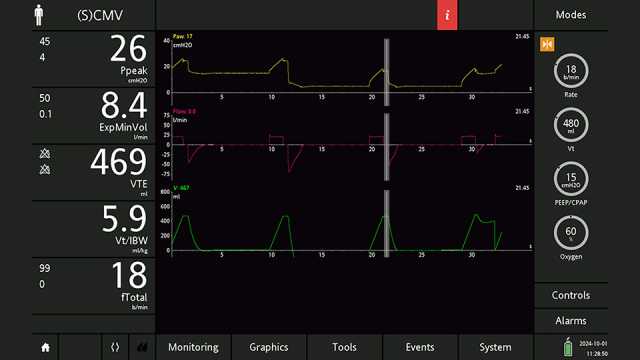
Die Berechnung des R/I-Verhältnisses ist relativ unkompliziert und basiert auf Daten, die vom Monitoringsystem des Beatmungsgerätes abgelesen werden können: dem exspiratorischen Volumen bei hohem PEEP, dem exspiratorischen Volumen während des PEEP-Übergangsatemzugs und der Compliance des Atemsystems bei niedrigem PEEP. Je niedriger das R/I-Verhältnis, desto geringer das Recruitmentpotenzial, wobei Null kein Recruitment bedeutet. Mittlere Werte liegen bei etwa 0,5 (dem Medianwert der von Chen et al. untersuchten Population), wobei Werte über 0,6 auf eine hohe Rekrutierbarkeit hindeuten (Chen L, Del Sorbo L, Grieco DL, et al.). Potential for Lung Recruitment Estimated by the Recruitment-to-Inflation Ratio in Acute Respiratory Distress Syndrome. A Clinical Trial. Am J Respir Crit Care Med. 2020;201(2):178-187. doi:10.1164/rccm.201902-0334OC3​). Die Ergebnisse des R/I-Verhältnisses wurden mit der Hysterese auf statischen PV-Loops verglichen, und es wurde eine gute Übereinstimmung festgestellt (Nakayama R, Bunya N, Katayama S, et al.). Correlation between the hysteresis of the pressure-volume curve and the recruitment-to-inflation ratio in patients with coronavirus disease 2019. Ann Intensive Care. 2022;12(1):106. Published 2022 Nov 12. doi:10.1186/s13613-022-01081-x5​). 

Was sagen uns diese Methoden zur PEEP-Einstellung?

Sobald entweder die Hysterese auf einem einzelnen statischen PV-Loop oder das R/I-Verhältnis bei einem De-Recruitmentmanöver von 10 cmH2O eine hohe, mittlere oder niedrige Rekrutierbarkeit anzeigt, wie sollte die PEEP-Einstellung in der klinischen Praxis angepasst werden? Bei niedriger Rekrutierbarkeit ist in der Regel ein niedriger PEEP-Wert die beste Wahl. Obwohl eine hohe Rekrutierbarkeit häufig als Indikator für einen hohen PEEP betrachtet wird, ist es wichtig, die aktuellen Warnhinweise zu diesem Konzept zu beachten (Gattinoni L, Collino F, Camporota L. Assessing lung recruitability: does it help with PEEP settings?). Intensive Care Med. 2024;50(5):749-751. doi:10.1007/s00134-024-07351-56​). Und wie verhält es sich mit mittlerer Rekrutierbarkeit? Interessanterweise wurde die Hysterese-Bewertung auf mehreren statischen PV-Loops während eines absteigenden PEEP-Tests vorgeschlagen, um das optimale PEEP-Niveau zum Recruitment und zur mechanischen Stabilisierung instabiler Alveolen präzise zu bestimmen (Mojoli F, Pozzi M, Arisi E. Setting positive end-expiratory pressure: using the pressure-volume curve. Curr Opin Crit Care. 2024;30(1):35-42. doi:10.1097/MCC.00000000000011277​). Der Ansatz mit der Bestimmung des R/I-Verhältnisses wurde auch zur präzisen Bewertung des De-Recruitments während eines absteigenden PEEP-Tests eingesetzt. Allerdings erfordert dieser Ansatz eine komplexe Technologie, da die Messung des endexspiratorischen Lungenvolumens mittels Stickstoffverdünnung notwendig ist (Grieco DL, Pintaudi G, Bongiovanni F, et al.). Recruitment-to-inflation Ratio Assessed through Sequential End-expiratory Lung Volume Measurement in Acute Respiratory Distress Syndrome. Anesthesiology. 2023;139(6):801-814. doi:10.1097/ALN.00000000000047168​) 

Auf Ihrem Beatmungsgerät

Das R/I-Verhältnis ermöglicht die Beurteilung der Rekrutierbarkeit am Patientenbett unter Verwendung der Standardmonitoringparameter auf Beatmungsgeräten von Hamilton Medical. Die alternative Methode mit dem statischen PV-Loop kann mithilfe des P/V-Tools angewendet werden, das auf den Beatmungsgeräten HAMILTON‑C3/C6 und HAMILTON‑G5/S1 verfügbar ist (Als Option auf den Beatmungsgeräten HAMILTON-G5 und HAMILTON-C3/C6 verfügbar.A​, Standardausstattung beim HAMILTON-S1.B ). Hierbei kann die Rekrutierbarkeit direkt aus der Druck/Volumen-Kurve in einem einzigen diagnostischen Manöver abgelesen werden. Das P/V-Tool kann darüber hinaus für Recruitmentmanöver oder zur Bestimmung des optimalen PEEP-Niveaus eingesetzt werden, indem es eine präzise Analyse der Hysterese aus verschiedenen diagnostischen Manövern liefert.
 

Fußnoten

  • A. Auf den Beatmungsgeräten HAMILTON-G5 und HAMILTON-C3/C6 als Option verfügbar.
  • B. Standardausstattung auf dem HAMILTON-S1.

Referenzen

  1. 1. Demory D, Arnal JM, Wysocki M, et al. Recruitability of the lung estimated by the pressure volume curve hysteresis in ARDS patients. Intensive Care Med. 2008;34(11):2019-2025. doi:10.1007/s00134-008-1167-8
  2. 2. Chiumello D, Arnal JM, Umbrello M, et al. Hysteresis and Lung Recruitment in Acute Respiratory Distress Syndrome Patients: A CT Scan Study [published correction appears in Crit Care Med. 2022 Mar 1;50(3):e339]. Crit Care Med. 2020;48(10):1494-1502. doi:10.1097/CCM.0000000000004518
  3. 3. Chen L, Del Sorbo L, Grieco DL, et al. Potential for Lung Recruitment Estimated by the Recruitment-to-Inflation Ratio in Acute Respiratory Distress Syndrome. A Clinical Trial. Am J Respir Crit Care Med. 2020;201(2):178-187. doi:10.1164/rccm.201902-0334OC
  4. 4. Chen L, Chen GQ, Shore K, et al. Implementing a bedside assessment of respiratory mechanics in patients with acute respiratory distress syndrome. Crit Care. 2017;21(1):84. Published 2017 Apr 4. doi:10.1186/s13054-017-1671-8
  5. 5. Nakayama R, Bunya N, Katayama S, et al. Correlation between the hysteresis of the pressure-volume curve and the recruitment-to-inflation ratio in patients with coronavirus disease 2019. Ann Intensive Care. 2022;12(1):106. Published 2022 Nov 12. doi:10.1186/s13613-022-01081-x
  6. 6. Gattinoni L, Collino F, Camporota L. Assessing lung recruitability: does it help with PEEP settings?. Intensive Care Med. 2024;50(5):749-751. doi:10.1007/s00134-024-07351-5
  7. 7. Mojoli F, Pozzi M, Arisi E. Setting positive end-expiratory pressure: using the pressure-volume curve. Curr Opin Crit Care. 2024;30(1):35-42. doi:10.1097/MCC.0000000000001127
  8. 8. Grieco DL, Pintaudi G, Bongiovanni F, et al. Recruitment-to-inflation Ratio Assessed through Sequential End-expiratory Lung Volume Measurement in Acute Respiratory Distress Syndrome. Anesthesiology. 2023;139(6):801-814. doi:10.1097/ALN.0000000000004716

Recruitability of the lung estimated by the pressure volume curve hysteresis in ARDS patients.

Demory D, Arnal JM, Wysocki M, et al. Recruitability of the lung estimated by the pressure volume curve hysteresis in ARDS patients. Intensive Care Med. 2008;34(11):2019-2025. doi:10.1007/s00134-008-1167-8

OBJECTIVE To assess the hysteresis of the pressure-volume curve (PV curve) as to estimate, easily and at the bedside, the recruitability of the lung in ARDS patients. DESIGN Prospective study. SETTING Twelve medico-surgical ICU beds of a general hospital. PATIENTS Twenty-six patients within the first 24 h from meeting ARDS criteria. INTERVENTION A Quasi-static inflation and deflation PV curve from 0 to 40 cmH(2)O and a 40 cmH(2)O recruitment maneuver (RM) maintained for 10 s were successively done with an interval of 30 min in between. RECORDINGS AND CALCULATION: Hysteresis of the PV curve (H(PV)) was calculated as the ratio of the area enclosed by the pressure volume loop divided by the predicted body weight (PBW). The volume increase during the RM (V(RM)) was measured by integration of the flow required to maintain the pressure at 40 cmH(2)O and divided by PBW, as an estimation of the volume recruited during the RM. RESULTS A positive linear correlation was found between H(PV) and V(RM) (r = 0.81, P < 0.0001). CONCLUSIONS The results suggest using the hysteresis of the PV curve to assess the recruitability of the lung.

Hysteresis and Lung Recruitment in Acute Respiratory Distress Syndrome Patients: A CT Scan Study.

Chiumello D, Arnal JM, Umbrello M, et al. Hysteresis and Lung Recruitment in Acute Respiratory Distress Syndrome Patients: A CT Scan Study [published correction appears in Crit Care Med. 2022 Mar 1;50(3):e339]. Crit Care Med. 2020;48(10):1494-1502. doi:10.1097/CCM.0000000000004518

OBJECTIVES Hysteresis of the respiratory system pressure-volume curve is related to alveolar surface forces, lung stress relaxation, and tidal reexpansion/collapse. Hysteresis has been suggested as a means of assessing lung recruitment. The objective of this study was to determine the relationship between hysteresis, mechanical characteristics of the respiratory system, and lung recruitment assessed by a CT scan in mechanically ventilated acute respiratory distress syndrome patients. DESIGN Prospective observational study. SETTING General ICU of a university hospital. PATIENTS Twenty-five consecutive sedated and paralyzed patients with acute respiratory distress syndrome (age 64 ± 15 yr, body mass index 26 ± 6 kg/m, PaO2/FIO2 147 ± 42, and positive end-expiratory pressure 9.3 ± 1.4 cm H2O) were enrolled. INTERVENTIONS A low-flow inflation and deflation pressure-volume curve (5-45 cm H2O) and a sustained inflation recruitment maneuver (45 cm H2O for 30 s) were performed. A lung CT scan was performed during breath-holding pressure at 5 cm H2O and during the recruitment maneuver at 45 cm H2O. MEASUREMENTS AND MAIN RESULTS Lung recruitment was computed as the difference in noninflated tissue and in gas volume measured at 5 and at 45 cm H2O. Hysteresis was calculated as the ratio of the area enclosed by the pressure-volume curve and expressed as the hysteresis ratio. Hysteresis was correlated with respiratory system compliance computed at 5 cm H2O and the lung gas volume entering the lung during inflation of the pressure-volume curve (R = 0.749, p < 0.001 and R = 0.851, p < 0.001). The hysteresis ratio was related to both lung tissue and gas recruitment (R = 0.266, p = 0.008, R = 0.357, p = 0.002, respectively). Receiver operating characteristic analysis showed that the optimal cutoff value to predict lung tissue recruitment for the hysteresis ratio was 28% (area under the receiver operating characteristic curve, 0.80; 95% CI, 0.62-0.98), with sensitivity and specificity of 0.75 and 0.77, respectively. CONCLUSIONS Hysteresis of the respiratory system computed by low-flow pressure-volume curve is related to the anatomical lung characteristics and has an acceptable accuracy to predict lung recruitment.

Potential for Lung Recruitment Estimated by the Recruitment-to-Inflation Ratio in Acute Respiratory Distress Syndrome. A Clinical Trial.

Chen L, Del Sorbo L, Grieco DL, et al. Potential for Lung Recruitment Estimated by the Recruitment-to-Inflation Ratio in Acute Respiratory Distress Syndrome. A Clinical Trial. Am J Respir Crit Care Med. 2020;201(2):178-187. doi:10.1164/rccm.201902-0334OC

Rationale: Response to positive end-expiratory pressure (PEEP) in acute respiratory distress syndrome depends on recruitability. We propose a bedside approach to estimate recruitability accounting for the presence of complete airway closure.Objectives: To validate a single-breath method for measuring recruited volume and test whether it differentiates patients with different responses to PEEP.Methods: Patients with acute respiratory distress syndrome were ventilated at 15 and 5 cm H2O of PEEP. Multiple pressure-volume curves were compared with a single-breath technique. Abruptly releasing PEEP (from 15 to 5 cm H2O) increases expired volume: the difference between this volume and the volume predicted by compliance at low PEEP (or above airway opening pressure) estimated the recruited volume by PEEP. This recruited volume divided by the effective pressure change gave the compliance of the recruited lung; the ratio of this compliance to the compliance at low PEEP gave the recruitment-to-inflation ratio. Response to PEEP was compared between high and low recruiters based on this ratio.Measurements and Main Results: Forty-five patients were enrolled. Four patients had airway closure higher than high PEEP, and thus recruitment could not be assessed. In others, recruited volume measured by the experimental and the reference methods were strongly correlated (R2 = 0.798; P < 0.0001) with small bias (-21 ml). The recruitment-to-inflation ratio (median, 0.5; range, 0-2.0) correlated with both oxygenation at low PEEP and the oxygenation response; at PEEP 15, high recruiters had better oxygenation (P = 0.004), whereas low recruiters experienced lower systolic arterial pressure (P = 0.008).Conclusions: A single-breath method quantifies recruited volume. The recruitment-to-inflation ratio might help to characterize lung recruitability at the bedside.Clinical trial registered with www.clinicaltrials.gov (NCT02457741).

Implementing a bedside assessment of respiratory mechanics in patients with acute respiratory distress syndrome.

Chen L, Chen GQ, Shore K, et al. Implementing a bedside assessment of respiratory mechanics in patients with acute respiratory distress syndrome. Crit Care. 2017;21(1):84. Published 2017 Apr 4. doi:10.1186/s13054-017-1671-8

BACKGROUND Despite their potential interest for clinical management, measurements of respiratory mechanics in patients with acute respiratory distress syndrome (ARDS) are seldom performed in routine practice. We introduced a systematic assessment of respiratory mechanics in our clinical practice. After the first year of clinical use, we retrospectively assessed whether these measurements had any influence on clinical management and physiological parameters associated with clinical outcomes by comparing their value before and after performing the test. METHODS The respiratory mechanics assessment constituted a set of bedside measurements to determine passive lung and chest wall mechanics, response to positive end-expiratory pressure, and alveolar derecruitment. It was obtained early after ARDS diagnosis. The results were provided to the clinical team to be used at their own discretion. We compared ventilator settings and physiological variables before and after the test. The physiological endpoints were oxygenation index, dead space, and plateau and driving pressures. RESULTS Sixty-one consecutive patients with ARDS were enrolled. Esophageal pressure was measured in 53 patients (86.9%). In 41 patients (67.2%), ventilator settings were changed after the measurements, often by reducing positive end-expiratory pressure or by switching pressure-targeted mode to volume-targeted mode. Following changes, the oxygenation index, airway plateau, and driving pressures were significantly improved, whereas the dead-space fraction remained unchanged. The oxygenation index continued to improve in the next 48 h. CONCLUSIONS Implementing a systematic respiratory mechanics test leads to frequent individual adaptations of ventilator settings and allows improvement in oxygenation indexes and reduction of the risk of overdistention at the same time. TRIAL REGISTRATION The present study involves data from our ongoing registry for respiratory mechanics (ClinicalTrials.gov identifier: NCT02623192 . Registered 30 July 2015).

Correlation between the hysteresis of the pressure-volume curve and the recruitment-to-inflation ratio in patients with coronavirus disease 2019.

Nakayama R, Bunya N, Katayama S, et al. Correlation between the hysteresis of the pressure-volume curve and the recruitment-to-inflation ratio in patients with coronavirus disease 2019. Ann Intensive Care. 2022;12(1):106. Published 2022 Nov 12. doi:10.1186/s13613-022-01081-x

BACKGROUND Since the response to lung recruitment varies greatly among patients receiving mechanical ventilation, lung recruitability should be assessed before recruitment maneuvers. The pressure-volume curve (PV curve) and recruitment-to-inflation ratio (R/I ratio) can be used bedside for evaluating lung recruitability and individualing positive end-expiratory pressure (PEEP). Lung tissue recruitment on computed tomography has been correlated with normalized maximal distance (NMD) of the quasi-static PV curve. NMD is the maximal distance between the inspiratory and expiratory limb of the PV curve normalized to the maximal volume. However, the relationship between the different parameters of hysteresis of the quasi-static PV curve and R/I ratio for recruitability is unknown. METHODS We analyzed the data of 33 patients with severe coronavirus disease 2019 (COVID-19) who received invasive mechanical ventilation. Respiratory waveform data were collected from the ventilator using proprietary acquisition software. We examined the relationship of the R/I ratio, quasi-static PV curve items such as NMD, and respiratory system compliance (Crs). RESULTS The median R/I ratio was 0.90 [interquartile range (IQR), 0.70-1.15] and median NMD was 41.0 [IQR, 37.1-44.1]. The NMD correlated significantly with the R/I ratio (rho = 0.74, P < 0.001). Sub-analysis showed that the NMD and R/I ratio did not correlate with Crs at lower PEEP (- 0.057, P = 0.75; and rho = 0.15, P = 0.41, respectively). On the contrary, the ratio of Crs at higher PEEP to Crs at lower PEEP (Crs ratio (higher/lower)) moderately correlated with NMD and R/I ratio (rho = 0.64, P < 0.001; and rho = 0.67, P < 0.001, respectively). CONCLUSIONS NMD of the quasi-static PV curve and R/I ratio for recruitability assessment are highly correlated. In addition, NMD and R/I ratio correlated with the Crs ratio (higher/lower). Therefore, NMD and R/I ratio could be potential indicators of recruitability that can be performed at the bedside.

Assessing lung recruitability: does it help with PEEP settings?

Gattinoni L, Collino F, Camporota L. Assessing lung recruitability: does it help with PEEP settings?. Intensive Care Med. 2024;50(5):749-751. doi:10.1007/s00134-024-07351-5

Setting positive end-expiratory pressure: using the pressure-volume curve.

Mojoli F, Pozzi M, Arisi E. Setting positive end-expiratory pressure: using the pressure-volume curve. Curr Opin Crit Care. 2024;30(1):35-42. doi:10.1097/MCC.0000000000001127

PURPOSE OF REVIEW To discuss the role of pressure-volume curve (PV curve) in exploring elastic properties of the respiratory system and setting mechanical ventilator to reduce ventilator-induced lung injury. RECENT FINDINGS Nowadays, quasi-static PV curves and loops can be easily obtained and analyzed at the bedside without disconnection of the patient from the ventilator. It is shown that this tool can provide useful information to optimize ventilator setting. For example, PV curves can assess for patient's individual potential for lung recruitability and also evaluate the risk for lung injury of the ongoing mechanical ventilation setting. SUMMARY In conclusion, PV curve is an easily available bedside tool: its correct interpretation can be extremely valuable to enlighten potential for lung recruitability and select a high or low positive end-expiratory pressure (PEEP) strategy. Furthermore, recent studies have shown that PV curve can play a significant role in PEEP and driving pressure fine tuning: clinical studies are needed to prove whether this technique will improve outcome.

Recruitment-to-inflation Ratio Assessed through Sequential End-expiratory Lung Volume Measurement in Acute Respiratory Distress Syndrome.

Grieco DL, Pintaudi G, Bongiovanni F, et al. Recruitment-to-inflation Ratio Assessed through Sequential End-expiratory Lung Volume Measurement in Acute Respiratory Distress Syndrome. Anesthesiology. 2023;139(6):801-814. doi:10.1097/ALN.0000000000004716

BACKGROUND Positive end-expiratory pressure (PEEP) benefits in acute respiratory distress syndrome are driven by lung dynamic strain reduction. This depends on the variable extent of alveolar recruitment. The recruitment-to-inflation ratio estimates recruitability across a 10-cm H2O PEEP range through a simplified maneuver. Whether recruitability is uniform or not across this range is unknown. The hypotheses of this study are that the recruitment-to-inflation ratio represents an accurate estimate of PEEP-induced changes in dynamic strain, but may show nonuniform behavior across the conventionally tested PEEP range (15 to 5 cm H2O). METHODS Twenty patients with moderate-to-severe COVID-19 acute respiratory distress syndrome underwent a decremental PEEP trial (PEEP 15 to 13 to 10 to 8 to 5 cm H2O). Respiratory mechanics and end-expiratory lung volume by nitrogen dilution were measured the end of each step. Gas exchange, recruited volume, recruitment-to-inflation ratio, and changes in dynamic, static, and total strain were computed between 15 and 5 cm H2O (global recruitment-to-inflation ratio) and within narrower PEEP ranges (granular recruitment-to-inflation ratio). RESULTS Between 15 and 5 cm H2O, median [interquartile range] global recruitment-to-inflation ratio was 1.27 [0.40 to 1.69] and displayed a linear correlation with PEEP-induced dynamic strain reduction (r = -0.94; P < 0.001). Intraindividual recruitment-to-inflation ratio variability within the narrower ranges was high (85% [70 to 109]). The relationship between granular recruitment-to-inflation ratio and PEEP was mathematically described by a nonlinear, quadratic equation (R2 = 0.96). Granular recruitment-to-inflation ratio across the narrower PEEP ranges itself had a linear correlation with PEEP-induced reduction in dynamic strain (r = -0.89; P < 0.001). CONCLUSIONS Both global and granular recruitment-to-inflation ratio accurately estimate PEEP-induced changes in lung dynamic strain. However, the effect of 10 cm H2O of PEEP on lung strain may be nonuniform. Granular recruitment-to-inflation ratio assessment within narrower PEEP ranges guided by end-expiratory lung volume measurement may aid more precise PEEP selection, especially when the recruitment-to-inflation ratio obtained with the simplified maneuver between PEEP 15 and 5 cm H2O yields intermediate values that are difficult to interpret for a proper choice between a high and low PEEP strategy.

Related articles. Get a deeper look