


Session expired

Due to inactivity your session has expired. Please login again.

 Tecnologie

INTELLiVENT®-ASV®:

un assistente sempre con voi

"" ""

Intelligent Ventilation sempre al vostro fianco: ecco INTELLiVENT-ASV

Gestire la ventilazione durante il trasporto è impegnativo. I pazienti possono peggiorare nel giro di poco tempo, e ogni regolazione richiede tempo prezioso. INTELLiVENT-ASV supporta i pazienti adulti e pediatrici intubati controllando automaticamente la ventilazione e l'ossigenazione sulla base dei valori di SpO2 ed etCO2 misurati in tempo reale.

I vantaggi di INTELLiVENT-ASV nell'assistenza preospedaliera

Si adatta automaticamente

INTELLiVENT-ASV regola costantemente la frequenza respiratoria, il volume corrente, la pressione inspiratoria, la PEEP e l'ossigeno, passando dalla ventilazione controllata a quella assistita e viceversa sulla base dei dati fisiologici, che vengono esaminati a ogni respiro (Bialais E, Wittebole X, Vignaux L, et al. Closed-loop ventilation mode (IntelliVent®-ASV) in intensive care unit: a randomized trial. Minerva Anestesiol. 2016;82(6):657-668. 1, Fot EV, Izotova NN, Yudina AS, Smetkin AA, Kuzkov VV, Kirov MY. Automated Weaning from Mechanical Ventilation after Off-Pump Coronary Artery Bypass Grafting. Front Med (Lausanne). 2017;4:31. Pubblicato il 21 marzo 2017. doi:10.3389/fmed.2017.000312, Arnal JM, Saoli M, Garnero A. Airway and transpulmonary driving pressures and mechanical powers selected by INTELLiVENT-ASV in passive, mechanically ventilated ICU patients. Heart Lung. 2020;49(4):427-434. doi:10.1016/j.hrtlng.2019.11.0013).

Permette di risparmiare tempo e ridurre il carico di lavoro

INTELLiVENT-ASV richiede meno regolazioni manuali rispetto alla ventilazione convenzionale, contribuisce quindi a ridurre il carico di lavoro degli operatori, che possono così concentrarsi sul paziente (Bialais E, Wittebole X, Vignaux L, et al. Closed-loop ventilation mode (IntelliVent®-ASV) in intensive care unit: a randomized trial. Minerva Anestesiol. 2016;82(6):657-668. 1, Fot EV, Izotova NN, Yudina AS, Smetkin AA, Kuzkov VV, Kirov MY. Automated Weaning from Mechanical Ventilation after Off-Pump Coronary Artery Bypass Grafting. Front Med (Lausanne). 2017;4:31. Published 2017 Mar 21. doi:10.3389/fmed.2017.000312​, Beijers AJ, Roos AN, Bindels AJ. Fully automated closed-loop ventilation is safe and effective in post-cardiac surgery patients. Intensive Care Med. 2014;40(5):752-753. doi:10.1007/s00134-014-3234-74).

Aumenta la sicurezza dei pazienti

Mantiene le condizioni di ventilazione che garantiscono la protezione dei polmoni anche in condizioni di instabilità, riducendo il rischio di iperossia o di ipo-/iper-ventilazione (Bialais E, Wittebole X, Vignaux L, et al. Closed-loop ventilation mode (IntelliVent®-ASV) in intensive care unit: a randomized trial. Minerva Anestesiol. 2016;82(6):657-668. 1, Fot EV, Izotova NN, Yudina AS, Smetkin AA, Kuzkov VV, Kirov MY. Automated Weaning from Mechanical Ventilation after Off-Pump Coronary Artery Bypass Grafting. Front Med (Lausanne). 2017;4:31. Pubblicato il 21 marzo 2017. doi:10.3389/fmed.2017.000312, Arnal JM, Saoli M, Garnero A. Airway and transpulmonary driving pressures and mechanical powers selected by INTELLiVENT-ASV in passive, mechanically ventilated ICU patients. Heart Lung. 2020;49(4):427-434. doi:10.1016/j.hrtlng.2019.11.0013).

Semplifica ciò che è complesso

È particolarmente utile durante il trasporto in situazioni ad alto stress e per i soccorritori con livelli di esperienza diversi.

""

Sì, è così semplice: il flusso di lavoro di INTELLiVENT-ASV in 4 passaggi

  1. Impostare i dati essenziali: immettere il sesso, l'altezza e, se presente, la condizione del paziente (per esempio, ARDS, danno cerebrale o ipercapnia cronica).
  2. Definire i target: scegliere gli intervalli di ossigenazione (SpO2) e ventilazione (etCO2) per il paziente.
  3. Avviare la ventilazione: INTELLiVENT-ASV regola automaticamente volume corrente, frequenza respiratoria, FiO2 e PEEP in modo da raggiungere i target scelti e adatta continuamente le impostazioni, respiro per respiro, in base a SpO2, etCO2 e meccanica polmonare.
  4. Eseguire una regolazione di precisione, se necessario: se si preferisce gestire l'impostazione personalmente è possibile impostare sulla modalità manuale ciascuno dei tre controller (VolMin, Ossigeno o PEEP).
Dr. João Alves

Cosa dicono i clienti

Dal punto di vista dell'assistenza clinica, INTELLiVENT-ASV ci permette di non preoccuparci delle operazioni di supporto alla gestione del paziente mentre svolgiamo compiti più critici concentrandoci sull'aspetto decisionale.

Dr. João Alves

Intensivista, Reparto di Medicina interna ed emergenza-urgenza dal 2018
University Hospital Center Lisbon, Lisbona, Portogallo

Disponibilità

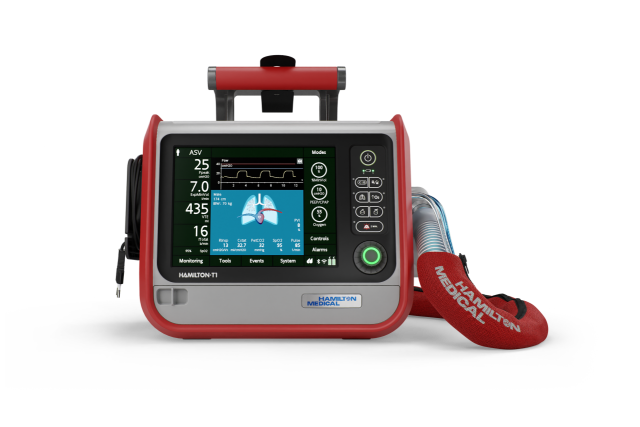
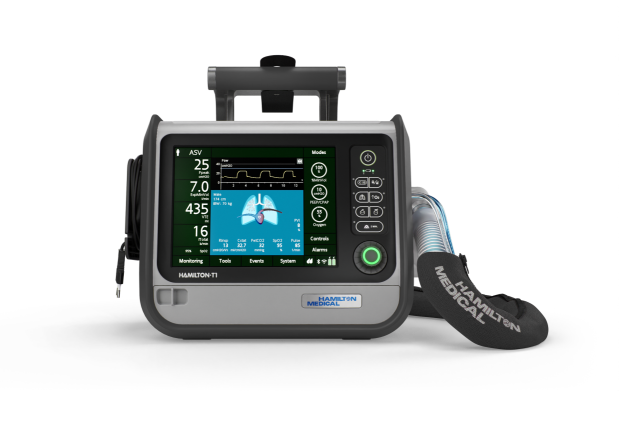
INTELLiVENT-ASV è disponibile come modalità standard su tutti i dispositivi HAMILTON-T1.

Closed-loop ventilation mode (IntelliVent®-ASV) in intensive care unit: a randomized trial.

Bialais E, Wittebole X, Vignaux L, et al. Closed-loop ventilation mode (IntelliVent®-ASV) in intensive care unit: a randomized trial. Minerva Anestesiol. 2016;82(6):657-668.

BACKGROUND Closed-loop modes automatically adjust ventilation settings, delivering individualized ventilation over short periods of time. The objective of this randomized controlled trial was to compare safety, efficacy and workload for the health care team between IntelliVent®-ASV and conventional modes over a 48-hour period. METHODS ICU patients admitted with an expected duration of mechanical ventilation of more than 48 hours were randomized to IntelliVent®-ASV or conventional ventilation modes. All ventilation parameters were recorded breath-by-breath. The number of manual adjustments assesses workload for the healthcare team. Safety and efficacy were assessed by calculating the time spent within previously defined ranges of non-optimal and optimal ventilation, respectively. RESULTS Eighty patients were analyzed. The median values of ventilation parameters over 48 hours were similar in both groups except for PEEP (7[4] cmH2O versus 6[3] cmH2O with IntelliVent®-ASV and conventional ventilation, respectively, P=0.028) and PETCO2 (36±7 mmHg with IntelliVent®-ASV versus 40±8 mmHg with conventional ventilation, P=0.041). Safety was similar between IntelliVent®-ASV and conventional ventilation for all parameters except for PMAX, which was more often non-optimal with IntelliVent®-ASV (P=0.001). Efficacy was comparable between the 2 ventilation strategies, except for SpO2 and VT, which were more often optimal with IntelliVent®-ASV (P=0.005, P=0.016, respectively). IntelliVent®-ASV required less manual adjustments than conventional ventilation (P<0.001) for a higher total number of adjustments (P<0.001). The coefficient of variation over 48 hours was larger with IntelliVent®-ASV in regard of maximum pressure, inspiratory pressure (PINSP), and PEEP as compared to conventional ventilation. CONCLUSIONS IntelliVent®-ASV required less manual intervention and delivered more variable PEEP and PINSP, while delivering ventilation safe and effective ventilation in terms of VT, RR, SpO2 and PETCO2.

Automated Weaning from Mechanical Ventilation after Off-Pump Coronary Artery Bypass Grafting.

Fot EV, Izotova NN, Yudina AS, Smetkin AA, Kuzkov VV, Kirov MY. Automated Weaning from Mechanical Ventilation after Off-Pump Coronary Artery Bypass Grafting. Front Med (Lausanne). 2017;4:31. Published 2017 Mar 21. doi:10.3389/fmed.2017.00031

BACKGROUND The discontinuation of mechanical ventilation after coronary surgery may prolong and significantly increase the load on intensive care unit personnel. We hypothesized that automated mode using INTELLiVENT-ASV can decrease duration of postoperative mechanical ventilation, reduce workload on medical staff, and provide safe ventilation after off-pump coronary artery bypass grafting (OPCAB). The primary endpoint of our study was to assess the duration of postoperative mechanical ventilation during different modes of weaning from respiratory support (RS) after OPCAB. The secondary endpoint was to assess safety of the automated weaning mode and the number of manual interventions to the ventilator settings during the weaning process in comparison with the protocolized weaning mode. MATERIALS AND METHODS Forty adult patients undergoing elective OPCAB were enrolled into a prospective single-center study. Patients were randomized into two groups: automated weaning (n = 20) using INTELLiVENT-ASV mode with quick-wean option; and protocolized weaning (n = 20), using conventional synchronized intermittent mandatory ventilation (SIMV) + pressure support (PS) mode. We assessed the duration of postoperative ventilation, incidence and duration of unacceptable RS, and the load on medical staff. We also performed the retrospective analysis of 102 patients (standard weaning) who were weaned from ventilator with SIMV + PS mode based on physician's experience without prearranged algorithm. RESULTS AND DISCUSSION Realization of the automated weaning protocol required change in respiratory settings in 2 patients vs. 7 (5-9) adjustments per patient in the protocolized weaning group. Both incidence and duration of unacceptable RS were reduced significantly by means of the automated weaning approach. The FiO2 during spontaneous breathing trials was significantly lower in the automated weaning group: 30 (30-35) vs. 40 (40-45) % in the protocolized weaning group (p < 0.01). The average time until tracheal extubation did not differ in the automated weaning and the protocolized weaning groups: 193 (115-309) and 197 (158-253) min, respectively, but increased to 290 (210-411) min in the standard weaning group. CONCLUSION The automated weaning system after off-pump coronary surgery might provide postoperative ventilation in a more protective way, reduces the workload on medical staff, and does not prolong the duration of weaning from ventilator. The use of automated or protocolized weaning can reduce the duration of postoperative mechanical ventilation in comparison with non-protocolized weaning based on the physician's decision.

Airway and transpulmonary driving pressures and mechanical powers selected by INTELLiVENT-ASV in passive, mechanically ventilated ICU patients.

Arnal JM, Saoli M, Garnero A. Airway and transpulmonary driving pressures and mechanical powers selected by INTELLiVENT-ASV in passive, mechanically ventilated ICU patients. Heart Lung. 2020;49(4):427-434. doi:10.1016/j.hrtlng.2019.11.001

BACKGROUND Driving pressure (ΔP) and mechanical power (MP) are predictors of the risk of ventilation- induced lung injuries (VILI) in mechanically ventilated patients. INTELLiVENT-ASV® is a closed-loop ventilation mode that automatically adjusts respiratory rate and tidal volume, according to the patient's respiratory mechanics. OBJECTIVES This prospective observational study investigated ΔP and MP (and also transpulmonary ΔP (ΔPL) and MP (MPL) for a subgroup of patients) delivered by INTELLiVENT-ASV. METHODS Adult patients admitted to the ICU were included if they were sedated and met the criteria for a single lung condition (normal lungs, COPD, or ARDS). INTELLiVENT-ASV was used with default target settings. If PEEP was above 16 cmH2O, the recruitment strategy used transpulmonary pressure as a reference, and ΔPL and MPL were computed. Measurements were made once for each patient. RESULTS Of the 255 patients included, 98 patients were classified as normal-lungs, 28 as COPD, and 129 as ARDS patients. The median ΔP was 8 (7 - 10), 10 (8 - 12), and 9 (8 - 11) cmH2O for normal-lungs, COPD, and ARDS patients, respectively. The median MP was 9.1 (4.9 - 13.5), 11.8 (8.6 - 16.5), and 8.8 (5.6 - 13.8) J/min for normal-lungs, COPD, and ARDS patients, respectively. For the 19 patients managed with transpulmonary pressure ΔPL was 6 (4 - 7) cmH2O and MPL was 3.6 (3.1 - 4.4) J/min. CONCLUSIONS In this short term observation study, INTELLiVENT-ASV selected ΔP and MP considered in safe ranges for lung protection. In a subgroup of ARDS patients, the combination of a recruitment strategy and INTELLiVENT-ASV resulted in an apparently safe ΔPL and MPL.

Fully automated closed-loop ventilation is safe and effective in post-cardiac surgery patients.

Beijers AJ, Roos AN, Bindels AJ. Fully automated closed-loop ventilation is safe and effective in post-cardiac surgery patients. Intensive Care Med. 2014;40(5):752-753. doi:10.1007/s00134-014-3234-7