

Indietro

Determining the R/I ratio using the single-breath technique

Articolo

Autore: Giorgio Iotti, Caroline Brown

Data: 29.04.2025

How to determine the recruitment-to-inflation ratio from monitoring values on your ventilator.

The recruitment-to-inflation ratio (R/I) offers clinicians a bedside means of assessing a patient’s recruitability so PEEP can be set accordingly. Using the single-breath technique as described by Chen et al. (Chen L, Del Sorbo L, Grieco DL, et al. Potential for Lung Recruitment Estimated by the Recruitment-to-Inflation Ratio in Acute Respiratory Distress Syndrome. A Clinical Trial. Am J Respir Crit Care Med. 2020;201(2):178-187. doi:10.1164/rccm.201902-0334OC1​, Chen L, Chen GQ, Shore K, et al. Implementing a bedside assessment of respiratory mechanics in patients with acute respiratory distress syndrome. Crit Care. 2017;21(1):84. Published 2017 Apr 4. doi:10.1186/s13054-017-1671-82​), the R/I ratio can be calculated from data available on the monitoring screen of the ventilator. 

In the following steps we show you how to perform the technique on a HAMILTON-C6 ventilator.

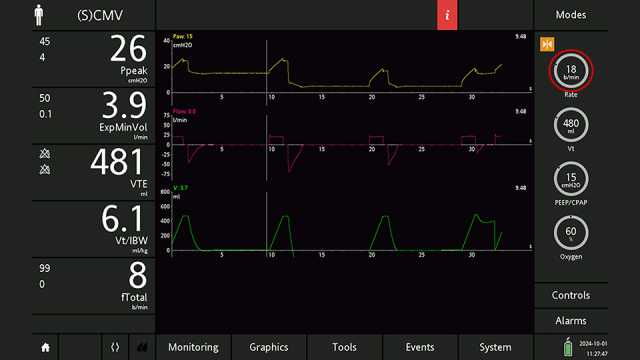
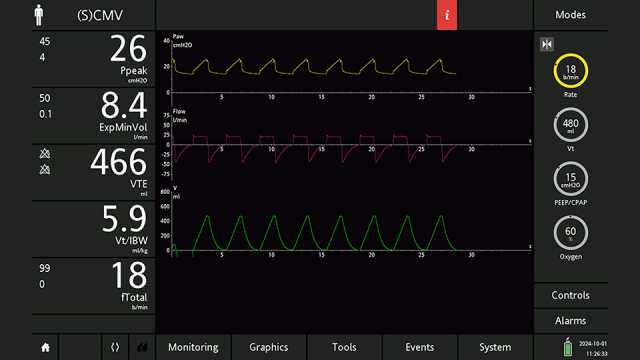
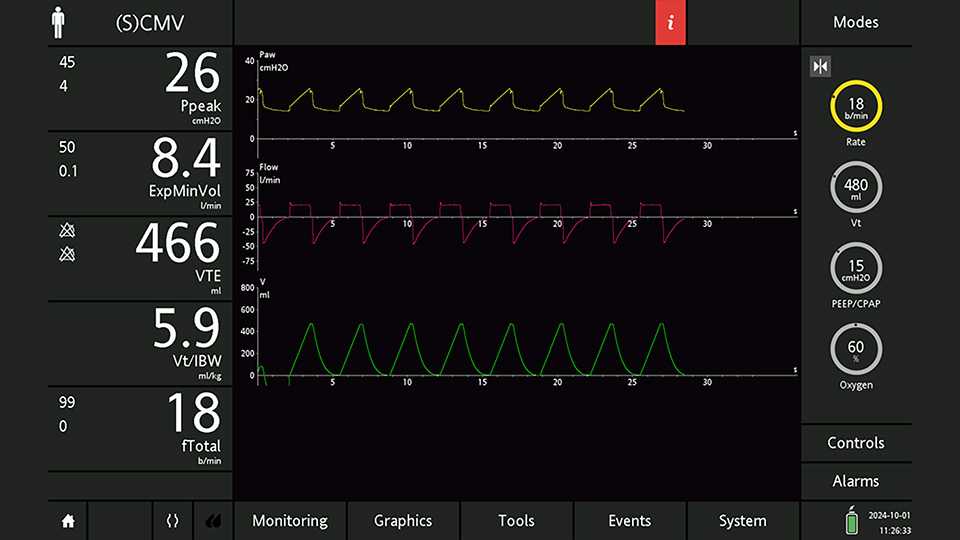
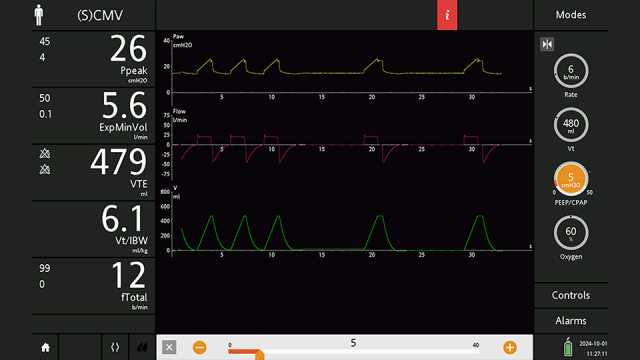
The patient should be ventilated in (S)CMV mode with a PEEP of 15 cmH2O for 30 minutes (see Figure 1). Pause for inspiration should be set at the minimum of 5%. We recommend using a time scale of 30 seconds to ensure the relevant part of the curves do not disappear before the screen freezes.
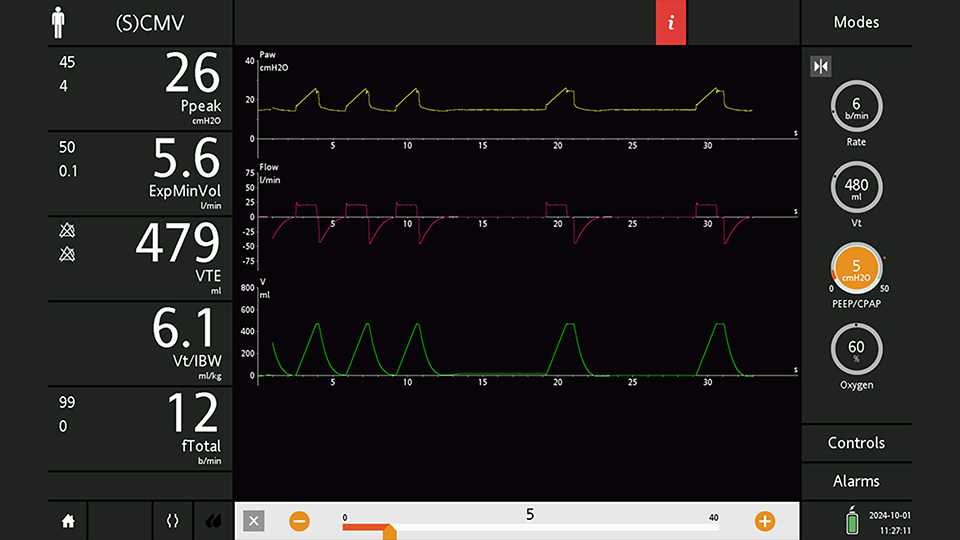
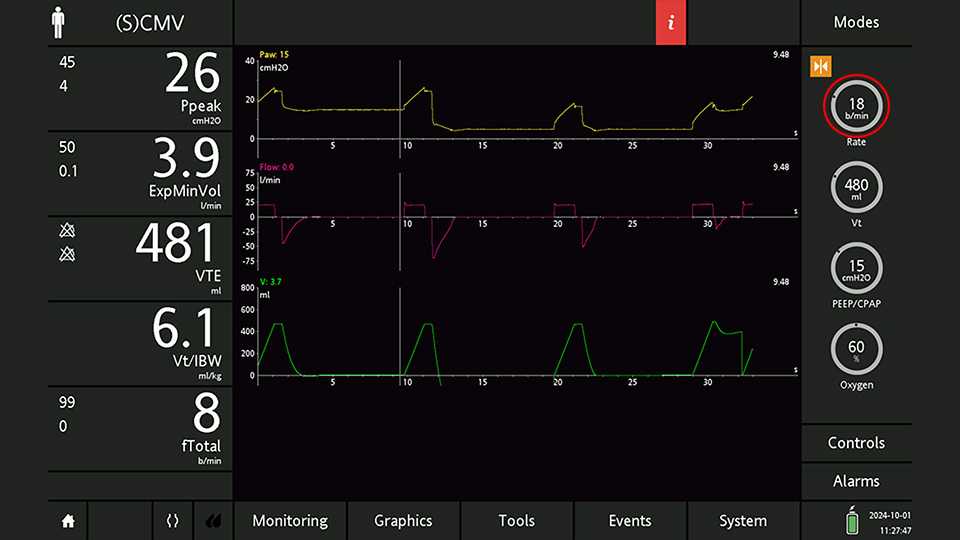
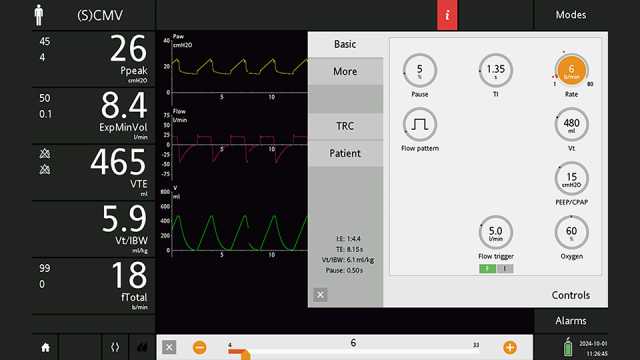
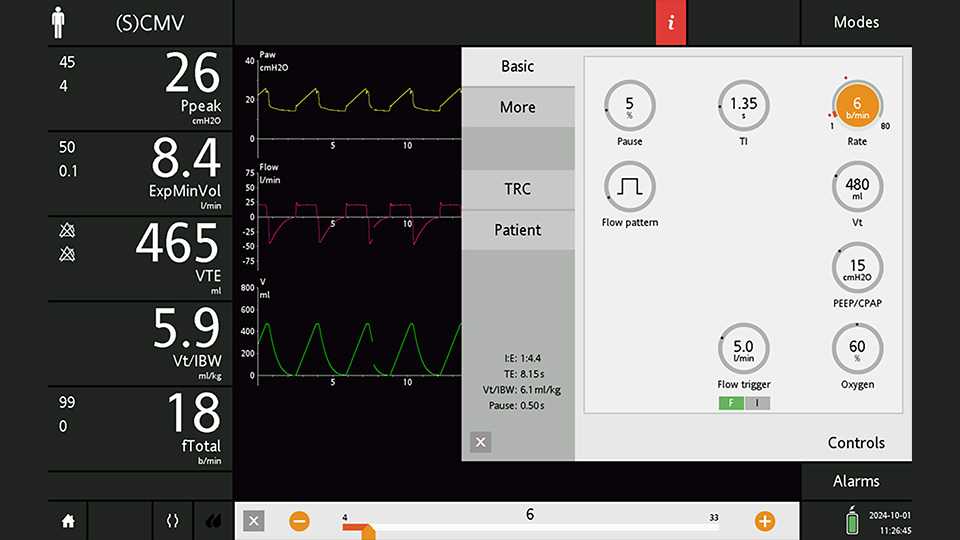
  • After 30 minutes, set Rate to 6 b/min (see Figure 2).
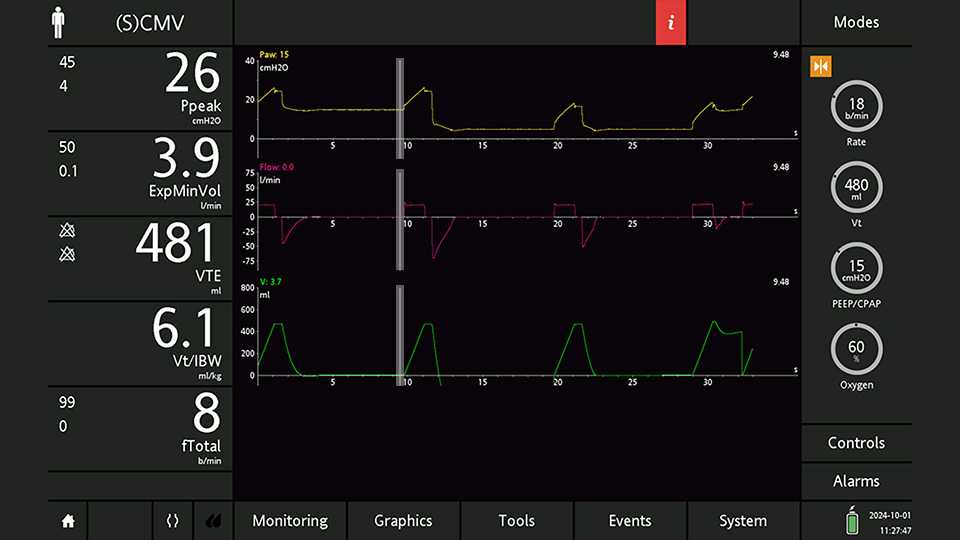
  • Then set PEEP to 5 cmH2O (see Figure 3).
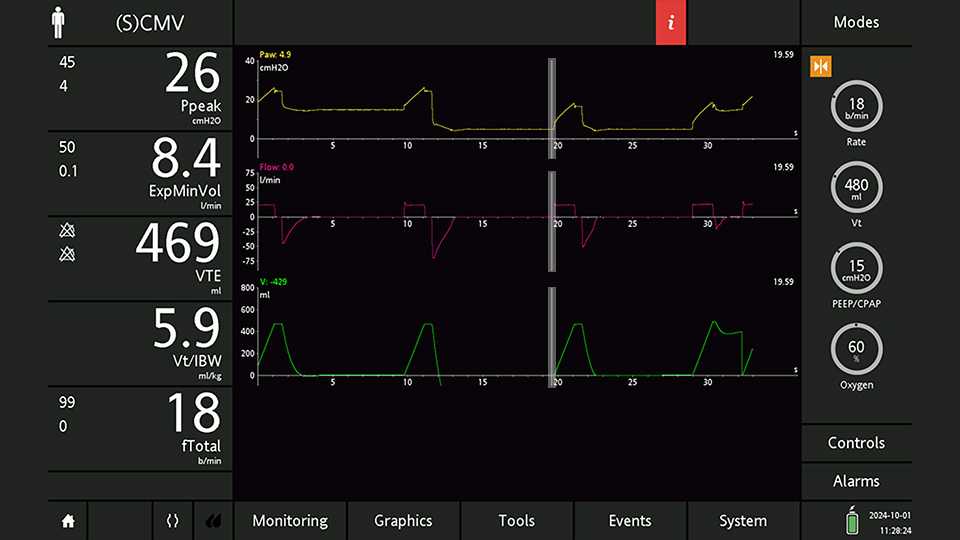
  • While PEEP is dropping to 5 cmH2O, quickly reset Rate to the previous value, reset PEEP to 15 cmH20, and freeze the screen (see Figure 4).
Screenshot of waveforms in SCMV mode with PEEP at 15
Figure 1
Screenshot of waveforms in SCMV mode with PEEP at 15
Figure 1
Screenshot showing Rate decreased to 6
Figure 2
Screenshot showing Rate decreased to 6
Figure 2
Screenshot showing PEEP decreased to 5 cmH2O
Figure 3
Screenshot showing PEEP decreased to 5 cmH2O
Figure 3
Screenshot showing screen freeze with cursor at beginning of last inspiration before the PEEP change
Figure 4
Screenshot showing screen freeze with cursor at beginning of last inspiration before the PEEP change
Figure 4

Step 1 - PEEP, high

Place the cursor at the end of the last expiration at the higher PEEP level (see Figure 5).
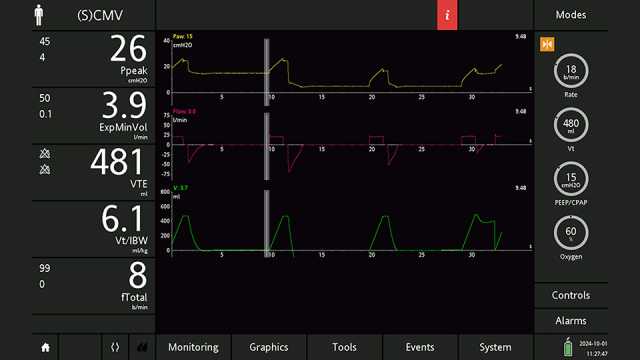
  • Paw = PEEP, high = 15 cmH2O


Screenshot showing cursor correctly positioned and Paw of 15
Figure 5
Screenshot showing cursor correctly positioned and Paw of 15
Figure 5

Step 2 - Difference in PEEP

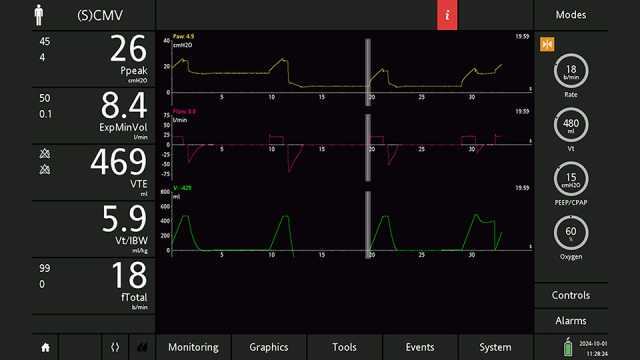
Move the cursor to the end of the first expiration at the lower PEEP level (see Figure 6). Here you measure the actual value of PEEP,low and the end-expiratory volume relative to the baseline (End-exp Vol, not visible on the curve but readable by the cursor). The additional expiratory VT due to deflation and derecruitment (VTe,plus) is the opposite of End-exp Vol.

  • Paw = PEEP, low = 4.9 cmH2O
  • V  = End-exp Vol (end-expiratory volume) = -429 ml 
  • VTe,plus  = 429 ml
     

Now you can calculate the difference in PEEP:
  • PEEP,high = 15 cmH2O
  • PEEP,low = 4.9 cmH2O
  • ΔPEEP = 10.1 cmH2O


Screenshot showing cursor correctly positioned and corresponding values
Figure 6
Screenshot showing cursor correctly positioned and corresponding values
Figure 6

Step 3 - Driving pressure and compliance at the lower PEEP level

Move the cursor to the end of the first inspiratory plateau at the lower PEEP level (see Figure 7). Here you measure the plateau pressure (Pplat,low) and the inspiratory VT (VTi,low).

  • Paw = Pplat,low = 17 cmH2O
  • V = VTi,low = 467 ml


Now you can calculate driving pressure and compliance at the lower PEEP level: 

  • ΔP,low = Pplat,low – PEEP,low = 17 – 4.9 = 12.1 
  • C,low = VTi,low/ΔP,low = 467/12.1 = 38.6

After taking note of the cursor measurements as described for steps 1, 2, and 3, do not forget to check the PEEP setting. The R/I ratio measurement requires just one breath at the lower PEEP level. Prolonging ventilation at the lower PEEP level may result in extensive alveolar collapse with severe worsening of the gas exchanges as a consequence.
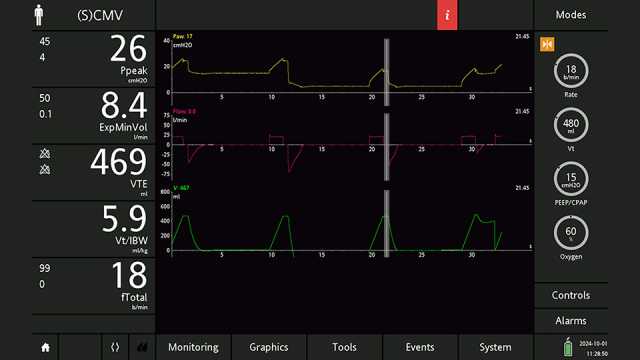
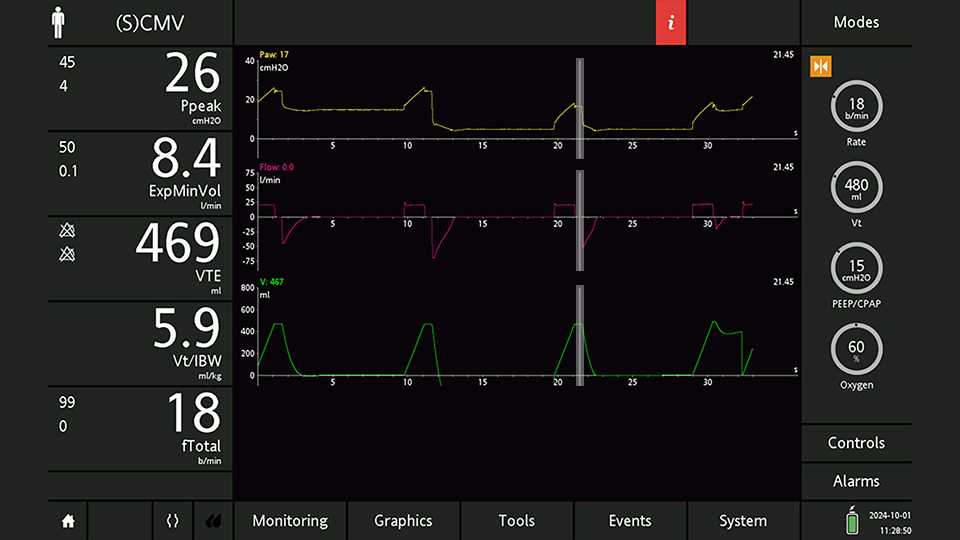
Screenshot with cursor correctly positioned showing values as abovve
Figure 7
Screenshot with cursor correctly positioned showing values as abovve
Figure 7

Step 4 - Inflated and recruited volume

With the values you have made note of, you can now calculate, for the PEEP change you have explored, the volume change just due to alveolar inflation (Vinflated) and the change due to alveolar recruitment (Vrecruited). 

  • Vinflated = C,low x ΔPEEP = 38.6 x 10.1 = 390 ml
  • Vrecruited = VTe,plus – Vinflated = 429 – 390 = 39 ml

These two values give you the recruitment-to-inflation ratio.

  • R/I = Vrecruited/Vinflated = 39/390 = 0.10 ml  

What does it tell us?

R/I values lower than 0.3 – 0.4 indicate low recruitability. As is the case here, a low PEEP setting (of between 5 and 8 cmH2O) may be the more appropriate choice. On the other hand, a PEEP level of at least 12 cmH2O has been suggested when R/I values higher than 0.6 – 0.7 indicate high recruitability. Intermediate PEEP levels are suggested when R/I is found to be around 0.5 (Rosà T, Bongiovanni F, Michi T, et al. Recruitment-to-inflation ratio for bedside PEEP selection in acute respiratory distress syndrome. Minerva Anestesiol. 2024;90(7-8):694-706. doi:10.23736/S0375-9393.24.17982-53​).

Paw - Airway pressure
V - Volume
End-exp Vol - End-expiratory volume
VTe,plus - Additional expiratory tidal volume associated with the abrupt drop in PEEP
Pplat,low - Plateau pressure at the lower PEEP level
VTi,low - Inspiratory volume at the lower PEEP level
C,low - Compliance at the lower PEEP level

Potential for Lung Recruitment Estimated by the Recruitment-to-Inflation Ratio in Acute Respiratory Distress Syndrome. A Clinical Trial.

Chen L, Del Sorbo L, Grieco DL, et al. Potential for Lung Recruitment Estimated by the Recruitment-to-Inflation Ratio in Acute Respiratory Distress Syndrome. A Clinical Trial. Am J Respir Crit Care Med. 2020;201(2):178-187. doi:10.1164/rccm.201902-0334OC

Rationale: Response to positive end-expiratory pressure (PEEP) in acute respiratory distress syndrome depends on recruitability. We propose a bedside approach to estimate recruitability accounting for the presence of complete airway closure.Objectives: To validate a single-breath method for measuring recruited volume and test whether it differentiates patients with different responses to PEEP.Methods: Patients with acute respiratory distress syndrome were ventilated at 15 and 5 cm H2O of PEEP. Multiple pressure-volume curves were compared with a single-breath technique. Abruptly releasing PEEP (from 15 to 5 cm H2O) increases expired volume: the difference between this volume and the volume predicted by compliance at low PEEP (or above airway opening pressure) estimated the recruited volume by PEEP. This recruited volume divided by the effective pressure change gave the compliance of the recruited lung; the ratio of this compliance to the compliance at low PEEP gave the recruitment-to-inflation ratio. Response to PEEP was compared between high and low recruiters based on this ratio.Measurements and Main Results: Forty-five patients were enrolled. Four patients had airway closure higher than high PEEP, and thus recruitment could not be assessed. In others, recruited volume measured by the experimental and the reference methods were strongly correlated (R2 = 0.798; P < 0.0001) with small bias (-21 ml). The recruitment-to-inflation ratio (median, 0.5; range, 0-2.0) correlated with both oxygenation at low PEEP and the oxygenation response; at PEEP 15, high recruiters had better oxygenation (P = 0.004), whereas low recruiters experienced lower systolic arterial pressure (P = 0.008).Conclusions: A single-breath method quantifies recruited volume. The recruitment-to-inflation ratio might help to characterize lung recruitability at the bedside.Clinical trial registered with www.clinicaltrials.gov (NCT02457741).

Implementing a bedside assessment of respiratory mechanics in patients with acute respiratory distress syndrome.

Chen L, Chen GQ, Shore K, et al. Implementing a bedside assessment of respiratory mechanics in patients with acute respiratory distress syndrome. Crit Care. 2017;21(1):84. Published 2017 Apr 4. doi:10.1186/s13054-017-1671-8

BACKGROUND Despite their potential interest for clinical management, measurements of respiratory mechanics in patients with acute respiratory distress syndrome (ARDS) are seldom performed in routine practice. We introduced a systematic assessment of respiratory mechanics in our clinical practice. After the first year of clinical use, we retrospectively assessed whether these measurements had any influence on clinical management and physiological parameters associated with clinical outcomes by comparing their value before and after performing the test. METHODS The respiratory mechanics assessment constituted a set of bedside measurements to determine passive lung and chest wall mechanics, response to positive end-expiratory pressure, and alveolar derecruitment. It was obtained early after ARDS diagnosis. The results were provided to the clinical team to be used at their own discretion. We compared ventilator settings and physiological variables before and after the test. The physiological endpoints were oxygenation index, dead space, and plateau and driving pressures. RESULTS Sixty-one consecutive patients with ARDS were enrolled. Esophageal pressure was measured in 53 patients (86.9%). In 41 patients (67.2%), ventilator settings were changed after the measurements, often by reducing positive end-expiratory pressure or by switching pressure-targeted mode to volume-targeted mode. Following changes, the oxygenation index, airway plateau, and driving pressures were significantly improved, whereas the dead-space fraction remained unchanged. The oxygenation index continued to improve in the next 48 h. CONCLUSIONS Implementing a systematic respiratory mechanics test leads to frequent individual adaptations of ventilator settings and allows improvement in oxygenation indexes and reduction of the risk of overdistention at the same time. TRIAL REGISTRATION The present study involves data from our ongoing registry for respiratory mechanics (ClinicalTrials.gov identifier: NCT02623192 . Registered 30 July 2015).

Recruitment-to-inflation ratio for bedside PEEP selection in acute respiratory distress syndrome.

Rosà T, Bongiovanni F, Michi T, et al. Recruitment-to-inflation ratio for bedside PEEP selection in acute respiratory distress syndrome. Minerva Anestesiol. 2024;90(7-8):694-706. doi:10.23736/S0375-9393.24.17982-5

In acute respiratory distress syndrome, the role of positive end-expiratory pressure (PEEP) to prevent ventilator-induced lung injury is controversial. Randomized trials comparing higher versus lower PEEP strategies failed to demonstrate a clinical benefit. This may depend on the inter-individually variable potential for lung recruitment (i.e. recruitability), which would warrant PEEP individualization to balance alveolar recruitment and the unavoidable baby lung overinflation produced by high pressure. Many techniques have been used to assess recruitability, including lung imaging, multiple pressure-volume curves and lung volume measurement. The Recruitment-to-Inflation ratio (R/I) has been recently proposed to bedside assess recruitability without additional equipment. R/I assessment is a simplified technique based on the multiple pressure-volume curve concept: it is measured by monitoring respiratory mechanics and exhaled tidal volume during a 10-cmH2O one-breath derecruitment maneuver after a short high-PEEP test. R/I scales recruited volume to respiratory system compliance, and normalizes recruitment to a proxy of actual lung size. With modest R/I (<0.3-0.4), setting low PEEP (5-8 cmH2O) may be advisable; with R/I>0.6-0.7, high PEEP (≥15 cmH2O) can be considered, provided that airway and/or transpulmonary plateau pressure do not exceed safety limits. In case of intermediate R/I (≈0.5), a more granular assessment of recruitability may be needed. This could be accomplished with advanced monitoring tools, like sequential lung volume measurement with granular R/I assessment or electrical impedance tomography monitoring during a decremental PEEP trial. In this review, we discuss R/I rationale, applications and limits, providing insights on its clinical use for PEEP selection in moderate-to-severe acute respiratory distress syndrome.

Related articles. Get a deeper look