







Session expired

Due to inactivity your session has expired. Please login again.

Detectamos que você está visitando nosso site a partir de Estados Unidos.
Dispomos de uma versão separada do site para (Estados Unidos).

Mudar para ${país}

Novos recursos e melhorias.

Versão de software 3.1.1 para HAMILTON-C1/T1/MR1

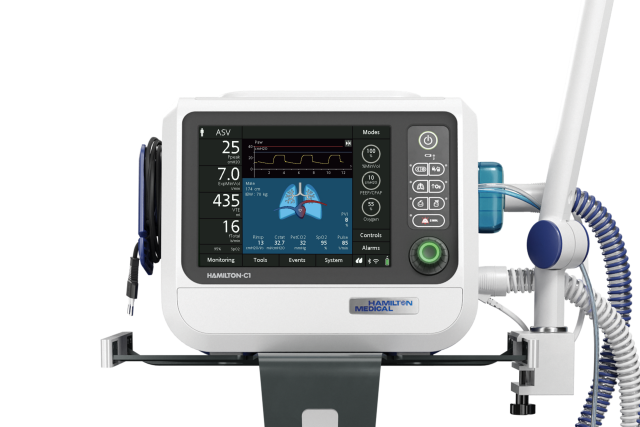
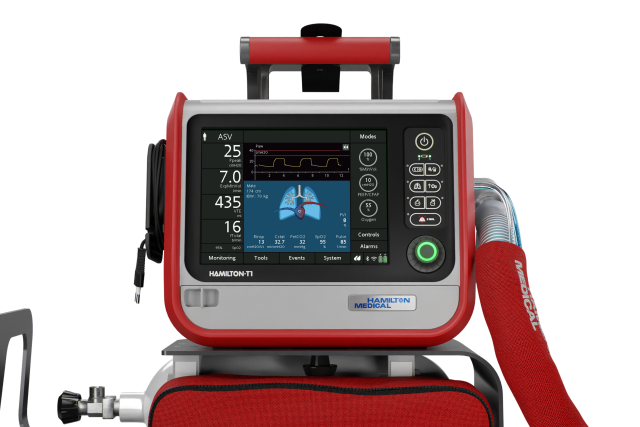
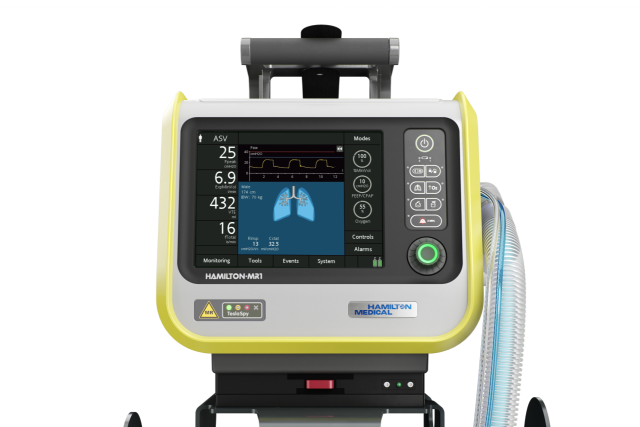
Foto do HAMILTON-C1, HAMILTON-T1 e HAMILTON-MR1 lado a lado Foto do HAMILTON-C1, HAMILTON-T1 e HAMILTON-MR1 lado a lado

Atualize uma vez, beneficie-se três vezes. O poder do software 3.1.1

A atualização de software 3.1.1 apresenta três novos recursos interessantes (Não está disponível em todos os mercadosA ) para os respiradores HAMILTON-C1/T1/MR1.

Para obter informações detalhadas sobre a atualização, consulte a respectiva brochura, as notas de lançamento do software v3.1.1 e o manual do operador para o seu dispositivo.
 

As novas opções de software

NIV_Adult

Opção NIV-only. A solução completa para ventilação não invasiva

Menos também pode ser mais! O HAMILTON-C1/T1 com a opção NIV-only oferece exatamente os modos de que você precisa para um suporte de ventilação não invasiva de alto desempenho.


Permite uma transição perfeita entre os modos não invasivos e o tratamento de oxigênio de alto fluxo (Também conhecido como tratamento por cânula de alto fluxo nasal. Essa terminologia pode ser usada alternadamente com o tratamento de oxigênio de alto fluxo.B ) (opcional) para pacientes pediátricos e adultos, sem alterar o dispositivo ou mesmo o circuito de respiração.

O2 assist

O2 assist. Seu assistente de cuidados de precisão

O O2 assist atua como seu assistente de cuidados de precisão junto ao leito. Ajuda a manter os níveis de SpO2 do seu paciente dentro dos intervalos-alvo definidos individualmente, ajustando continuamente o fornecimento de oxigênio.


Isso garante um gerenciamento contínuo e responsivo do oxigênio para o seu paciente e menos ajustes para você (Roca O, Caritg O, Santafé M, et al. Closed-loop oxygen control improves oxygen therapy in acute hypoxemic respiratory failure patients under high flow nasal oxygen: a randomized cross-over study (the HILOOP study). Crit Care. 2022;26(1):108. Published 2022 Apr 14. doi:10.1186/s13054-022-03970-w1, Atakul G, Ceylan G, Sandal O, et al. Closed-loop oxygen usage during invasive mechanical ventilation of pediatric patients (CLOUDIMPP): a randomized controlled cross-over study. Front Med (Lausanne). 2024;11:1426969. Published 2024 Sep 10. doi:10.3389/fmed.2024.14269692).

Intellisync

IntelliSync®+. Mantenha um olho na sincronia paciente-respirador

O olho treinado de um especialista em ventilação é capaz de detectar assincronias analisando as formas das ondas de fluxo e pressão. O IntelliSync+ oferece um valioso suporte ao fluxo de trabalho, gerenciando o acionamento e a ciclagem automaticamente.


Esse recurso pode ajudar os profissionais de saúde a despender menos tempo ajustando essas configurações e liberá-los para se concentrarem mais em outras tarefas importantes junto ao leito.

Padrão Opcional Não disponível
HAMILTON-C1 HAMILTON-T1 HAMILTON-MR1

O2 assist

Opção NIV-only

IntelliSync+

Availability

See it with your own eyes. Book a free personal demonstration or schedule a callback

Book a free personal demonstration or call with one of our specialists, or simply request more information. Fill out the form below, and we will get back to you with all the details you need.

Closed-loop oxygen control improves oxygen therapy in acute hypoxemic respiratory failure patients under high flow nasal oxygen: a randomized cross-over study (the HILOOP study).

Roca O, Caritg O, Santafé M, et al. Closed-loop oxygen control improves oxygen therapy in acute hypoxemic respiratory failure patients under high flow nasal oxygen: a randomized cross-over study (the HILOOP study). Crit Care. 2022;26(1):108. Published 2022 Apr 14. doi:10.1186/s13054-022-03970-w

BACKGROUND We aimed to assess the efficacy of a closed-loop oxygen control in critically ill patients with moderate to severe acute hypoxemic respiratory failure (AHRF) treated with high flow nasal oxygen (HFNO). METHODS In this single-centre, single-blinded, randomized crossover study, adult patients with moderate to severe AHRF who were treated with HFNO (flow rate ≥ 40 L/min with FiO2 ≥ 0.30) were randomly assigned to start with a 4-h period of closed-loop oxygen control or 4-h period of manual oxygen titration, after which each patient was switched to the alternate therapy. The primary outcome was the percentage of time spent in the individualized optimal SpO2 range. RESULTS Forty-five patients were included. Patients spent more time in the optimal SpO2 range with closed-loop oxygen control compared with manual titrations of oxygen (96.5 [93.5 to 98.9] % vs. 89 [77.4 to 95.9] %; p < 0.0001) (difference estimate, 10.4 (95% confidence interval 5.2 to 17.2). Patients spent less time in the suboptimal range during closed-loop oxygen control, both above and below the cut-offs of the optimal SpO2 range, and less time above the suboptimal range. Fewer number of manual adjustments per hour were needed with closed-loop oxygen control. The number of events of SpO2 < 88% and < 85% were not significantly different between groups. CONCLUSIONS Closed-loop oxygen control improves oxygen administration in patients with moderate-to-severe AHRF treated with HFNO, increasing the percentage of time in the optimal oxygenation range and decreasing the workload of healthcare personnel. These results are especially relevant in a context of limited oxygen supply and high medical demand, such as the COVID-19 pandemic. Trial registration The HILOOP study was registered at www. CLINICALTRIALS gov under the identifier NCT04965844 .

Closed-loop oxygen usage during invasive mechanical ventilation of pediatric patients (CLOUDIMPP): a randomized controlled cross-over study.

Atakul G, Ceylan G, Sandal O, et al. Closed-loop oxygen usage during invasive mechanical ventilation of pediatric patients (CLOUDIMPP): a randomized controlled cross-over study. Front Med (Lausanne). 2024;11:1426969. Published 2024 Sep 10. doi:10.3389/fmed.2024.1426969

BACKGROUND The aim of this study is the evaluation of a closed-loop oxygen control system in pediatric patients undergoing invasive mechanical ventilation (IMV). METHODS Cross-over, multicenter, randomized, single-blind clinical trial. Patients between the ages of 1 month and 18 years who were undergoing IMV therapy for acute hypoxemic respiratory failure (AHRF) were assigned at random to either begin with a 2-hour period of closed-loop oxygen control or manual oxygen titrations. By using closed-loop oxygen control, the patients' SpO2 levels were maintained within a predetermined target range by the automated adjustment of the FiO2. During the manual oxygen titration phase of the trial, healthcare professionals at the bedside made manual changes to the FiO2, while maintaining the same target range for SpO2. Following either period, the patient transitioned to the alternative therapy. The outcomes were the percentage of time spent in predefined SpO2 ranges ±2% (primary), FiO2, total oxygen use, and the number of manual adjustments. FINDINGS The median age of included 33 patients was 17 (13-55.5) months. In contrast to manual oxygen titrations, patients spent a greater proportion of time within a predefined optimal SpO2 range when the closed-loop oxygen controller was enabled (95.7% [IQR 92.1-100%] vs. 65.6% [IQR 41.6-82.5%]), mean difference 33.4% [95%-CI 24.5-42%]; P < 0.001). Median FiO2 was lower (32.1% [IQR 23.9-54.1%] vs. 40.6% [IQR 31.1-62.8%]; P < 0.001) similar to total oxygen use (19.8 L/h [IQR 4.6-64.8] vs. 39.4 L/h [IQR 16.8-79]; P < 0.001); however, median SpO2/FiO2 was higher (329.4 [IQR 180-411.1] vs. 246.7 [IQR 151.1-320.5]; P < 0.001) with closed-loop oxygen control. With closed-loop oxygen control, the median number of manual adjustments reduced (0.0 [IQR 0.0-0.0] vs. 1 [IQR 0.0-2.2]; P < 0.001). CONCLUSION Closed-loop oxygen control enhances oxygen therapy in pediatric patients undergoing IMV for AHRF, potentially leading to more efficient utilization of oxygen. This technology also decreases the necessity for manual adjustments, which could reduce the workloads of healthcare providers. CLINICAL TRIAL REGISTRATION This research has been submitted to ClinicalTrials.gov (NCT05714527).