


Session expired

Due to inactivity your session has expired. Please login again.

Detectamos que você está visitando nosso site a partir de Estados Unidos.
Dispomos de uma versão separada do site para (Estados Unidos).

Mudar para ${país}
 Soluções digitais

Sistemas de alarme distribuído.

Para uma UTI silenciosa

Enfermeira tapa os ouvidos devido ao alarme

O desafio é real. Cansaço por alarmes na UTI

O número médio de alarmes por paciente na UTI pode ultrapassar 700 por dia. Estima-se que 80% a 95% desses alarmes não sejam clinicamente significativos (Cvach M. Monitor alarm fatigue: an integrative review. Biomed Instrum Technol. 2012;46(4):268-277. doi:10.2345/0899-8205-46.4.2681​, McBride DL, LeVasseur SA. Personal Communication Device Use by Nurses Providing In-Patient Care: Survey of Prevalence, Patterns, and Distraction Potential. JMIR Hum Factors. 2017;4(2):e10. Published 2017 Apr 13. doi:10.2196/humanfactors.51102​).

A exposição a tantos alarmes que não requerem ação pode levar ao cansaço por alarmes nos prestadores de cuidados (https://www.ecri.org/Resources/In_the_News/Sound_the_Alarm(PSQH).pdfA). Isso pode aumentar o risco de danos aos pacientes e a insatisfação tanto entre os pacientes quanto entre a equipe médica (https://www.ecri.org/Resources/In_the_News/Sound_the_Alarm(PSQH).pdfA​, https://www.ncbi.nlm.nih.gov/books/NBK555522/B).

Ilustração: Paciente sendo ventilado. O alarme é exibido no posto de enfermagem.

Desligar áudio! Silêncio!

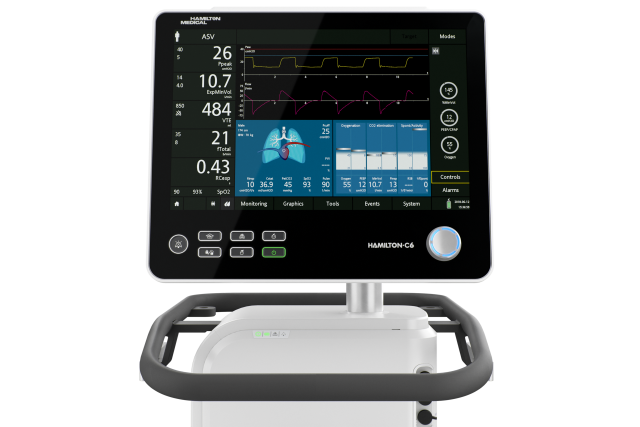
Quando é configurado como parte de um sistema de alarme distribuído (DAS) (Somente disponível para HAMILTON-C6/G5/S1C​), o alarme sonoro do respirador pode ser pausado por um período de tempo ilimitado. Esta função é conhecida como DESL. ÁUDIO geral.

Quando DESL. ÁUDIO geral está ativo, os alarmes do respirador são transmitidos a outros dispositivos no DAS, enquanto os indicadores de alarme visuais no respirador permanecem ativos.

HAMILTON-C6_ASCOM-Silent-ICU_youtube

Tranquilidade. Gerenciamento de alarmes com Ascom

A combinação do Ascom Digistat 7.2 com os respiradores HAMILTON‑C6 e HAMILTON‑G5/S1 proporciona um sistema compatível com DAS. O sistema de gerenciamento de alarmes da Ascom recebe a delegação total de todos os alarmes dos respiradores HAMILTON‑G5/S1 e HAMILTON‑C6, garantindo um gerenciamento de alarmes totalmente confiável.

As notificações de alarme podem ser enviadas para os celulares dos prestadores de cuidados ou exibidas em desktops ou painéis.

Disponibilidade

A integração do sistema de alarme distribuído está disponível como opção nos respiradores HAMILTON-C6 e HAMILTON-G5/S1.

Monitor alarm fatigue: an integrative review.

Cvach M. Monitor alarm fatigue: an integrative review. Biomed Instrum Technol. 2012;46(4):268-277. doi:10.2345/0899-8205-46.4.268

Alarm fatigue is a national problem and the number one medical device technology hazard in 2012. The problem of alarm desensitization is multifaceted and related to a high false alarm rate, poor positive predictive value, lack of alarm standardization, and the number of alarming medical devices in hospitals today. This integrative review synthesizes research and non-research findings published between 1/1/2000 and 10/1/2011 using The Johns Hopkins Nursing Evidence-Based Practice model. Seventy-two articles were included. Research evidence was organized into five main themes: excessive alarms and effects on staff; nurse's response to alarms; alarm sounds and audibility; technology to reduce false alarms; and alarm notification systems. Non-research evidence was divided into two main themes: strategies to reduce alarm desensitization, and alarm priority and notification systems. Evidence-based practice recommendations and gaps in research are summarized.

Personal Communication Device Use by Nurses Providing In-Patient Care: Survey of Prevalence, Patterns, and Distraction Potential.

McBride DL, LeVasseur SA. Personal Communication Device Use by Nurses Providing In-Patient Care: Survey of Prevalence, Patterns, and Distraction Potential. JMIR Hum Factors. 2017;4(2):e10. Published 2017 Apr 13. doi:10.2196/humanfactors.5110

BACKGROUND Coincident with the proliferation of employer-provided mobile communication devices, personal communication devices, including basic and enhanced mobile phones (smartphones) and tablet computers that are owned by the user, have become ubiquitous among registered nurses working in hospitals. While there are numerous benefits of personal communication device use by nurses at work, little is known about the impact of these devices on in-patient care. OBJECTIVE Our aim was to examine how hospital-registered nurses use their personal communication devices while doing both work-related and non‒work-related activities and to assess the impact of these devices on in-patient care. METHODS A previously validated survey was emailed to 14,797 members of two national nursing organizations. Participants were asked about personal communication device use and their opinions about the impact of these devices on their own and their colleagues' work. RESULTS Of the 1268 respondents (8.57% response rate), only 5.65% (70/1237) never used their personal communication device at work (excluding lunch and breaks). Respondents self-reported using their personal communication devices at work for work-related activities including checking or sending text messages or emails to health care team members (29.02%, 363/1251), as a calculator (25.34%, 316/1247), and to access work-related medical information (20.13%, 251/1247). Fewer nurses reported using their devices for non‒work-related activities including checking or sending text messages or emails to friends and family (18.75%, 235/1253), shopping (5.14%, 64/1244), or playing games (2.73%, 34/1249). A minority of respondents believe that their personal device use at work had a positive effect on their work including reducing stress (29.88%, 369/1235), benefiting patient care (28.74%, 357/1242), improving coordination of patient care among the health care team (25.34%, 315/1243), or increasing unit teamwork (17.70%, 220/1243). A majority (69.06%, 848/1228) of respondents believe that on average personal communication devices have a more negative than positive impact on patient care and 39.07% (481/1231) reported that personal communication devices were always or often a distraction while working. Respondents acknowledged their own device use negatively affected their work performance (7.56%, 94/1243), or caused them to miss important clinical information (3.83%, 47/1225) or make a medical error (0.90%, 11/1218). Respondents reported witnessing another nurse's use of devices negatively affect their work performance (69.41%, 860/1239), or cause them to miss important clinical information (30.61%, 378/1235) or make a medical error (12.51%, 155/1239). Younger respondents reported greater device use while at work than older respondents and generally had more positive opinions about the impact of personal communication devices on their work. CONCLUSIONS The majority of registered nurses believe that the use of personal communication devices on hospital units raises significant safety issues. The high rate of respondents who saw colleagues distracted by their devices compared to the rate who acknowledged their own distraction may be an indication that nurses are unaware of their own attention deficits while using their devices. There were clear generational differences in personal communication device use at work and opinions about the impact of these devices on patient care. Professional codes of conduct for personal communication device use by hospital nurses need to be developed that maximize the benefits of personal communication device use, while reducing the potential for distraction and adverse outcomes.