


Session expired

Due to inactivity your session has expired. Please login again.


 Technologies

ASV - Adaptive Support Ventilation®.

Support for you and your patients alike

"" ""

More than just a mode. This is ASV

ASV is an intelligent mode for invasive ventilation in both pediatric and adult patients. Ventilation parameters are continuously adjusted in real time to deliver precisely the level of support each patient needs — no more and no less.

Designed for speed and safety, ASV combines evidence-based ventilation with real-time adaptability. In high-stress environments where every second counts, ASV delivers clinical precision and gives you peace of mind.

The benefits of ASV in prehospital care

Versatile across patient types

Supports adult and pediatric patients from spontaneous breathing to needing full ventilatory support.

Enhances patient safety

ASV includes safety mechanisms to prevent issues like hyperventilation, hypoventilation, and apnea (Arnal JM, Wysocki M, Novotni D, et al. Safety and efficacy of a fully closed-loop control ventilation (IntelliVent-ASV®) in sedated ICU patients with acute respiratory failure: a prospective randomized crossover study. Intensive Care Med. 2012;38(5):781-787. doi:10.1007/s00134-012-2548-61​, Kirakli C, Naz I, Ediboglu O, Tatar D, Budak A, Tellioglu E. A randomized controlled trial comparing the ventilation duration between adaptive support ventilation and pressure assist/control ventilation in medical patients in the ICU. Chest. 2015;147(6):1503-1509. doi:10.1378/chest.14-25992​, Brunner JX, Iotti GA. Adaptive Support Ventilation (ASV). Minerva Anestesiol. 2002;68(5):365-368. 3​). 

This also helps prevent complications such as tachypnea, AutoPEEP, and excessive dead-space ventilation (Sulemanji D, Marchese A, Garbarini P, Wysocki M, Kacmarek RM. Adaptive support ventilation: an appropriate mechanical ventilation strategy for acute respiratory distress syndrome?. Anesthesiology. 2009;111(4):863-870. doi:10.1097/ALN.0b013e3181b55f8f4​).

Lessens the cognitive load

Reduces the amount of changes to ventilator settings, enabling you to focus on other important aspects of patient care (Kirakli C, Naz I, Ediboglu O, Tatar D, Budak A, Tellioglu E. A randomized controlled trial comparing the ventilation duration between adaptive support ventilation and pressure assist/control ventilation in medical patients in the ICU. Chest. 2015;147(6):1503-1509. doi:10.1378/chest.14-25992​, Moradian ST, Saeid Y, Ebadi A, Hemmat A, Ghiasi MS. Adaptive Support Ventilation Reduces the Incidence of Atelectasis in Patients Undergoing Coronary Artery Bypass Grafting: A Randomized Clinical Trial. Anesth Pain Med. 2017;7(3):e44619. Published 2017 Apr 22. doi:10.5812/aapm.446195​).

Continuous adaptation to your patient

When a patient’s condition changes, ASV automatically adapts the support level.
 

It increases assistance when the patient is struggling, and reduces it when the patient begins to breathe more effectively on their own.

""

Easy, peasy. The ASV workflow in 4 steps

  1. Simple setup: Set the patient's sex, height, and the desired minute ventilation.
  2. Continuous monitoring: ASV tracks the tidal volume, respiratory rate, airway pressures, and more.
  3. Automatic adjustment: ASV modulates the inspiratory pressure and rate to maintain target ventilation.
  4. Adaptive response: ASV reduces support as spontaneous effort increases — or ramps it up if needed.
     
Kyle Drisse

Отзывы клиентов

ASV is really advantageous in trauma patients where you have so many fires to put out. It’s nice to just put up the ventilator and allow ASV to manage the patient from the lung standpoint. It’s fairly easy to set up.

Kyle Drisse

Critical Care Flight Paramedic
Life Link III, Minnesota, USA

Availability

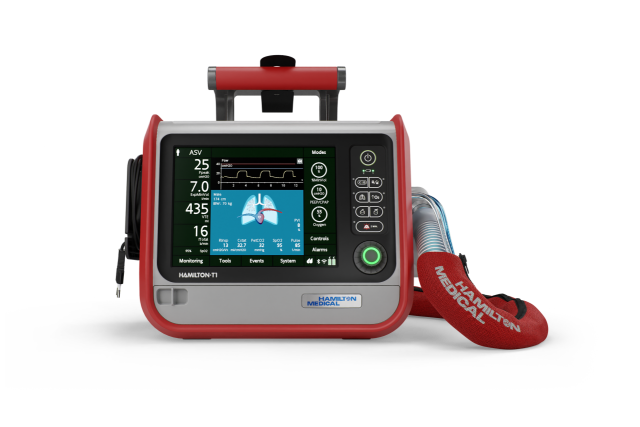
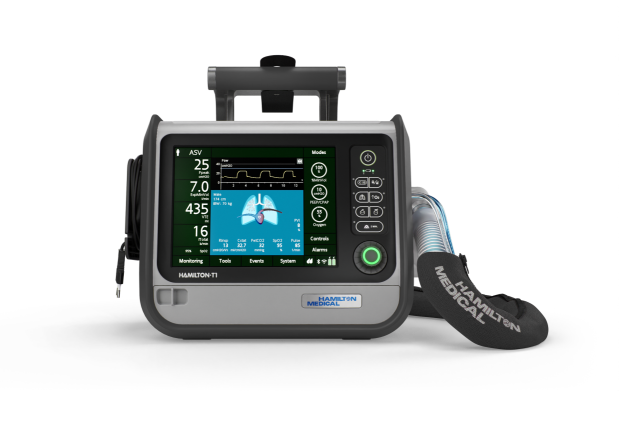
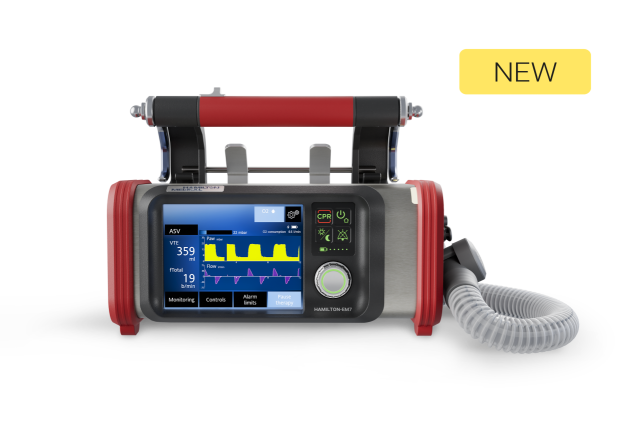
ASV is available as a standard mode on all HAMILTON-T1 and HAMILTON-EM7 devices.

Safety and efficacy of a fully closed-loop control ventilation (IntelliVent-ASV®) in sedated ICU patients with acute respiratory failure: a prospective randomized crossover study.

Arnal JM, Wysocki M, Novotni D, et al. Safety and efficacy of a fully closed-loop control ventilation (IntelliVent-ASV®) in sedated ICU patients with acute respiratory failure: a prospective randomized crossover study. Intensive Care Med. 2012;38(5):781-787. doi:10.1007/s00134-012-2548-6

PURPOSE IntelliVent-ASV(®) is a development of adaptive support ventilation (ASV) that automatically adjusts ventilation and oxygenation parameters. This study assessed the safety and efficacy of IntelliVent-ASV(®) in sedated intensive care unit (ICU) patients with acute respiratory failure. METHODS This prospective randomized crossover comparative study was conducted in a 12-bed ICU in a general hospital. Two periods of 2 h of ventilation in randomly applied ASV or IntelliVent-ASV(®) were compared in 50 sedated, passively ventilated patients. Tidal volume (V(T)), respiratory rate (RR), inspiratory pressure (P(INSP)), SpO(2) and E(T)CO(2) were continuously monitored and recorded breath by breath. Mean values over the 2-h period were calculated. Respiratory mechanics, plateau pressure (P(PLAT)) and blood gas exchanges were measured at the end of each period. RESULTS There was no safety issue requiring premature interruption of IntelliVent-ASV(®). Minute ventilation (MV) and V(T) decreased from 7.6 (6.5-9.5) to 6.8 (6.0-8.0) L/min (p < 0.001) and from 8.3 (7.8-9.0) to 8.1 (7.7-8.6) mL/kg PBW (p = 0.003) during IntelliVent-ASV(®) as compared to ASV. P(PLAT) and FiO(2) decreased from 24 (20-29) to 20 (19-25) cmH(2)O (p = 0.005) and from 40 (30-50) to 30 (30-39) % (p < 0.001) during IntelliVent-ASV(®) as compared to ASV. RR, P(INSP), and PEEP decreased as well during IntelliVent-ASV(®) as compared to ASV. Respiratory mechanics, pH, PaO(2) and PaO(2)/FiO(2) ratio were not different but PaCO(2) was slightly higher during IntelliVent-ASV(®) as compared to ASV. CONCLUSIONS In passive patients with acute respiratory failure, IntelliVent-ASV(®) was safe and able to ventilate patients with less pressure, volume and FiO(2) while producing the same results in terms of oxygenation.

A randomized controlled trial comparing the ventilation duration between adaptive support ventilation and pressure assist/control ventilation in medical patients in the ICU.

Kirakli C, Naz I, Ediboglu O, Tatar D, Budak A, Tellioglu E. A randomized controlled trial comparing the ventilation duration between adaptive support ventilation and pressure assist/control ventilation in medical patients in the ICU. Chest. 2015;147(6):1503-1509. doi:10.1378/chest.14-2599

BACKGROUND Adaptive support ventilation (ASV) is a closed loop mode of mechanical ventilation (MV) that provides a target minute ventilation by automatically adapting inspiratory pressure and respiratory rate with the minimum work of breathing on the part of the patient. The aim of this study was to determine the effect of ASV on total MV duration when compared with pressure assist/control ventilation. METHODS Adult medical patients intubated and mechanically ventilated for > 24 h in a medical ICU were randomized to either ASV or pressure assist/control ventilation. Sedation and medical treatment were standardized for each group. Primary outcome was the total MV duration. Secondary outcomes were the weaning duration, number of manual settings of the ventilator, and weaning success rates. RESULTS Two hundred twenty-nine patients were included. Median MV duration until weaning, weaning duration, and total MV duration were significantly shorter in the ASV group (67 [43-94] h vs 92 [61-165] h, P = .003; 2 [2-2] h vs 2 [2-80] h, P = .001; and 4 [2-6] days vs 4 [3-9] days, P = .016, respectively). Patients in the ASV group required fewer total number of manual settings on the ventilator to reach the desired pH and Paco2 levels (2 [1-2] vs 3 [2-5], P < .001). The number of patients extubated successfully on the first attempt was significantly higher in the ASV group (P = .001). Weaning success and mortality at day 28 were comparable between the two groups. CONCLUSIONS In medical patients in the ICU, ASV may shorten the duration of weaning and total MV duration with a fewer number of manual ventilator settings. TRIAL REGISTRY ClinicalTrials.gov; No.: NCT01472302; URL: www.clinicaltrials.gov.

Adaptive Support Ventilation Reduces the Incidence of Atelectasis in Patients Undergoing Coronary Artery Bypass Grafting: A Randomized Clinical Trial.

Moradian ST, Saeid Y, Ebadi A, Hemmat A, Ghiasi MS. Adaptive Support Ventilation Reduces the Incidence of Atelectasis in Patients Undergoing Coronary Artery Bypass Grafting: A Randomized Clinical Trial. Anesth Pain Med. 2017;7(3):e44619. Published 2017 Apr 22. doi:10.5812/aapm.44619

BACKGROUND Pulmonary complications are common following cardiac surgery and can lead to increased morbidity, mortality, and healthcare costs. Atelectasis is the most common respiratory complication following cardiac surgery. One of the most important methods for reducing pulmonary complications is supportive care with protective ventilation strategies. In this study, we aimed to assess the effect of adaptive support ventilation (ASV) on atelectasis in patients undergoing cardiac surgery. METHODS In this single-blind randomized clinical trial, 115 patients, undergoing coronary artery bypass grafting, were randomly allocated into 2 groups: 57 patients in the intervention and 58 patients in the control group. Patients in the intervention group were weaned with ASV, while patients in the control group were managed using synchronized intermittent mandatory ventilation (SIMV) and pressure support. The incidence of atelectasis, duration of mechanical ventilation, manual ventilator setting, arterial blood gas measurements, and length of hospital stay were compared between the groups. RESULTS The incidence of atelectasis, number of changes in the manual ventilator setting, number of alarms, and length of hospital stay reduced in the intervention group. However, duration of mechanical ventilation and number of ABG measurements were not significantly different between the groups. CONCLUSIONS The ASV mode could reduce the incidence of atelectasis and length of hospital stay. However, it did not reduce the duration of mechanical ventilation. It seems that ASV is not a superior mode for faster extubation.