Session expired

Due to inactivity your session has expired. Please login again.


切换至 美国

Critical care transport.

Ventilation that moves with the patient

"" ""

Intelligent transport ventilation. Supporting you and your patients during critical care transport

When transporting a ventilated ICU patient, you want to maintain a level of care that closely matches bedside conditions — including the quality of ventilation.
""

Maintaining ICU-level therapy in a mobile setting

Your patients might be leaving the ICU, but their ventilation needs remain just as complex. During transport, you want to maintain high-level respiratory therapy and still have full access to modes, monitoring, and precision settings — all while navigating unfamiliar or moving environments.

  • Use the same advanced modes, lung-protective strategies, and monitoring capabilities you rely on in the ICU
  • Adapt to rapidly changing patient conditions en route
""

Adapting to rapidly changing patient conditions en route

A patient can deteriorate quickly during transport. You need a ventilator that responds just as fast, giving you clear feedback, quick access to alarms, and the ability to adapt ventilation settings in seconds.

  • Intelligent, adaptive ventilation modes that keep the patient within defined target ranges
  • Continuous oxygen management
  • CPR ventilation feature
Ralf Huth 博士

客户评语

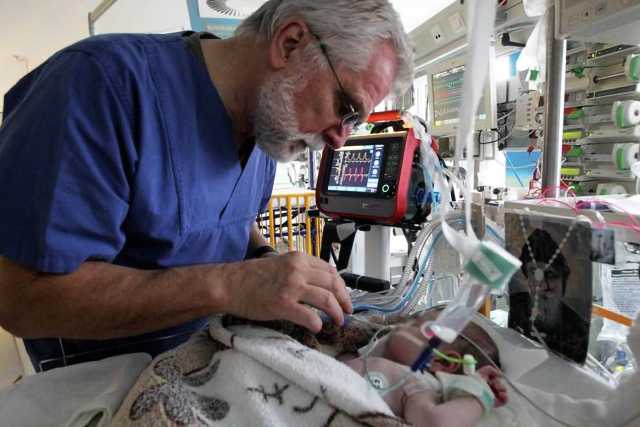
我们使用 HAMILTON-T1 为院内转运和院外转运病人通气。保证病人转运过程中的通气质量与床头通气质量等同。

Ralf Huth 博士

跨学科儿科 ICU 高级医生
Center for Pediatrics and Adolescent Medicine,德国美因茨

""

Bridging the monitoring gap

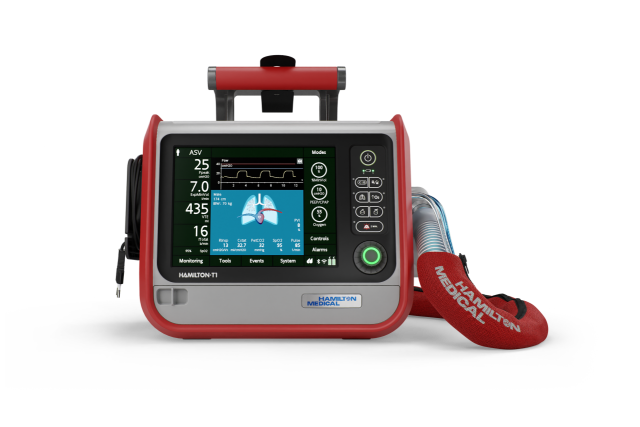
In the ICU, you can rely on labs, ABGs, and imaging to guide the ventilation strategy. In transport, you often have to manage without these tools. That is why you depend on real-time waveforms, trends, and intuitive data displays to support clinical decisions on the go.

  • Visualization of lung mechanics (Dynamic Lung)

  • Volumetric capnography and SpO2 monitoring

  • Trends and loops

  • Wide array of monitoring parameters

""

No worries about tight space, vibration, or power limitations

Ambulances, helicopters, and medical aircraft combine limited room with a lot of movement. Your ventilator has to be compact, stable, and able to run without mains power, while staying firmly in place in any conditions.

  • Portable: Easily transportable by healthcare providers across different platforms

  • Extended run time: One integrated and one hot-swappable battery (optionalA​), as well as AC and DC power connectors

  • Self-sufficient: Independence from compressed air due to the high-performance turbine

Our 360° services

""

Ready when you are. Your partner for prehospital transport care

The Hamilton Medical Prehospital Team is committed to delivering comprehensive services and support around mechanical ventilation during transport in prehospital settings.

Our solution for critical care transport

脚注

参考文献